
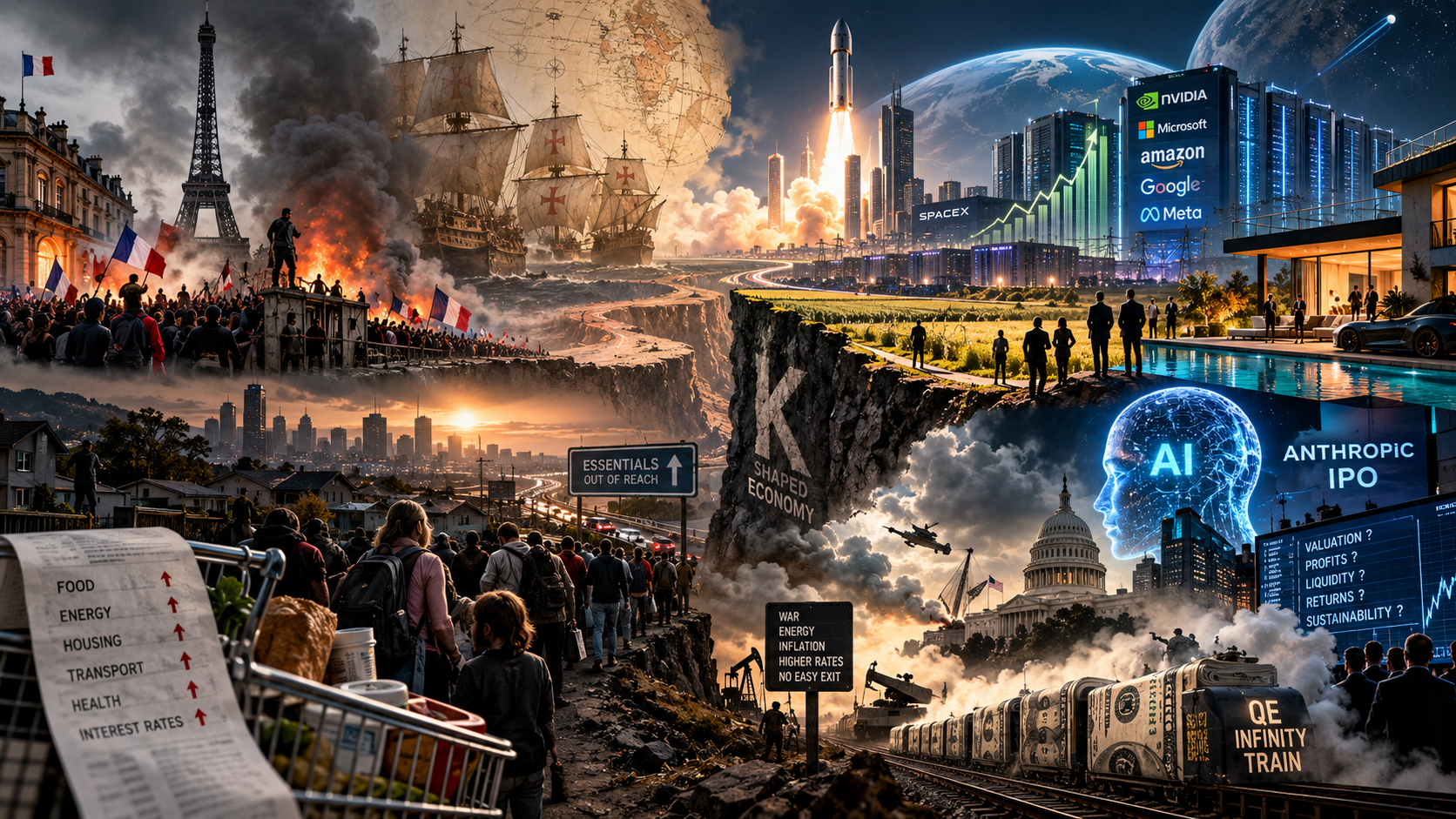
“There’s no K in France?” Copyright 2026. nextlevelcorporate. nextlevelcorporate prompts, AI generated image.
TL; DR
We have a war with no obvious endgame or offramp, elevated energy costs, interest rates that remain restrictive for many borrowers, and a political environment in which populism is gaining ground across the West. Meanwhile, the world's largest technology companies are committing extraordinary sums to artificial intelligence, financial markets are questioning how those investments will be repaid, and households are increasingly divided between those benefiting from asset ownership and those struggling to afford the essentials.
Individually, each of these developments is manageable. Together, they present a more interesting question. Are we approaching a point where our economic, political and financial systems begin to work against one another?
And are we, in our own ways, becoming France?
The French warning
France offers a useful case study in what happens when economic pressures collide with public expectations.
Years of fiscal pressure, high public debt, weak productivity growth and difficult debates over labour, immigration, public services, and student conditions like overflowing classrooms have made it increasingly challenging to reconcile what people expect from the state with what the economy can sustainably provide. Political unrest is not simply about one budget or one government. It reflects a deeper argument over who pays, who benefits and what people believe they are entitled to expect from the system.
There’s a lesson here for the rest of us.
When people work hard but find that housing, energy, food and other essentials consume an increasingly larger share of their income, the social contract begins to weaken. When they conclude that the system works exceptionally well for some but not for them, irritation and frustration follows.
Populism can then flourish on either side of politics. The labels are probably less important than the outcome when political movements begin to concentrate power, weaken institutional checks without replacement solutions, and present complex problems as battles against “convenient” enemies.
The historical parallels don’t sit in a comfy armchair. The economic and political order established after 1492 was shaped by mercantilism, colonial expansion and the concentration of wealth and power. Today, we see a new contest for strategic resources, technological supremacy and control of supply chains, and not just for axles and chassis. The corporate ambitions of the great technology platforms now extend from the seabed to space, with SpaceX providing perhaps the most visible example, and potentially the new spacefaring Dutch East India Company. But is Musk, Kurtz?
The institutions and technologies are different. The recurring question is not.
And the question now is who controls the productive assets, and who captures the resulting wealth?
The K-shaped economy
We can see versions of this tension in both the U.S. and here down under in Straya.
In a K-shaped economy, one group moves upwards while another moves downwards or falls behind. Asset owners can benefit from rising markets, investment income and the wealth effect that encourages spending. Households dependent on wages, particularly where wage growth fails to keep pace with living costs, experience something very different. But at the same time, require the wealth effect to create demand.
In Australia, people with substantial assets or cash earning attractive interest income may be doing reasonably well. That spending supports restaurants, cafés, tourism and other businesses. But households carrying large mortgages, facing higher food and energy costs, or struggling to get ahead on their wages have less room to manoeuvre.
Policy choices can make this divide better or worse. Tax changes that discourage investment or reduce incentives to accumulate productive assets can be the kiss of death, particularly when the economy is already struggling with productivity growth as it currently is. Governments must raise revenue, of course, but how they do it can make a huge difference.
The danger is that people increasingly believe the system offers them no credible route to a better life. When that happens, support for more radical political solutions can grow. In Australia, a failure by the major political parties to address economic insecurity could create space for movements that offer simple answers at the expense of social cohesion and Australia's tradition of relatively broad-based opportunity.
That is one route towards a French-style political predicament, even if our circumstances are not identical.
From voting to weighing
Meanwhile, financial markets have been parsing the AI story and now appear to be moving from Benjamin Graham’s voting machine, to his weighing machine.
For some time, investors have been prepared to pay massive premiums for companies expected to benefit from artificial intelligence. The underlying technology is compelling. But the financing structures, spending commitments and valuations supporting the investment boom deserve closer examination.
I’d like you to consider three things.
First, the circular financing within the AI ecosystem. Nvidia and other suppliers benefit from massive infrastructure spending, while investments, financing arrangements and commercial relationships connect companies across the same ecosystem. These arrangements are not inherently improper, but they can make it harder to distinguish independent end-customer demand from capital circulating among a relatively concentrated group of participants.
Second, the scale of the spending. According to Goldman Sachs Research, consensus estimates put U.S. hyperscaler capital expenditure at around US$800 billion in 2026. Goldman Sachs expects that figure to rise to approximately US$1.2 trillion in 2027. These are forecasts, not final expenditure figures, and the estimates cover broader infrastructure spending rather than AI alone. Nevertheless, they illustrate the extraordinary scale of the bet being placed on AI.
The question is what happens if the revenue and productivity gains arrive more slowly than the capital being committed. Goldman Sachs has estimated that the largest U.S. hyperscalers will need to generate roughly US$300 billion in annual AI revenue in the coming years just to break even on their investment outlays. The technology may be transformative, but the financial returns still have to add up. There needs to be a clear and present commercial engine that starts purring.
Third, the cost of capital. As we have been arguing at NextLevelCorporate since 2022, investors should be careful about speculative equities without durable competitive advantages, particularly when valuations depend on distant cash flows. Long-duration bonds are exposed to a related problem: higher interest rates reduce the present value of future payments.
The question is no longer simply whether AI will change the world. It almost certainly will. The question is whether the returns will justify the capital being committed, and when those returns will arrive.
June may have marked an important turning point for the semiconductor trade. According to Reuters on 19 October, the Philadelphia Semiconductor Index had fallen approximately 24% from its June 2026 highs, amid concerns about borrowing costs and the sustainability of AI infrastructure spending. The index had also endured an unusually long losing streak before rebounding on 19 October.
That is a substantial correction, but it does not establish that the semiconductor trade has permanently peaked. Nor does it prove that SpaceX's valuation or market debut caused the turning point. The more important question is whether future earnings and cash flows can justify the capital being committed across the AI ecosystem.
The market is no longer simply rewarding the promise of AI. It is beginning to scrutinise the price being paid for that promise, the financing behind it and the time required to turn investment into cash flow.
And now Anthropic enters the picture.
On 1 June, Anthropic announced that it had confidentially submitted a draft registration statement to the US Securities and Exchange Commission for a proposed initial public offering. The company made clear that any listing would depend on market conditions and other factors.
According to Reuters, Anthropic held a pre-IPO investor meeting in October, reporting third-quarter revenue of US$16.8 billion, up from US$11.6 billion in the second quarter. Reuters also reported that the listing was expected after the November US midterm elections.
This is signal in the making. An Anthropic IPO could become one of the most significant public-market tests of the AI investment boom. Investors will have to assess not just extraordinary revenue growth, but also the costs of developing and operating increasingly powerful models, the commitments to computing infrastructure and the prospects for sustainable returns.
A major listing could attract fresh capital into the sector. It could also compete for investor funds that might otherwise flow into existing technology stocks. The net effect on market liquidity is uncertain, but the valuation achieved and the reception from public investors could influence how the wider AI ecosystem is priced.
Anthropic does not need to disappoint for the AI trade to correct. Expectations simply need to become less generous.
The TIFFIT QE Infinity train to nowhere
A correction would not necessarily mean we are heading for another 1929 or another dot-com collapse.
We are dealing with a genuine technological transformation. AI and physical robotics could fundamentally change how businesses operate, how industrial assets are managed and how much labour and capital are required to produce goods and services. The opportunity is real, even if parts of the investment boom prove excessive.
But a sharp market correction could have consequences beyond tech valuations.
Lower equity prices would weaken the wealth effect, potentially reducing household spending and business confidence. If economic activity slowed sufficiently, pressure would grow for monetary easing and renewed liquidity support. My TIFFIT QE Infinity train to nowhere could take on more fuel and accelerate, yet again, regardless of what acronym No Dot Warsh and No Brake Bessent come up with to hide the monetary debasement (money supply expansion) that the eventual pivot will produce.
There is also a fiscal dimension. No Brake Bessent and the U.S. Treasury face the continuing challenge of refinancing enormous quantities of government debt. Lower yields would make that task easier, although the Treasury can’t simply choose its preferred borrowing costs. Investors and inflation expectations all influence the outcome.
The alternative is an ongoing cycle of refinancing and issuing new short-term debt, leaving the government exposed to frequent repricing as that debt matures. Longer-term borrowing can reduce some of that rollover risk, but locking in higher yields is expensive.
This is the uncomfortable intersection of markets, monetary policy and public finances. The same correction that damages private wealth could increase pressure for policies designed to support asset prices and lower borrowing costs.
We might get another liquidity rescue. But liquidity alone cannot repair weak productivity, make poor investments profitable or ensure that the benefits of technological change reach the wider population. And so, we still cannot retire the TIFFIT QE Infinity train to nowhere.
The real question
So where does this leave us?
I don't think anyone needs to predict another 1929, or another dot-com bust, simply to recognise that the rather obvious risks are building. The AI revolution can be real, transformative and ultimately enormously productive. That doesn't mean every company riding the wave is worth its current valuation (they are NOT), that every dollar of capital expenditure will earn an adequate return, or that financial markets will wait patiently for the benefits to arrive. They will not.
But in the meantime, the social contract is under pressure and that’s why Paris is burning.
If the benefits of automation accrue mainly to those who own the machines, the capital and the intellectual property, while everyone else faces higher living costs and less secure work, we may discover that technological progress and social progress are two very different things and Paris continues to burn while Macron fiddles the numbers.
Still, a correction could bring lower asset prices, tighter financial conditions and another rush towards monetary support. The TIFFIT QE Infinity train might accelerate, to nowhere, again. But cheaper money can’t manufacture a fair distribution of wealth, and it simply can’t make an unprofitable investment profitable by keeping the financing alive.
That is the uncomfortable possibility. We could be approaching an era of Musk’s extraordinary technological abundance at the same time as our economic and political systems struggle to distribute its benefits.
France is a warning. Anthropic is a catalyst. And AI may still change almost everything.
The real question is whether our institutions, our capital markets and our politics can adapt quickly enough to the world we are building without completely shredding the social contract between a government and its people.
Because if the machines can produce more, but fewer people can afford to live well, we will have solved one problem while creating a bigger one.
And that brings us to a question much bigger than Anthropic, the next market correction or the politics of France.
What should we do with the extraordinary wealth that technology, automation and our natural resources can generate?
How should we turn temporary economic windfalls into lasting productive capacity, stronger institutions and a better standard of living for generations to come?
These are not simply questions about markets or government spending. They are questions about how we redesign the institutions that govern prosperity itself.
Because creating wealth is only half the challenge. The other half is building a system capable of turning that wealth into something enduring. Not burning down cities.
Abracadabra. See you in carriage 5 🖐
Mike.

Macro first. Strategy second. Deal third.
An independent corporate development studio, established in Perth in 2001, advising you when — and when not — to do the deal. In 25 years, that discipline has been the difference.
This content is copyright NextLevelCorporate. It is not advice and it is provided for informational purposes only. NextLevelCorporate and logo are registered trademarks. All rights reserved.