
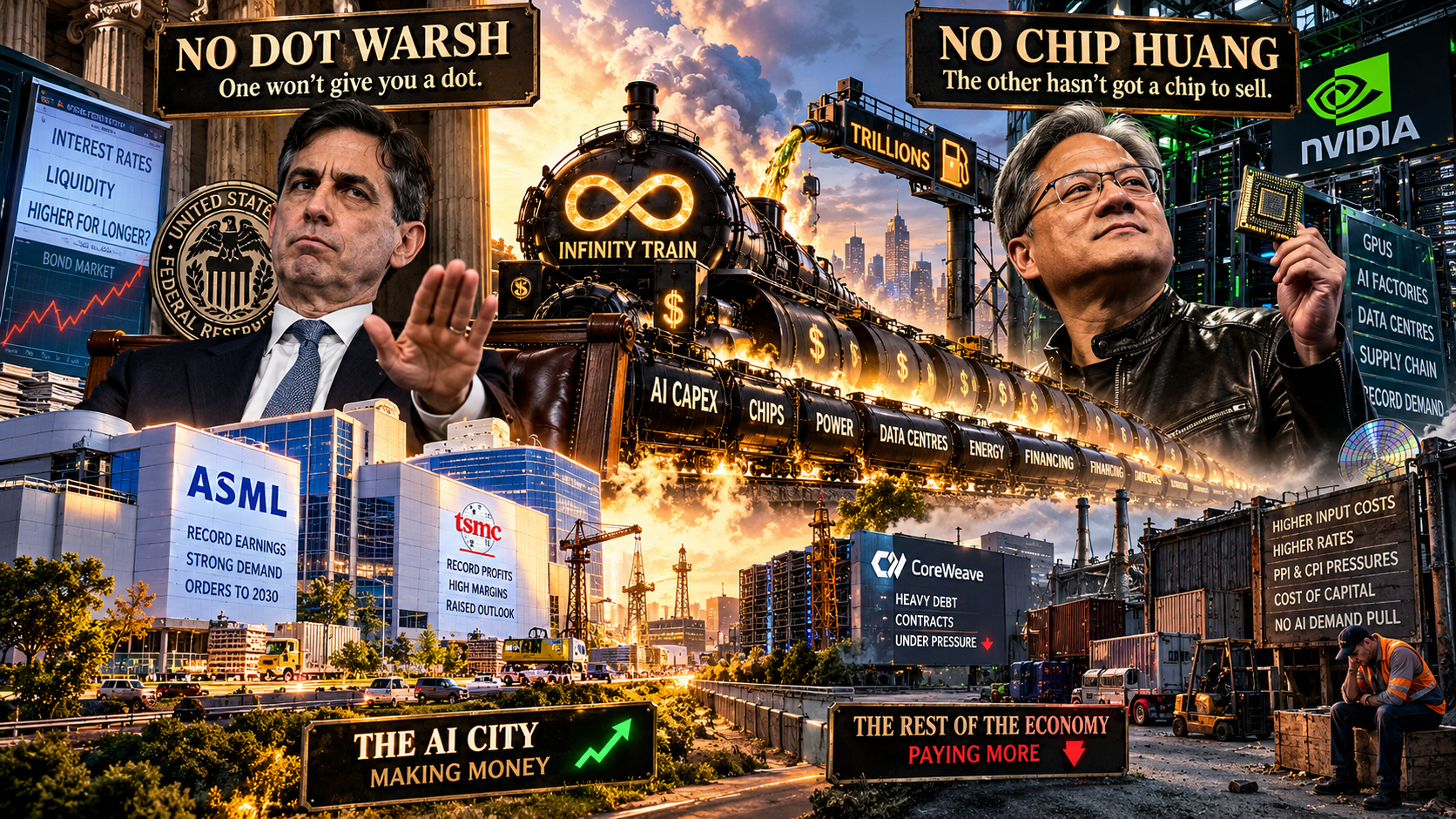
“AI versus bond market” Copyright 2026. nextlevelcorporate. nextlevelcorporate prompts, AI generated image.
TL; DR
One won't give you a dot. The other hasn't got a chip to sell.
And somewhere in the background, the Infinity Train keeps taking on fuel. 🚂💸
Welcome to this week's NextPerspective. Jump on board and let’s dig in!
The market voted on AI. Now it's weighing it.
For a while, it seemed that all you needed to do was put AI somewhere in a company's investor presentation and watch the market do the rest.
Build chips? Brilliant. Build the machines that make the chips? Even better. Build the data centres that house the chips, supply the electricity that powers them, or provide the cooling that stops the whole lot melting? Take a ticket. The AI train is leaving the station.
And if you happened to be Jensen Huang, wearing that black leather jacket and standing on the apex of that extraordinary pyramid, you could hardly be blamed for enjoying the ride.
But something has changed.
The market isn't necessarily rejecting AI. It's becoming rather more particular about who makes money from it, who needs to borrow money to participate, and who might eventually be left holding the bill.
Just look at last week's results.
ASML, the Dutch company that makes sophisticated lithography machines needed to manufacture advanced semiconductors, reported third-quarter revenue of €11.7 billion and net income of approximately €5 billion. Its gross margin reached 57.5%. Management said customer demand was so strong that some customers were asking about equipment deliveries in 2029 and even 2030.
Then came Taiwan Semiconductor Manufacturing Company, or TSMC, the foundry manufacturing chips for Nvidia and many other technology companies. You know, ~80% of the world’s chips come from its clean rooms. Well, its third-quarter revenue reached US$46.72 billion, up 41.2% year on year in U.S. dollars. Its operating margin was 58.7%, and it raised its full-year 2026 revenue growth outlook to 44%.
These are head snapping numbers. ASML's results and TSMC's results show that the AI investment boom is creating genuine demand for equipment and manufacturing capacity.
Yet TSMC's shares fell after its results as part of a wider sell-off in semiconductor stocks. Meanwhile, debt-heavy AI infrastructure businesses came under much heavier pressure as investors reassessed the cost of financing the build-out as rates stay higher for longer. Names like Applied Digital, IREN, Oracle, CoreWeave and Nebius come to mind.
Well, that's interesting, isn't it? The earnings are unprecedented. The margins are unprecedented. The demand is unprecedented . And yet the market is becoming less willing to pay any price for the privilege of owning the story, depending on which carriage you’re sitting in.
The market voted on AI. Now it's weighing it.
And to understand why, we need to meet two gents who sit near the top of two rather different pyramids.
Enter No Dot Warsh and No Chip Huang
Let's start with the Federal Reserve.
Fed Chair Kevin Warsh, the man I've affectionately dubbed No Dot Warsh, sits at the apex of the U.S. central banking system. The Fed influences the price of short-term money, provides liquidity to eligible banks against acceptable collateral, and can make financial conditions easier or more difficult through its monetary policy tools.
It cannot dictate every interest rate in the economy. And it certainly cannot order the bond market to behave itself.
Now let's meet Jensen Huang, founder and chief executive of Nvidia.
We'll call him No Chip Huang.
One won't give you a dot. The other hasn't got a chip to sell. They're all spoken for!
Well, perhaps not literally every chip. But you get the idea.
Nvidia sits near the centre of the AI infrastructure ecosystem. Its GPUs, networking technology, systems and software are critical to much of the current AI build-out. Its product roadmap influences what customers can build, when they can build it and how much computing power they can deploy.
Huang isn't a central banker. And clearly, Nvidia can’t create reserves, set interest rates or lend to banks through a discount window. But Nvidia does occupy a position from which it can influence access to one of the scarcest resources in the AI economy: advanced computing capacity.
And here's where the comparison becomes more interesting.
The Fed influences the flow and price of money through the financial system. Nvidia influences the supply of the computing technology that an enormous amount of that money is chasing.
Both sit near the apex of systems that need capital. Both influence the conditions beneath them. And neither can guarantee that every investment made downstream will earn an adequate return.
The two-speed economy
Now, before we get carried away with the two chairs, let's look at what's happening on the ground.
Imagine two businesses operating in the same economy.
The first supplies the AI build-out. It makes semiconductor equipment, memory, servers, networking components or power infrastructure. Orders are flowing in. Customers want more capacity than the supply chain can comfortably deliver. The business has pricing power, revenue is growing and margins are expanding.
Higher interest rates might annoy the finance director. But if demand is strong, the balance sheet is sound and the company is generating substantial cash, the business may be able to absorb the additional cost.
Now consider the second business. It manufactures ordinary industrial equipment, operates a transport fleet, runs a food-processing plant or supplies products to households.
It isn't receiving a flood of AI-related orders. Its customers aren't suddenly spending more because Jensen Huang has announced another generation of chips.
But its energy, materials, equipment and financing costs are rising. Its customers are becoming more cautious. And it may not have enough pricing power to pass all those costs on.
Same economy. Same interest rates. But a very different experience.
This is the two-speed economy, or perhaps the two-city economy. One city is enjoying the investment boom. The other is paying for some of the costs without yet receiving the same benefits.
And even within the AI city, there are different neighbourhoods.
ASML sells critical equipment into a market where demand is surging. TSMC manufactures the advanced chips that customers need. These businesses are close to the source of the spending and have established operations capable of generating substantial profits.
A company building data centres, on the other hand, may have to borrow massive sums today and wait for years of future computing revenue to justify the investment.
Both may be described as AI companies. Their financial positions can be very different.
Higher interest rates don't hurt every business equally, and an AI boom doesn't lift every boat equally either.
When the bond market joins the conversation
In my recent article, If AI can outrun the Infinity Train, can it also outrun the bond market?, I explored the competition for capital between the U.S. Treasury, the hyperscalers and the rest of Corporate America.
The Treasury needs capital to refinance maturing debt and fund continuing deficits. Hyperscalers need capital to build the infrastructure. Other businesses need capital to invest, expand and employ.
All of them are asking investors for money. And if investors demand higher yields, the cost of financing rises.
No Dot Warsh can influence short-term interest rates, but the bond market has its own ideas about what it wants to be paid for lending money over ten or thirty years. Inflation expectations, Treasury issuance, the term premium and investor confidence all matter.
The market can therefore tighten financial conditions even when the Fed isn't actively raising its policy rate.
Well, that's a problem if you're building a capital-intensive industry on the assumption that financing will remain readily available at an acceptable price.
And it's an even bigger problem if your business has already borrowed heavily to get there.
Reuters reported this week that debt heavy AI infrastructure companies came under pressure as expectations of higher interest rates intensified concerns about the cost of the industry's massive build-out.
CoreWeave became a particularly striking example. The company has a substantial contracted revenue backlog but also carries around US$50 billion in debt. Its shares and bonds sold off sharply as investors questioned whether future cash flows would justify the financing burden.
Reuters' reporting on the AI infrastructure sell-off captures the difference there. A large backlog can be valuable, but it isn't cash in the bank. Revenue isn't free cash flow. And neither automatically guarantees that a business can service its debt, fund new capital expenditure and deliver an attractive return to shareholders.
😲
The technology might work beautifully. The customers may genuinely want the computing power. But the financing still has to work.
The financial lasagne gets another layer
And this brings us back to something I wrote about a fortnight ago in The further we abstract the asset, the closer we get to the bailout.
The underlying asset is important. But so does everything we build on top of it.
In the AI economy, the underlying asset might be a GPU, a server rack or a data centre. Those assets can support productive activity and generate revenue. They can also form part of a financing structure, where lenders assess their value and the cash flows, they are expected to produce.
Nvidia has recognised that the next stage of the build-out requires more than selling chips.
In August 2026, it announced partnerships with Apollo, BlackRock, Blackstone, Brookfield, Goldman Sachs and KKR to establish financing platforms intended to mobilise more than US$500 billion in third-party capital for AI infrastructure over time. The stated aim is to make computing infrastructure an investable asset class and help customers obtain the capital needed to build AI factories.
You can read the details in Nvidia's announcement.
Think about what that means. Nvidia began by making chips. It is now helping to organise the financing ecosystem that allows more chips to be deployed. That makes commercial sense. If customers need more computing power, but cannot fund the infrastructure themselves, new financing structures can help bridge the gap. Investors gain access to a new asset class, operators gain access to capital, and Nvidia's ecosystem can continue to expand.
But there is another side to the equation.
What happens if the expected revenue doesn't arrive? What happens if computing prices fall, customers delay commitments or a new chip generation makes older hardware less valuable? What happens if a lender discovers that the collateral supporting a loan is worth less than expected?
A GPU can remain perfectly functional while its economic value falls. Technology moves on. Equipment depreciates. New generations arrive. The lender still wants to be repaid.
This is what got me thinking about the comparison with the Fed.
The Fed lends to eligible institutions against acceptable collateral under established rules. The borrower remains liable for the loan. Nvidia's financing ecosystem is commercial, involving private lenders and investors who assess credit risk, collateral and expected returns.
These are not the same thing. Nvidia is not creating money in the way a central bank can create reserves.
But both examples do show how collateral and confidence can support the extension of credit. And when that credit finances a rapidly expanding system, we need to ask whether the underlying productive activity will generate enough cash to support the claims being built on top of it.
Well, that's the financial lasagne again. The asset is at the bottom, the claims are stacked above it, and the important question is whether the whole structure can withstand a change in conditions.
No Dot Warsh versus No Chip Huang
So, let's return to our two fine gents.
No Dot Warsh influences the price of money. But the bond market can still demand higher yields.
No Chip Huang influences access to critical computing technology. But he cannot guarantee that every customer can finance its infrastructure or earn an adequate return from deploying it.
One operates within a public monetary institution with a statutory mandate. The other runs a commercial company whose technology has become central to an extraordinary investment cycle.
Their incentives are different. Their powers are different. Their responsibilities are different.
Yet both operate near the top of systems that depend on confidence, collateral, capital and the willingness of others to participate.
And the market is now asking more demanding questions of the AI system.
It wants to know which companies are generating cash today, which need more capital before they can generate cash tomorrow, and which may be relying on increasingly complicated financing arrangements to keep the expansion moving.
That doesn't mean the AI thesis is broken. It’s not. ASML's results show strong demand for the equipment needed to manufacture advanced semiconductors. TSMC's results show that the demand for advanced chip manufacturing remains substantial. These are not imaginary businesses selling an imaginary product, like dot com.
But a real technology boom can still produce poor investments if too much capital is committed at the wrong price, on the wrong terms or in anticipation of returns that never quite arrive.
The difference is between a technology that changes the world and an investment that earns an adequate return from that change.
AI can be transformative without every AI related company being a winner.
Who gets left carrying the bill?
This is where I think the investment story becomes really interesting.
If you’re supplying a scarce component into a market experiencing extraordinary demand, you may have pricing power, strong margins and the cash flow to fund expansion.
If you’re building infrastructure with substantial debt, your fortunes may depend on a more complicated equation. You need the chips, the electricity, the customers, the financing and enough revenue to cover the operating costs, interest payments and eventual replacement of the equipment.
And if you operate outside the AI supply chain, you may be facing higher costs and more expensive credit without receiving much of the immediate demand benefit.
The productivity dividend may eventually spread throughout the economy. AI could help businesses reduce costs, improve output and create products and services that were previously impossible.
But that dividend takes time to arrive. The cost of building the infrastructure arrives first.
The market is now trying to work out which companies can bridge that gap.
It is weighing the balance sheets as well as the technology. It is weighing the cash flows as well as the growth forecasts. It is weighing the financing arrangements as well as the excitement.
In other words, the market is moving from voting on AI to weighing it.
And that’s probably a healthy development, even if it makes for a rather uncomfortable week or fortnight for some investors.
Well, we've followed the asset through the financial lasagne. We've followed the money into the bond market. Now we've followed the money and the Machines back to the two chairs sitting near the top of their respective pyramids.
The technology remains extraordinary. The investment opportunity remains enormous. But capital has a price, collateral has a value that can change, and eventually every investment has to earn its keep.
Can No Chip Huang keep supplying the Machines? Can No Dot Warsh keep the financial conditions manageable? And can the rest of the economy afford to wait for the productivity dividend?
That’s the trillion-dollar question.
No Dot Warsh. No Chip Huang.
One won't give you a dot. The other hasn't got a chip to sell.
And somewhere in the background, the QE Infinity train chugs along quietly, waiting for Scott and No Dot 🚂💸
See you in carriage 5 🖐
Mike

Macro first. Strategy second. Deal third.
An independent corporate development studio, established in Perth in 2001, advising you when — and when not — to do the deal. In 25 years, that discipline has been the difference.
This content is copyright NextLevelCorporate. It is not advice and it is provided for informational purposes only. NextLevelCorporate and logo are registered trademarks. All rights reserved.