
The further we abstract the asset, the closer we get to the bailout
The financial lasagne of a hyper-financialised world
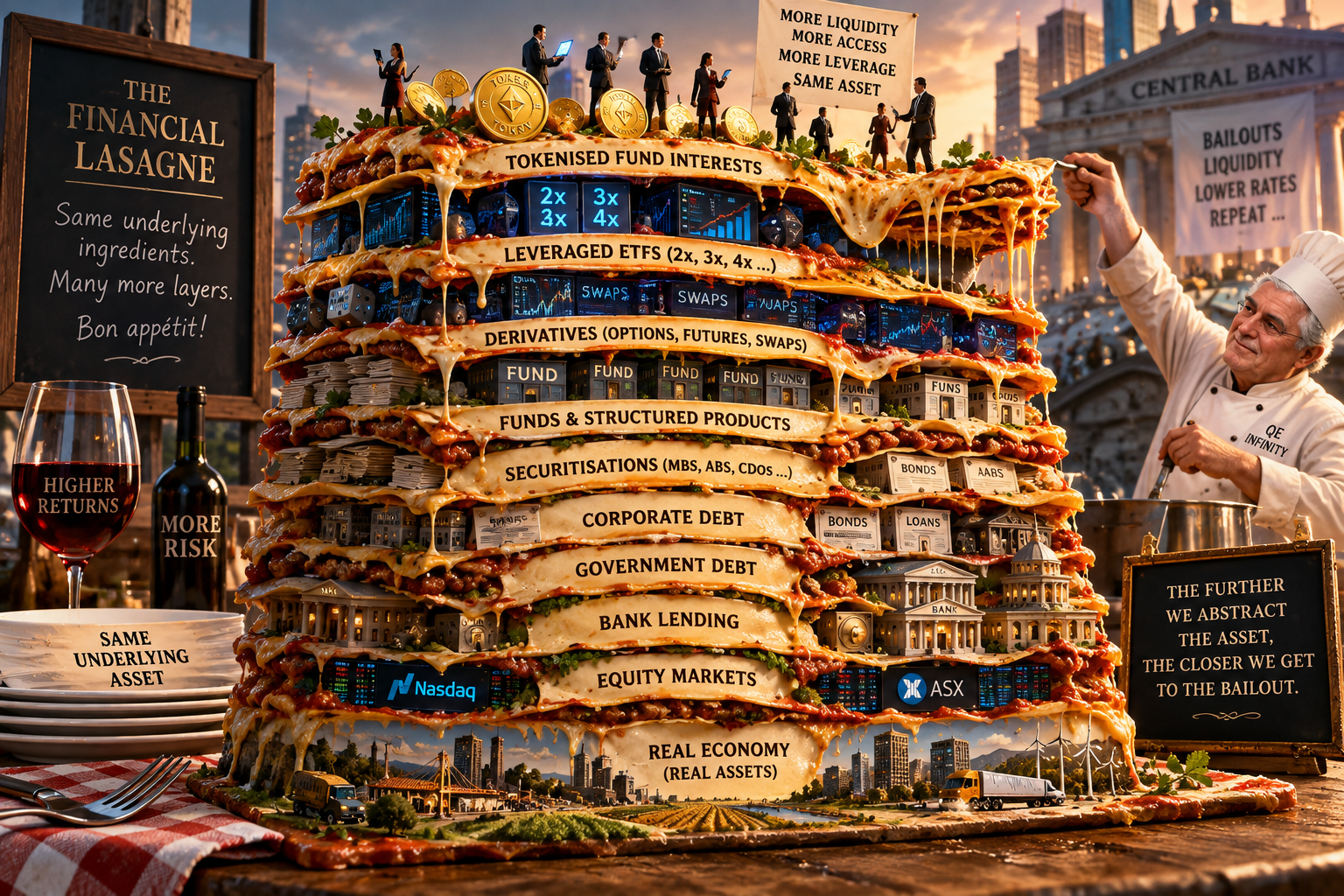
“Financial lasagne” Copyright 2026. nextlevelcorporate. nextlevelcorporate prompts, AI generated image.
TL; DR
ARK is tokenising interests in its venture fund. That sounds like a story about blockchain, but I think it is really a story about something much older. And that is the extraordinary ability to of markets to create layers of financial claims around the same underlying asset.
Global debt is now roughly US$365 trillion, against annual global GDP of about US$126 trillion. Alongside that sits a derivatives machine with US$846 trillion of OTC notional outstanding and US$21.8 trillion of gross market value, before we properly account for the full economic exposure embedded in exchange-traded futures and options. Then there are funds, securitisations, leveraged ETFs and increasingly, tokenised fund interests.
Sometimes the leverage sits in the company, sometimes in the fund, sometimes in the derivative and sometimes in the investor's own borrowing. Sometimes it sits in all of those layers.
The underlying business, meanwhile, remains stubbornly unchanged.
That does not make financial innovation bad. Quite the opposite. These instruments can make markets more efficient and capital more mobile. But they can also increase the distance between the investor and the asset that ultimately has to generate the cash.
And that matters when things go wrong because the further we abstract the asset the harder it can become to see who ultimately carries the risk, who gets paid first and where the losses land. And when enough claims become interconnected, the pressure on governments and central banks to stop the financial lasagne collapsing can become rather considerable.
So perhaps the question is not whether tokenisation is good or bad. Perhaps it is simply this.
“How many layers can we put between the investor and the asset before we forget what is actually underneath the claim? And it’s not just tokens, it’s about every claim, right, chose, share, managed unit, royalty, stream, option, future, derivative and collateralised obligation. It’s literally a financial lasagne stacked inside a baking pan that’s not allowed to fail.”
Well, ARK is adding another layer 😘
There are things that happen in hyper-financialised markets that look modern, clever, and at first glance, harmless.
One such thing is that ARK Investment Management has partnered with Securitize to tokenise interests in the ARK Venture Fund. Eligible investors can get exposure to a portfolio containing companies like SpaceX, OpenAI, Anthropic, Stripe and Databricks. These digital tokens live on the Ethereum blockchain and represent fractional shares in the ARK Venture Fund (ARKVX).
The setup bypasses traditional brokerage hurdles. However, there are some rather important details buried in that announcement. First of all, the companies themselves are not being tokenised. What is being tokenised is the investor's interest in the fund that owns interests in those companies. Next, there is no deep liquidity mechanism supporting ownership. the implication being that investors can subscribe and buy into the fund at any time, but true "24/7 trading" does not exist. It’s because ARKVX is an interval fund. Investors can’t sell their tokens on an open exchange and must rely strictly on quarterly fund buyback intervals, historically capped at just 5% of total shares, if they want to liquidate their holdings.
Not ideal. But there’s always a catch, right?
Well, that got me thinking.
This isn't really a story about putting OpenAI on a blockchain. It’s a story about adding another layer between the investor and the underlying business or project. It’s a further abstraction of underlying reality. It belongs to the hyper-financialised world we’ve been living in the since the GFC.
The business sits underneath the fund. The fund sits between the business and its investors. The investor owns an interest in the fund, and now that interest can become a digital token.
And while that can be useful, what happens when we keep adding layers?
Let’s assume an investor borrows money to buy the token. The lender now has a claim against the investor, the investor has a claim against the fund, the fund has a claim against the underlying businesses, and those businesses may themselves have junior, mezzanine and senior debt as well as preferred equity sitting above their ordinary equity.
Cathy’s little token has suddenly acquired quite a family tree, grown on multiple layers of leverage.
Before tokenisation, look at what we already built
And before we get too excited about democratising access to these assets, perhaps we should take a look at the financial world we have already built, and what that might cost us in the long run.
The latest Institute of International Finance figures put global debt at about US$365 trillion. That is debt across governments, households, financial institutions and companies around the world.
At the same time, sitting alongside that debt is a derivatives machine of almost comical scale. The Bank for International Settlements (BIS) puts the notional value of outstanding OTC (which means over the counter) derivatives at US$846 trillion as at June 2025.
Err…, that’s US$0.85 quadrillion!
The gross market value was much smaller, and according to BIS, sits at US$21.8 trillion.
But it’s important to understand that the US$846 trillion figure does not mean somebody owes somebody else US$846 trillion. Notional is the reference amount used to calculate payments. It is not the amount that would necessarily change hands if every contract were closed out.
The US$21.8 trillion gross market value is much more useful for thinking about economic exposure. It represents the replacement value of the contracts before netting. And importantly, the BIS data cover the global OTC market across interest rates, foreign exchange, equity, commodity, credit and other derivatives.
There is then another enormous universe of exchange-traded futures and options sitting alongside the OTC market.
So, on a deliberately conservative basis, we can already see something like US$365 trillion of debt plus more than US$20 trillion of OTC derivative replacement value.
Call it roughly US$387 trillion before we properly capture the economic exposure embedded in the global exchange-traded futures and options markets. Global GDP, by comparison, is about US$126 trillion a year, according to the IMF.
That means the readily measurable stock of debt and OTC derivative replacement exposure is already around three times the annual output of the entire global economy.
And if we look at the notional architecture rather than economic exposure, the number becomes almost surreal. Debt plus OTC derivative notional alone gets us above US$1.2 quadrillion.
Again, that does not mean the world owes US$1.2 quadrillion. What it really means is that we have built a financial system capable of writing an extraordinary number of claims and contingent claims around the same underlying economic activity.
But there is a difference. Derivatives are not inherently bad. Quite the opposite. They are useful instruments for transferring risk, hedging currencies, managing interest rates and helping businesses deal with uncertainty.
So, the question I am interested in is a little different.
How many financial claims can we build around the same underlying assets before the financial structure becomes much more complicated and systemically significant than the thing underneath it?
Now look at the assets underneath all those claims
Instead of comparing financial claims with annual GDP, let's compare the financial architecture with the assets that ultimately support it.
This is where the global balance sheet becomes fascinating.
McKinsey's latest Global Balance Sheet estimates that the world's total balance sheet reached almost US$1.8 quadrillion in 2025. Beneath that enormous number sit ~US$620 trillion of real assets, including real estate, infrastructure, machinery, equipment and intellectual property.
And global wealth, after liabilities are deducted, was about US$600 trillion.
Let’s think about that.
A bond is an asset to the person who owns it and a liability to the person who issued it. A bank loan is an asset to the bank and a liability to the borrower. A share is an asset to the shareholder but ultimately represents a claim on the assets and future earnings of a business.
At the global level, financial assets and liabilities largely cancel each other.
But real assets don't. They are what is ultimately left when we strip away the financial plumbing, and this is where things get interesting.
We have something like US$620 trillion of real assets supporting a global balance sheet approaching US$1.8 quadrillion once the layers of financial assets, liabilities and intermediation are included. McKinsey estimates the financial sector alone intermediates about US$550 trillion of assets.
That does not mean there is US$1.8 quadrillion of debt chasing US$620 trillion of assets. It means that the same underlying economic assets can support a huge number of financial claims as they move through the system.
Let’s think about this in layers. A house can support a mortgage. The mortgage is an asset to a bank. The bank funds itself with liabilities. The mortgage can be securitised. The security can be owned by a fund. The fund can be owned by investors. And the interest in the fund can now be tokenised.
The house has not changed. The financial architecture around the house has.
Enter the drunken sailor
This is where my drunken sailor staggers back into the story.
Imagine our sailor walks into a bar and announces ownership of a very valuable boat. The bartender is happy to give him a drink on the strength of it. The sailor then discovers that the IOU can be sold to someone else. The new owner discovers that the IOU can be used as collateral for another loan.
Everyone is delighted, if not slightly squiffy on exuberance. Nonetheless, the sailor gets another drink, the bartender has another asset, the lender has collateral and somebody in the middle has collected a fee.
The only thing we haven't established is whether there is actually any more whisky. And that, in essence, is the problem with financial abstraction. It can make claims more liquid, more transferable and more financeable without necessarily creating another dollar of productive capacity underneath them.
And this is where leveraged ETFs make the whole thing considerably more interesting.
The financial lasagne
Leveraged ETFs are an almost perfect demonstration of how financial engineering can create additional exposure without creating another underlying asset.
You can buy a listed security through your normal brokerage account and obtain two or three times the daily exposure to an index, sector, commodity or, increasingly, an individual company. The fund creates the gearing using derivatives, borrowing or other financial instruments, so the investor does not necessarily have to take out a margin loan personally. It’s why I’ve always warned that when investing in ETFs, you need to know what you are investing in. Are you getting exposure to the thematic you really want, or to a series of futures contracts, or undeployed monies in the form of Treasuries?
The ASX describes leveraged ETFs as products designed to deliver a multiple of the daily return of an underlying asset, while warning that leverage magnifies both gains and losses.
Now let's take this one step further by jumping in the TARDIS, crossing countries and time.
Consider Strategy, formerly MicroStrategy. Strategy has built a very large Bitcoin position and finances its capital structure through a combination of common equity, convertible debt and preferred securities. As at May 2026, it reported US$6.7 billion of convertible notes and US$15.5 billion of preferred stock, alongside 843,738 Bitcoin.
That means there’s already leverage sitting between the investor and the underlying Bitcoin.
Then put a 2x leveraged ETF on top of MSTR. Products such as the MSTR 2x Daily ETF (MSTU) are designed to deliver roughly twice the daily performance of Strategy's shares, primarily through derivatives such as total-return swaps.
Now, I want to be careful here because it is not mathematically correct to say that this is simply "4x Bitcoin".
MSTR's equity exposure to Bitcoin changes as its capital structure changes, and the ETF resets its exposure every trading day. Over longer periods, compounding can produce results very different from a simple 2x multiple. The prospectus is quite explicit about that.
But conceptually, look at the stack. Bitcoin sits underneath Strategy. Strategy's equity sits underneath the ETF. The ETF uses derivatives to create 2x daily exposure. And the investor sits on top of the ETF.
One underlying asset. Several layers of financial engineering.
And it isn't just a Bitcoin curiosity. The U.S. market now has 2x leveraged ETFs on individual companies like SK Hynix. The SEC filings for products from Direxion, Leverage Shares and others explicitly describe funds targeting 200% of the daily performance of SK Hynix, generally through swaps and other derivatives.
There are even leveraged products providing 2x exposure to baskets of Korean AI semiconductor companies. Think about what’s happened. SK Hynix builds semiconductor factories, buys equipment, employs engineers and manufactures memory chips. Its shares represent a claim on that business. Then someone creates a financial product that gives an investor twice the daily movement of those shares.
The investor hasn't built another semiconductor factory. They haven't bought another piece of equipment. They haven't hired another engineer. All that’s happened is they have simply acquired another, more highly geared way of obtaining exposure to the same business.
And Australia is hardly immune.
The ASX itself recognises leveraged ETFs, options and warrants as forms of investment leverage. Some geared ETFs use borrowing, some use derivatives. There are also Australian geared ETFs designed to provide roughly 1.4x to 1.7x exposure to diversified Australian and global equity portfolios.
Well, that starts to look like a financial lasagne.
We have the business. The business may have debt. An investor can own the business through shares. A fund can own those shares. An ETF can provide leveraged exposure to the shares. The ETF can use swaps. The investor can borrow to buy the ETF. And now, increasingly, the fund interest itself can be tokenised.
Layer upon layer, each one perfectly respectable when viewed in isolation.
The trouble starts when the layers interact
And that’s the important point.
None of these instruments needs to be stupid. A derivative can be useful. A leveraged ETF can be useful. A fund can be useful. Tokenisation can be useful. Debt can be useful.
Financial markets need these things, so the real question is what happens when they interact?
Because leverage changes the game. When the underlying asset rises, leverage can make the financial claim rise faster. That can increase collateral values, support more borrowing and make the system look wonderfully efficient.
Until it doesn't.
When the asset falls, the same mechanism runs backwards. Collateral values fall. Lenders become more cautious. Margin requirements rise. Spreads widen. Positions are reduced. Assets are sold. And now the financial architecture can amplify the movement in the underlying asset rather than simply reflecting it.
This is why the hierarchy of claims matters so much.
When something goes wrong, secured debt generally sits in a different position from unsecured debt. Preferred equity sits somewhere else. Ordinary equity is further down the queue. Royalties, contractual claims and other forms of economic interest can have entirely different rights depending on the jurisdiction and the documents governing them.
Now spread all of that across borders.
The investor might be in Australia. The fund might be incorporated in Luxembourg. The lender might be American. The underlying business might be Korean. The derivatives counterparty might be somewhere else entirely.
The blockchain can tell us very efficiently who owns the token. But on its own, it can’t tell us who gets paid first when everything goes wrong. That still depends on contracts, insolvency law, collateral arrangements, regulation and courts.
And eventually the QE Infinity train to nowhere shows up
And this is where the QE Infinity train eventually approaches our station.
Not because tokenisation causes QE. It doesn't. And not because every tokenised asset will eventually require a government bailout.
Nope, the connection is more subtle, and it is this. The more layers of financial claims we build around the same underlying assets, the more difficult it becomes to allow those claims to fail in an orderly fashion when the underlying collateral falls sharply in value.
At some point, a private financial problem can become a systemic financial problem. And when enough of the financial system is connected to enough of the same collateral, governments and central banks can find themselves standing at the end of the chain.
We saw this during the GFC. A problem that began in one corner of the US mortgage market travelled through securitisation, banking, money markets and credit markets until it became a threat to the financial system itself.
After the barbeque, the response was not simply to rescue individual homeowners, because the system had become too interconnected.
That’s the point about financial abstraction. It doesn't necessarily make risk disappear. Sometimes it simply moves the risk somewhere else, or spreads it, or hides it. And sometimes it makes the political consequences of allowing it to fail considerably larger.
That is where the QE Infinity train gets its tracks and why central banks and governments maintain those tracks.
They don’t create liquidity simply because they enjoy buying bonds. They do it because, when the financial system is sufficiently interconnected, allowing a liquidity crisis to become a cascading solvency crisis can be economically and politically intolerable.
And it’s for this reason that fiscal and monetary coordination through a process of TIFFIT has come to pass and the QE Infinity train to nowhere continues on its globally interconnected rails, never allowed to stop.
So what does ARK actually tell us?
The fascinating thing about the ARK announcement is not that OpenAI, Anthropic, Stripe or Databricks are suddenly becoming tokens. They aren't. The fact that ARK had an existing investment in Securitize before it tokenised, is also not the point.
The fascinating thing is that an interest in a fund that owns interests in those businesses is being turned into a digital, potentially transferable financial asset. That is another layer of abstraction.
And if that digital claim can subsequently be borrowed against, used as collateral, bundled into another financial product or incorporated into another financial structure, then we have another layer again.
The underlying business still has to do exactly what it did before. It has to build something people want. It has to generate revenue. It has to make a profit eventually. It has to produce cash.
That cash is ultimately what supports the claims sitting above it.
And this is why I think we should look at tokenisation with neither irrational exuberance, nor doom. It could be genuinely useful. It could make private markets more liquid, settlement more efficient and ownership easier to transfer. It could bring assets that are currently difficult to trade onto much better digital rails.
But there is a difference between making an asset easier to own and making an asset more productive.
The first is financial infrastructure that can enables more ways of owning, financing, leveraging and trading an asset without creating another unit of productive capacity. The second is economic growth.
The thing underneath the token is the baking pan
We already have roughly US$365 trillion of debt sitting against an economy producing around US$126 trillion of output each year. Alongside it sits an enormous derivatives architecture, with US$846 trillion of OTC notional outstanding and US$21.8 trillion of gross market value, before we properly account for the full economic exposure embedded in exchange-traded futures and options.
We then have a global balance sheet approaching US$1.8 quadrillion, against a real-asset base of roughly US$620 trillion. The US$620 trillion is the baking pan.
We have built, in layers, an enormous financial lasagne inside a baking pan that’s not allowed to break. And now we are getting good at putting that on digital rails so anyone in the world can make a claim on that baking pan.
Perhaps that is the real investment question. Not whether everything should be tokenised. Not whether blockchain is revolutionary and not even whether the next great bull market is about to begin.
Perhaps the question is much simpler.
“How many layers can stack between the investor and the asset before we forget what is actually underneath the token or the investment? Or put another way, how many layers of financial lasagne can the baking pan hold?”
Because the financial system is already carrying an extraordinary amount of abstraction. Tokenisation may not create that abstraction. It may simply make it faster and more accessible.
And, as every drunken sailor eventually discovers, faster is not necessarily the same thing as better. That’s also why an eventual bailout might be required, but it’s also why its effects are likely to be short lived since the QE Infinity train never stopped, and the White House, through Scott Bessent, now has direct control of the throttle.
See you in carriage 5 🖐
Mike.

Macro first. Strategy second. Deal third.
An independent corporate development studio, established in Perth in 2001, advising you when — and when not — to do the deal. In 25 years, that discipline has been the difference.
This content is copyright NextLevelCorporate. It is not advice and it is provided for informational purposes only. NextLevelCorporate and logo are registered trademarks. All rights reserved.