
Follow the machine
How the Doctor’s TARDIS can help us navigate the biggest investments of the next decade
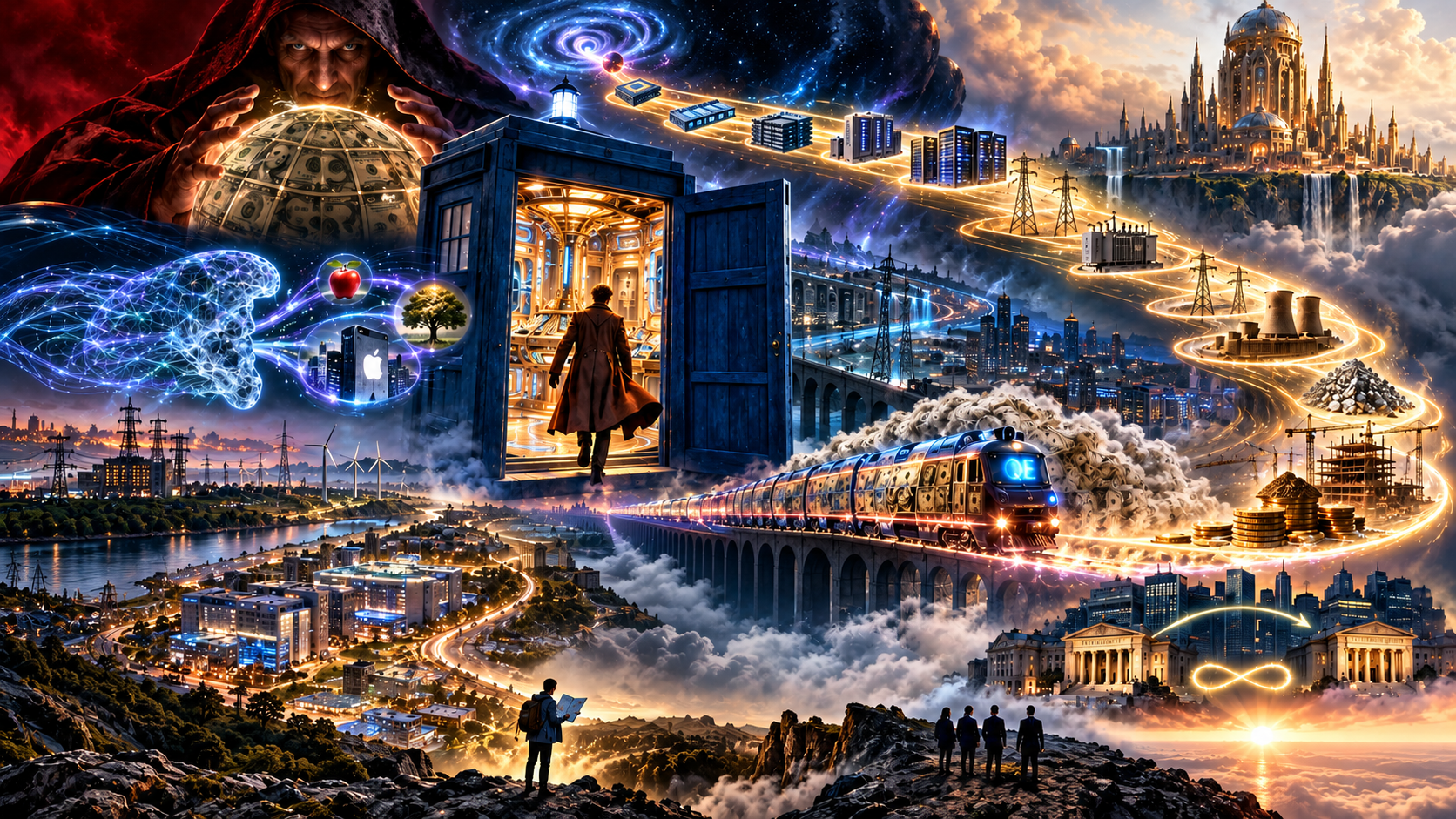
“Doctor!” Copyright 2026. nextlevelcorporate. nextlevelcorporate prompts, AI generated image.
TL;DR
I’m feeling a little nostalgic. I was recently watching a pivotal Doctor Who episode and thinking about the transition from one Doctor to the next. Jon Pertwee, Tom Baker and several others who, depending on your age, may have been the Doctor you grew up with. And then my mind turned to the show's real enabler, the thing that somehow tied all of those different Doctors, stories, villains, planets and adventures together. The element that glued time and space. The time-travelling police box. The TARDIS.
For those who don't know, TARDIS stands for Time And Relative Dimension In Space, and if you've ever wondered why a police box needs what sounds like a Fed acronym, well, that's Doctor Who for you. But the thing I love about the TARDIS is that it is much bigger on the inside than it appears to be on the outside, and that got me thinking about our new AI.
When we look at it, most of us see a chat window, an image generator or we hear about an agent doing something mind bending behind a closed door. What we don't immediately see is the biggest ever gathering of atoms that get extracted, cracked, stacked, shipped, melted, moulded, bent and used to construct the massive physical machine that will build the next epoch, behind that police box door.
From an investment perspective, AI is simply the archway into something much larger that’s still being built, and it’s the building of that machine which may become one of the most important investment and corporate development stories of the next decade. So, join me in the TARDIS. I think I've found something rather interesting.
The TARDIS is much bigger on the inside
Let's start inside the machine, because this is where the TARDIS analogy is useful. An AI model doesn't understand a word in quite the way you and I do. Text is broken into tokens, and those tokens are represented mathematically as embeddings that place words and other pieces of language into a huge, high-dimensional space. Relationships between words are learned from patterns in the data, so the model effectively develops a mathematical map of how concepts relate to one another.
Take the word "apple". Depending on the context, you might be talking about fruit, an orchard, a tree, a pie or something you ate yesterday. Move into another part of our accumulated human knowledge and the same word can take you somewhere completely different. Adam and Eve. The Tree of Knowledge. Newton and gravity. Then move again and we're in Cupertino, and the words that come to me are Steve, Woz, Macintosh, iPhone and that little bitten logo. Same word, but radically different neighbourhoods.
That’s just an example, largely inspired by a piece put out by Micron last week, and in reality, an embedding space is vastly more complicated than that and well above my pay grade. But the important point is that models can represent relationships across hundreds or thousands of dimensions, and when they generate an answer, they are not simply retrieving a sentence from a filing cabinet. They are operating within that enormous mathematical space and calculating which token is most appropriate next, given the context available to them.
This is where my TARDIS idea starts to make a little more sense. I'm not suggesting that one of those mathematical dimensions is literally "time". It isn't. Time is represented indirectly through relationships in the information the model has learned, including information accumulated over centuries, while the present context determines which part of that enormous landscape becomes relevant. The remarkable part is that the model can reach back through accumulated knowledge, locate relationships that fit the present context, weight them and calculate the probability distribution for what should come next.
Then the next token becomes part of the present, which changes the context for the next calculation, and the process continues.
I’ve found it useful to think about how it works as though it was a continuum of steps done at lightning-fast speed. Reach back, locate relationships, weight context, calculate probabilities, project the next token, add it to the present and reach back again. It's not time travel in the Doctor Who sense, but as a mental model for what these systems are doing, I think the TARDIS is on point.
And there’s another detail that tends to disappear behind the magic of the interface. Those mathematical relationships and the context being processed ultimately have to live somewhere physical. Modern AI systems rely heavily on high-bandwidth memory and specialised hardware because moving enormous quantities of information quickly is itself a constraint on performance. The model may look like mathematics on a screen, but underneath it is memory, silicon, electricity and physical infrastructure. Like, you cannot download a transformer, just like an agent can’t apply for a SWIFT account, it uses crypto instead.
Then we step outside
Once we leave the math and look at the physical TARDIS, the scale of the machine gets much harder to ignore.
AI wants electricity, data centres, advanced chips, memory, compute, networks, cooling, land and an increasingly impressive collection of transformers. It needs construction capacity, specialist manufacturing, skilled labour and capital, as well as copper, rare earths and other critical materials that most of us could previously avoid discussing at dinner.
The International Energy Agency's latest work gives a sense of the scale. It estimates that data centre electricity consumption will roughly double from 485 TWh in 2025 to 950 TWh in 2030, while electricity consumption from AI-focused data centres is expected to triple over the same period. It also points to tightening bottlenecks across advanced chips, high-bandwidth memory, transformers, gas turbines, grid connections, planning systems and capital markets, but they are already well-known targets.
The really interesting part is the mismatch in speed. Software can change in months. Capital can move in days. A semiconductor fab takes years. A mine takes years. A transmission line takes years. A new generation plant takes years. Even a transformer, which sounds like a rather humble piece of equipment compared with a trillion-dollar technology company, can become a critical bottleneck when everyone suddenly wants one at the same time.
This is where the investment story starts to change. If demand for the machine is growing faster than the physical system underneath it can respond, the constraint itself becomes valuable. Capital doesn't necessarily remain where the original excitement began. And just like the spinning TARDIS, it rotates towards whatever is preventing the machine from going faster.
The TARDIS doesn't travel in a straight line
This is why I don’t believe that the AI investment story is simply a hunt for the one company that will eventually "win" AI. Maybe there will be a dominant company in some part of the system, and there will certainly be enormous winners and losers, but the machine itself isn't travelling towards one fixed destination. It's moving through a changing landscape of constraints, and when one constraint is relieved, it often creates another somewhere else.
Think about the TARDIS itself. It can travel backwards and forwards through time, cross dimensions and take the Doctor somewhere completely unexpected. It also has that wonderful habit of eventually coming full circle, dropping off one trusted companion and beginning another adventure. The economic machine behaves rather similarly. Capital moves into a shortage, capacity expands, the bottleneck shifts, the machine moves somewhere else and, eventually, it may return to a familiar constraint at a much larger scale.
We've already seen the beginnings of this rotation into roadblocks. First the obvious shortage was GPUs. Then attention moved towards memory. Then CPUs. Then back towards memory again. As compute density increased, heat became a bigger problem and liquid cooling moved up the agenda. As data-centre construction accelerated, the problem moved further downstream into electricity, grid connections, transformers and generation capacity, and eventually back towards the much larger question of energy itself.
The sequence isn't random. More GPUs require more memory. More compute produces more heat. More heat creates demand for better cooling. More data centres create more electricity demand. More electricity demand eventually runs into generation, transmission, grid and fuel constraints. Solve one bottleneck and the machine simply exposes the next one.
That is the loop I think investors and corporate-development teams need to understand.
Six questions for following the machine
Rather than trying to predict the permanent winner, I think we can follow the TARDIS by asking six questions.
What does the TARDIS need? Chips, advanced memory, compute, electricity, data centres, cooling, networks, engines, transformers, copper, rare earths, critical materials, construction capacity, skilled labour and capital.
Where is it scarce? This is where the rotation into roadblocks begins. Find the part of the machine where demand is running ahead of supply.
Who controls the supply? Scarcity is only half the story. Ownership, geography, intellectual property, manufacturing capability, resources and government policy determine who controls access.
How quickly can supply respond? Software can change in months. A mine, grid, semiconductor fab or nuclear project can take years. That difference can create the period in which scarcity becomes economically valuable.
How much capital is required to expand it? And here we start getting into some very large numbers. Building the TARDIS is expensive. Very expensive. Governments can provide incentives, grants, tax credits and strategic financing, but the private sector still has to put a tsunami of money to work.
What becomes the next constraint when this one is relieved? Because solving one roadblock doesn't end the journey. It moves the machine to the next one.
The important thing about this framework is that it doesn't require us to know where the TARDIS will eventually end up. We only need to understand what is holding it back now, what and when it needs to overcome that constraint and where the pressure is likely to move once that constraint has been relieved. That makes the framework much more useful than simply trying to guess which company will still be standing ten years from now.
Then we meet Gallifrey
There is another part of the Doctor Who universe that fits rather neatly into this story. Gallifrey represents the institutional order sitting above the machine, the governments, sovereigns, regulators and public institutions with the power to tax it, regulate it, restrict it, subsidise it, finance it and determine access to strategically important resources. These are the Time Lords, and they have a rather obvious problem. The machine doesn't move at the speed of government.
Engineers work in months. Capital can move in days. Markets can reprice something in seconds. Governments have budgets, elections, consultations, planning systems, national-security reviews and laws to write. A semiconductor supply chain can become strategically important before a government has finished deciding whether it is strategically important, and a data centre boom can run into electricity constraints long before the grid has been redesigned to accommodate it.
This is the politics of the Time Lords. Gallifrey is trying to write the rules while the TARDIS has already traversed five dimensions. That tension is going to become increasingly important as AI moves from being primarily a software story into a story about energy, industrial capacity, strategic resources, infrastructure and national economic competitiveness.
But there is one more character we need to unveil.
Maybe the Master isn't a human at all
At first, I thought the obvious candidates for the Master might be the people building frontier AI. Elon, Sam, Dario and the other entrepreneurs and companies pushing the technology forward all have some of the characteristics of renegade Time Lords, but the more you think about that and their real agendas, the less satisfying that interpretation becomes. It misses the much larger force sitting underneath the entire system.
Maybe the Master isn't a man at all. Maybe the Master is Debt.
The Doctor Who mythology gives us a useful reason for taking the idea seriously. The Master isn't simply another traveller. He is a renegade Time Lord who becomes powerful enough to threaten the institutional order itself, including, in the BBC’s mythology, the destruction of Gallifrey.
Debt doesn't have to be evil to play a similar role in our economic system. It doesn't have to have a motive or a plan. It simply has to keep demanding that the financial system service, refinance and carry the obligations it has accumulated. Why? Because the other side of that debt is an asset, which is to say collateral. And that collateral underpins the entire global financial system.
Global debt reached a record roughly $348 trillion at the end of 2025 according to the Institute of International Finance, after almost $29 trillion was added during the year. By the end of March 2026, Reuters reported the IIF estimate had risen again to nearly $353 trillion. The precise number will move around depending on the date and definition, but the broad point doesn't require a decimal place.
So, let’s call if $360 trillion, excluding the derivative debt that does not pass through a clearing house.
And that creates a structural demand for economic growth. This is where the AI story intersects with the argument I made in my earlier Marshall Plan piece. The U.S. economy growing at around 1.5% annualised while the debt-carrying burden, using the 10 year Treasury yield as a market benchmark, around 6% of GDP. The simple arithmetic suggested an economy generating only about a quarter of the growth rate needed to keep pace with that burden.
I'm not going to repeat that whole argument here. The point for this article is simpler. AI is arriving in an economy that needs growth to carry the debt.
The Master says faster
Debt doesn't need to tell anyone what technology to build. It doesn't need to pick the winning model, the winning chip or the winning data centre. It simply creates a financial system that needs productive capacity, investment and economic growth to keep expanding. That makes AI potentially much more than another technology cycle because, if it can deliver a meaningful increase in productivity and economic activity, it is being built at precisely the moment when the existing financial system has a powerful reason to want it to succeed.
This is where the metaphor gets uncomfortable. Gallifrey may want to regulate the machine because it is worried about what the machine might do, while the Master is effectively standing behind it saying, "Faster." Governments may want safeguards, control and time to understand the consequences, while the financial system wants investment, growth and returns. The technology builders want to keep pushing the boundaries (and selling prospectuses) because that's what technology builders do. Nobody necessarily needs to be the villain for the tension to exist.
The machine is simply being asked to go faster, actually, by everyone.
The TARDIS needs an extraordinary amount of money
That brings us to another roadblock which I think is going to become increasingly important. At first, the AI story looked overwhelmingly like an equity story, with venture capital, growth capital, strategic investment and eventually public markets funding the next generation of companies. But the physical TARDIS is becoming so capital intensive that the financing mix itself is starting to become part of the investment thesis.
The IEA says data centre investments have grown too large to be funded from company balance sheets alone and that large amounts of capital markets funding will be critical to the buildout. The OECD makes a similar point from the debt-market side, noting that corporate borrowing reached a record $13.7 trillion in 2025 and that corporate borrowing is expected to increase substantially as companies fund the capital expenditure associated with AI expansion. And we’re already seeing it amongst the hyperscalers and many other beneficiaries of the buildout.
That takes us somewhere interesting. You can raise equity to build a chip company, an AI model or a software platform, but when the machine requires enormous data centres, power generation, transmission, semiconductor fabs, cooling systems and industrial infrastructure, the amount of capital required begins to outrun what equity markets alone can comfortably provide. Governments can help through subsidies, tax incentives and strategic financing, but they aren't going to finance every dollar of the physical buildout either.
And then there is physicality that often lends itself to project and/or collateralised debt financing. Data centres easily fit that bill, and more recently we have seen high-end chips being used as collateral for corporate loans.
So, the financing mix starts to migrate. The equity story becomes a debt story.
The TARDIS isn't just consuming capital. It's consuming balance-sheet capacity. And once you see that, the Master comes back into the room because the machine that started with algorithms and GPUs has rotated all the way into the financial system through several layers of hypothecation and abstraction, which, by the way, we will cover next week.
The constraint is no longer simply whether we can make enough chips or generate enough electricity. It's whether the financial system can continue to provide the balance-sheet capacity required to finance the next round of physical expansion.
The roadblock has moved again … … … 🚧🕳🚧
The QE Infinity train to nowhere
Be honest, you knew my favourite thesis would make an appearance. So, without any jelly babies to break the ice, here is where my QE Infinity train to nowhere thesis fits directly into the story.
I don't see it as a side issue or an interesting possibility sitting somewhere around the edges of the AI narrative. It is part of my working investment thesis. If the productive economy isn't generating enough growth to comfortably carry the accumulated financial burden, the system has to keep finding ways to maintain liquidity, support collateral values and keep the financing machine moving. That's the dynamic I have been describing through my years of work on the QE Infinity train to nowhere, and TIFFIT, which as my long-term readers will know to mean Treasury Is Fed, Fed Is Treasury.
The important thing here is that the train doesn't solve the underlying problem. It just keeps the journey going. The financial system can create liquidity, support markets and extend the capacity to finance another round of investment, but the underlying productive economy still has to generate the income and growth needed to carry the resulting obligations. That's why I call it a train to nowhere. It can keep moving, but it doesn't deliver you to a final destination, it simply keeps the party going.
And AI potentially puts another enormous demand on that system. The physical buildout requires capital at the same time as governments and companies are already refinancing huge amounts of existing debt. The OECD estimates that governments and companies are expected to borrow around $29 trillion from markets in 2026, most of it to refinance existing obligations.
If AI then creates another enormous requirement for capital, financing capacity itself can become another roadblock in the TARDIS journey as it will be some time before more GDP to support more debt is formed.
We are building the TARDIS while travelling in it
There is another reason I find this framework useful. We're not standing outside the machine looking at it. We're inside it. Businesses are already using AI, employees are already working with it, investors are already financing it, governments are already regulating it, utilities are already trying to connect it and semiconductor companies are already building the hardware it requires.
We're building the TARDIS while travelling in it, which makes conventional forecasting unusually difficult because the machine is changing the environment in which we're trying to forecast it. A more efficient model might reduce the cost of an AI task, and because it becomes cheaper, increase demand for AI at the same time. Jevon’s paradox at work. More efficient chips might reduce the energy required for each calculation while encouraging many more calculations. More data centres create more demand for electricity, which creates demand for generation, transmission and transformers, which creates demand for more manufacturing capacity.
The IEA is already seeing this dynamic. It reports that energy consumption per AI task has fallen as software and hardware improve, but that the growth in AI use and the emergence of more energy-intensive applications are pushing overall electricity consumption higher. At the same time, high-bandwidth memory, transformers, gas turbines, grid connections and other physical components are becoming bottlenecks.
Solving one problem can therefore create the next one. That's not necessarily a failure of the system. It's what happens when a system is expanding rapidly across multiple layers at once, and it’s exactly why following the machine as it rotates from one roadblock to the next is more useful than trying to draw a permanent map of where the machine will eventually end up.
So where does this leave the investor, and the corporate developer?
It leaves us with a rather different way of looking at the next decade. Instead of asking, "Who will win AI?", maybe we ask, "What is stopping AI from going faster?"
Instead of looking only at the obvious beneficiaries, look one layer underneath them and ask what they need. If everybody needs GPUs, what do the GPUs need? If everybody needs data centres, what do the data centres need? If everybody needs electricity, what does the electricity system need? And if everybody needs capital, where does that capital come from?
That is why I don't think the investment story is necessarily about finding one permanent AI winner. It is about following the machine and understanding what is constraining it at a particular point in its journey. The machine keeps moving, capital keeps chasing scarcity, and each constraint eventually reveals the next one.
And this isn't just an investment strategy. It works for corporate development too. A corporate-development team doesn't necessarily need to predict which technology will dominate a decade from now. It needs to understand what constraint could stop its strategy, who controls that constraint and whether it should build the capability, buy it, invest in it, partner with it or secure access to it. The question isn't simply where the technology is going. It's where the bottleneck is going, and where the capital will inevitably follow.
🚨 Don't try to predict which AI company will win. Follow the machine. Find the constraint. Then follow the capital 🚨
That is the broader lesson I take from the TARDIS. You don't need to know the final destination to understand the journey. Same with the QE Infinity train to nowhere. But you do need to know what the machine needs, what it can't currently get enough of, who controls it, how quickly supply can respond and what becomes scarce when the present constraint is relieved. And that is why I believe that the best performing assets classes at this time are paved with AI roadblocks. Find the roadblock, and own part of it.
Back to the blue box
Which brings me back to that ridiculous police box.
From the outside, the TARDIS looks like something you could park on a suburban street. Inside, it contains an impossibly infinite machine capable of travelling through time, crossing dimensions and carrying its occupants into places they couldn't possibly have reached by conventional means.
Chameleon code looks a little like that. The chat window is the blue box, but behind it sits a mathematical machine that reaches back through accumulated human knowledge, finds relationships that fit the present and projects forward one token at a time.
Behind that sits an extraordinary physical machine of chips, memory, electricity, cooling, networks, minerals, factories and data centres.
Behind that sits an equally extraordinary financial machine of equity, debt, liquidity and collateral.
And in the ether, always present, sits Gallifrey. Governments and institutions trying to work out how to regulate, finance and control something that keeps changing faster than the rulebook.
And somewhere inside the whole thing, the Master is still there. But maybe the Master isn't a human at all. Maybe it's Debt, which is to say the accumulated financial obligation/collateral base, that keeps demanding that the machine keep moving, keep investing, keep producing, and ultimately keep growing.
The QE Infinity train to nowhere keeps the financial system moving when the underlying economics become difficult, and the TARDIS keeps travelling from one roadblock to the next.
That’s why the machine keeps moving, capital keeps chasing scarcity, and each constraint eventually reveals the next one. So perhaps the investment map isn't really a map of AI companies at all. It’s a map of whatever the TARDIS can’t currently get enough of. A rotation into AI roadblocks.
And that’s what I believe is at the heart of recent investor rotations, and it won’t surprise you that once you start seeing the world that way, the same map works for corporate development. Follow the machine. Find the constraint. Rotate in. Personally, and corporately.
See you in carriage 5 🖐
Mike.

Macro first. Strategy second. Deal third.
An independent corporate development studio, established in Perth in 2001, advising you when — and when not — to do the deal. In 25 years, that discipline has been the difference.
This content is copyright NextLevelCorporate. It is not advice and it is provided for informational purposes only. NextLevelCorporate and logo are registered trademarks. All rights reserved.