
A new Marshall Plan, but can the Machines outrun the Infinity Train?

“Can the machine outrun the infinity train” Copyright 2026. nextlevelcorporate. nextlevelcorporate prompts, AI generated image.
TL; DR
The formula is brutally simple. America’s real economy (GDP) is growing at 1.5% while its debt burden costs roughly 6% of GDP. It reveals an economy generating only one quarter of the growth needed to carry its debt, forcing more borrowing to refinance old debts and enough liquidity to keep the dollar, new Treasury issuance, and the vast Eurodollar machine well lubed and functioning. Now enter AI. At the recent Jackson Hole symposium, Fed Chair “No Dot” Warsh spoke about AI as a potential new factor of production. So, the AI bet is that Machines can replace the missing three-quarters and lift productivity fast enough to outrun a debt stack now at 123% of GDP. If they can, the AI bubble may not be a bubble at all, but a massive wager on American ingenuity to grow its way out of debt. A new Marshall Plan? Maybe. Let’s dig in.
First, some context
America may be building the foundations of its next economy. But the question is whether the Machines can grow it fast enough to keep up with the cost of carrying forward American debts.
America is borrowing on a scale never seen before. Government and private enterprise. Most of it is refinancing old debts created from old spendings. At the same time, it is investing on a scale rarely seen outside wartime or major industrial transformations. Agentic AI, robotics, automation and autonomous systems, i.e. Machines.
But here’s the sobering part. America’s debt burden is growing at roughly four times the speed of the real economy.
I’ll come back to the math in the next section, but it is precisely why my TIFFIT-QE Infinity train to nowhere must keep stocked with fuel and lube, and moving at four times the pace of productivity growth.
And the bet of the current Trump administration is that the AI-fuelled Machines will eventually grow the economy faster than the cost of carrying $40 trillion alone in Federal debt.
The bet is that once incremental productivity reaches escape velocity, it creates the economic capacity to absorb the cost of carrying and rolling the debt forward. And just as importantly to Treasurer Scott Bessent, confidence in the Treasury, the dollar and the wider dollar-based financial system is reinforced by a fast-growing economy, where a debt default simply can’t happen. Without it, the world’s busiest bond salesman won’t have anything to sell, aside from presidential narrative.
That’s the coordinated wager that I believe Trump, Bessent and Warsh, have laid. And if it pays off, the Infinity train might become the Finity train to somewhere.
An off ramp? No.
A deceleration? Maybe, but only if their cunning plan works, and right at the moment the bond market is far from buying it.
Now let’s look at the math
The home of the brave and land of the free has more than US$40 trillion of federal debt, against an economy of roughly US$33 trillion.
Gross federal debt is more than 120% of GDP. But the problem is not simply the size of the debt. It is the cost of carrying it.
At 100% debt-to-GDP, a 5% interest rate produces an interest burden equivalent to roughly 5% of GDP. It is a one-for-one relationship.
America is now at roughly 123%. And using the 10-year Treasury yield of around 4.8% as an approximate market benchmark for the cost of longer-term government borrowing, that produces a debt carrying burden of roughly 5.9%, or about 6% of GDP.
Before you object, let me make one thing clear. The 10-year yield is not the rate America pays on every dollar of existing debt. That’s because the current debt stack has been accumulated over decades, across different bond/note maturities and coupon rates, and short-term bills issued at varying discounts/premia to face.
But the 10-year provides a useful indication of what the market currently demands for longer-term government borrowing, and increasingly, what it costs to refinance and add new debt. It’s the global risk-free rate.
And here is the slightly uncomfortable part. Real U.S. GDP grew at just 1.5% annualised in Q2 2026, down from 2.1% in Q1. So, the debt and liquidity train to nowhere is costing, or travelling at, roughly four times the speed of the real economy.
So why not just cut interest rates to 1.5%?
Well, aside from politics, there are two key reasons. The first is that to do so under current settings would be inflationary and undo presidential narrative going into the November midterms. The second and potentially more important reason is that the bond market would sell off even more violently than it is now and long-term Treasury yields would rise well above the 5% panic plimsoll.
Here at home, Australia provides a useful counterpoint. With government debt at around 40% of GDP and a 10-year Australian government bond yield of approximately 5.2%, the same calculation produces a debt carrying burden of ~2.1% of GDP. The RBA forecasts Australian GDP growth falling to 1.4% by December 2026, before recovering to just 1.8% by December 2028.
So, even Australia is struggling to generate enough growth to keep pace with its debt burden.
But the difference in the starting point is enormous.
When debt carrying burden costs four times the rate at which the underlying economy is growing, new debt increasingly has to finance old debt, interest and ongoing deficits and the debt stack cannot be repaid.
In turn, the liquidity machinery has to keep working harder to finance the new debt and refinance the old, and that puts “yield strain” on the global economy’s load bearing wall, U.S. Treasuries.
And now we get to the extraordinary question.
What if the American AI capex boom isn’t a technology bubble, but in the face of debt, deficits and demographics, it’s becoming a way to lift 1.5% annual GDP growth towards the 6% annual GDP burden of carrying the Federal debt stack?
Because America has another well-known problem. It is running out of people to create that growth.
Maybe AI, or better still, agentic AI, automation, robotics and crypto (via the Clarity Act) is being heavily supported by the Administration to grow America out of its unproductive debt refinancing stack.
Let's try to answer these interrelated questions.
The problem with running out of people
For most of modern economic history, the basic formula for economic growth has been relatively straightforward.
More land. More people. More workers. More capital. More ideas. More productivity.
These combined factors produce more goods and services, higher incomes and a larger economy.
But the demographic arithmetic is changing. America's baby boom generation is moving into retirement. The working-age population is growing more slowly, while the cost of supporting an ageing population is increasing.
At the same time, the government is carrying enormous debt, persistent twin deficits, rising interest costs and future entitlement obligations, measured in hundreds of trillions.
So, America faces a rather awkward equation. It needs substantially more economic output. Faster GDP.
But the traditional source of additional economic output, more human labour, is already diminished and COVID didn’t help that calculus because it reprioritised leisure ahead of work.
Now, there are only so many workers. There are only so many hours in a day. And there are only so many people willing and able to do increasingly complex work.
Unless, of course, the definition of a worker, or one productive unit, changes.
Enter, the Machines.
What if labour becomes code?
AI changes the economic equation because it potentially turns parts of human cognitive labour into something that can be replicated, scaled and deployed through machines.
An AI model can work around the clock. An agent can perform tasks without waiting for a human to intervene at every step. Software can write software. Robots can perform physical tasks. Autonomous vehicles can move goods. Machines can inspect mines, factories and infrastructure, and AI can accelerate research, engineering, design and scientific discovery.
The combination is potentially much more significant than simply giving an employee a better software tool. It creates the possibility of turning human capability into productive capital. That is a very different proposition.
The Industrial Revolution used machines to amplify physical labour. The information revolution used computers to amplify information processing. The AI revolution could potentially amplify, replicate and automate parts of cognitive labour itself, with the brakes perhaps rooted only in a lack of regulation and cybersecurity resilience.
That aside, robotics begins connecting digital intelligence to the physical economy, and crypto provides a means of machine-to-machine payment. Wait what?
Boom 💥
This is where things get interesting. AI does not exist in a cloud somewhere. It needs chips. It needs data centres. It needs electricity. It needs networks. It needs cooling. It needs factories. It needs minerals. It needs construction. It needs logistics. It needs machines. It needs blockchain and crypto so that it can get paid. And that means the Clarity Act or similar. And, of course, it needs enormous amounts of capital which more recently has started to take the form of corporate bond issuance.
In other words, the AI boom is beginning to look less like an app revolution and more like an industrial build-out. And we know it’s happened before. There is an analogue. We just need to go back four generations.
A quick trip back to 1947
To understand where this could be heading, it helps to go back to a different moment when America faced a very different economic problem.
In 1947, Europe was devastated. Factories had been destroyed. Railways, ports and power systems had been damaged. Industrial production had collapsed. Millions of people were displaced, and economies were struggling to recover from the Second World War.
America had emerged from the war as the world's dominant industrial power. The question was what to do with that position.
George Marshall, then American Secretary of State, proposed what became known as the Marshall Plan.
Congress subsequently authorised the European Recovery Program in 1948, and between 1948 and 1952, America provided more than US$13 billion in assistance to European countries.
To a younger generation, the Marshall Plan can sound like a giant American aid program. It was that. But it was also much more. The objective was to rebuild productive capacity, restore functioning economies, create reliable trading partners and strengthen political stability.
It also created markets for American goods.
And there was a geopolitical dimension. America was competing with the Soviets for influence over the future of Europe. Rebuilding Western European economies around market-based institutions helped anchor them to the American economic system while reducing the attraction of communism.
The Marshall Plan therefore combined capital, infrastructure, markets, economic reconstruction and geopolitical strategy.
That is why the analogy with China's Belt and Road Initiative is sometimes made. China's Belt and Road used infrastructure investment, financing, construction and trade relationships to deepen economic relationships and influence across a wide range of countries.
The two programs are obviously not identical. But both demonstrate something important.
Economic infrastructure can also be geopolitical infrastructure. Sometimes called, soft power.
And that brings us back to America.
What would a Marshall Plan look like if the scarce resource was no longer simply factories and railways, but intelligence?
A New Marshall Plan
America is now building the foundations of a new productive system.
Not through one government program called the "New Marshall Plan." Nope. There is no such program.
Rather, the pieces are emerging across government policy, private capital and corporate investment.
I think what describes it best is a coordinated effort to move from an industrial power to an intelligence superpower end-state, that’s being crowdfunded and crowdsourced across the private and public sector in a several-trillion-dollar-public-private-partnership.
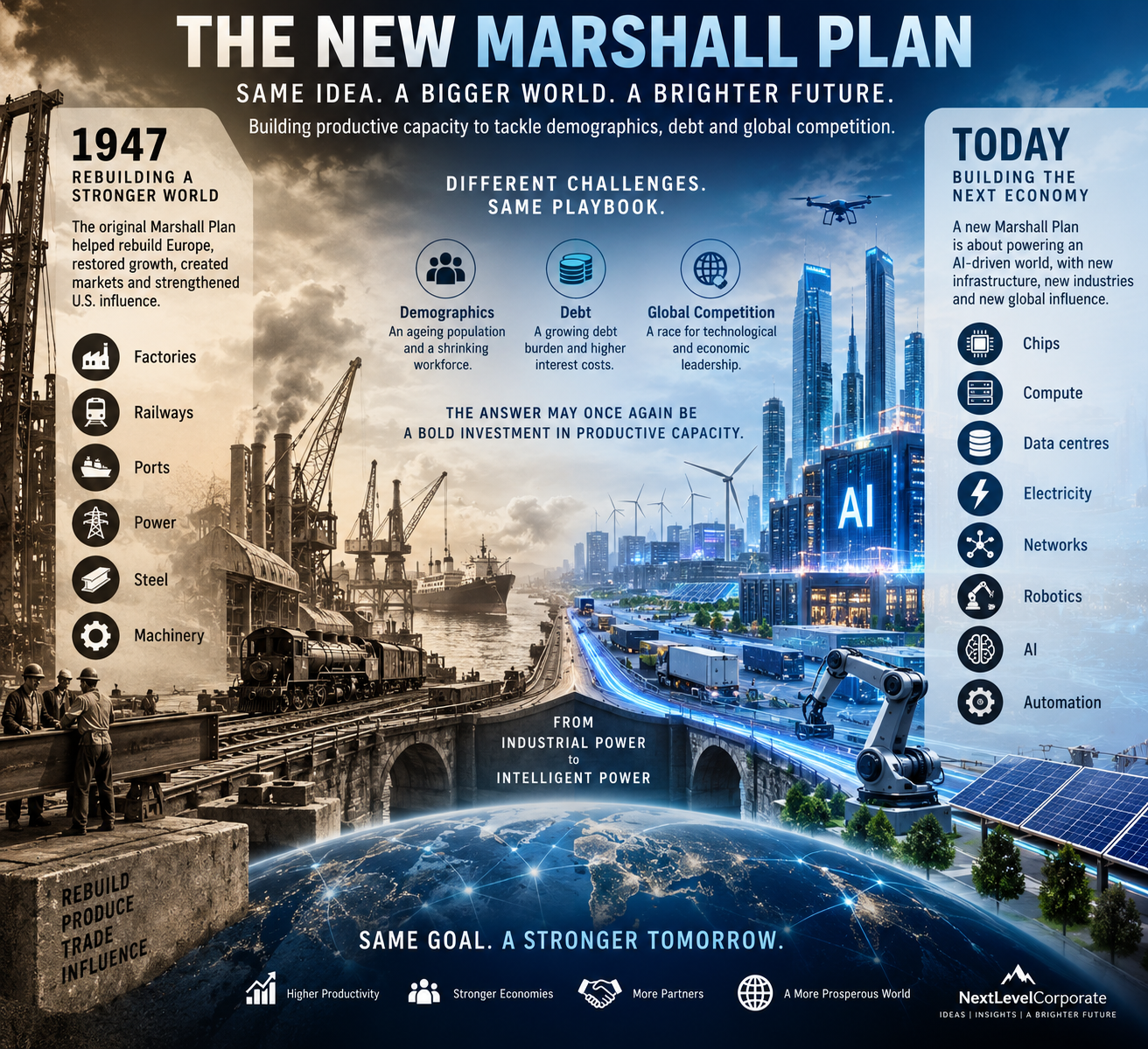
“The New Marshall Plan” Copyright 2026. nextlevelcorporate. nextlevelcorporate prompts, AI generated image.
The scale of this build out is already extraordinary.
OpenAI's Stargate project announced plans for up to US$500 billion of AI infrastructure investment over four years. Anthropic has announced US$50 billion of investment in domestic AI infrastructure.
Across the technology industry, hyperscalers are committing just under $1 trillion this year, and just over $1 trillion next year to data centres, chips and associated infrastructure.
America is simultaneously pursuing policies designed to accelerate domestic AI development, infrastructure investment, semiconductor production, energy availability, stablecoin regulation, and technological leadership.
Looked at individually, these are technology bets. But together, they start to resemble something much larger.
An industrial policy for the age of machines.
And there are two very good reasons for the White House to want to win this race and reject Anthropic. OpenAI and Elon Musk’s recent calls to “regulate us”.
One is to cover the debt burden cost that we’ve already discussed, and the second has to do with one very old and wise dragon.
China tokens
China has made no secret of its ambition to become a technological superpower.
It has enormous manufacturing capacity, a huge domestic market, significant investment in AI, robotics, batteries, electric vehicles, industrial automation and advanced manufacturing.
The competition therefore is not simply about ideology, or which country produces the best chatbot.
It is about who controls the productive technologies of the next economic era.
Who builds the chips?
Who controls the compute?
Who produces the robots?
Who generates the electricity?
Who manufactures the machines?
Who controls the critical minerals and processing?
Who owns the software?
Who builds the factories?
And ultimately, who captures the productivity gains?
This is why AI has increasingly become a geopolitical issue and the technology stack itself is becoming strategic infrastructure, despite the cybersecurity and “end of humanity” concerns.
I explored this idea earlier in NextPerspective in: "The Next Growth Engine: Geopolitics, Strategy, and Investment".
The central argument was that geopolitics is increasingly shaping where capital gets deployed because factories, mines, processing plants, laboratories and data centres are becoming strategic assets.
The AI race under a Marshall Plan context simply takes that argument several steps further.
Look under the hood of the AI capex boom
But when we look under the hood, something else becomes apparent.
This isn't just about technology companies. The AI build-out is pulling capital into the physical economy.
Data centres need electricity. Electricity needs generation and transmission. Generation requires fuel, equipment and minerals. Data centres require steel, concrete, copper, cooling systems and sophisticated electrical equipment.
Robots require semiconductors, sensors, motors, batteries and advanced materials. Autonomous mines require communications networks, sensors, software, vehicles and processing infrastructure.
This creates a potentially enormous investment multiplier.
But zooming out, we can see that the new economic engine isn't one machine. It is an ecosystem of machines. And that is why the investment opportunity may be considerably broader than simply buying AI companies.
The picks and shovels are literally everywhere.
Investment is not productivity
There is, however, one very large catch to all of this.
Investment is not productivity!
America can spend hundreds of billions of dollars building data centres and buying GPUs without necessarily generating the economic return required to solve its fiscal problem.
But the machines have to produce something. They have to increase output. They have to reduce costs. They have to accelerate innovation. They have to allow businesses to produce more with the same amount of labour and capital. And those gains have to spread through the economy.
This is where the debate becomes much more interesting.
The Federal Reserve has begun openly considering AI as a potential new factor of production.
In his August 2026 Jackson Hole speech, Kevin Warsh described AI in precisely those terms and raised the central question: will the enormous investment in AI infrastructure ultimately generate a sustained increase in productivity?
That is the trillion-dollar question.
Because if the productivity gains arrive, the investment could be transformative.
If they don't, America could simply end up with an enormous amount of expensive infrastructure sitting underneath an even larger mountain of debt.
So far, this is what sellers of long-Treasuries think. If they thought different, long-term Treasury yields would be rolling over, not spiking over 5%.
The TIFFIT QE Infinity train to nowhere
I have been writing about the QE Infinity train to nowhere since 2009.
The metaphor is simple. The U.S. financial system keeps finding ways to create the liquidity required to finance an ever-growing mountain of government debt. The Infinity train keeps moving because the debt has to be issued, financed, refinanced and serviced.
But over time, I began to see that the train driver/engineer was changing.
In 2024, I started developing what I called TIFFIT. Treasury Is Fed, Fed Is Treasury.
TIFFIT was my theory for explaining how Treasury was becoming the dominant fiscal partner in a coordinated game with the Fed, the monetary gatekeeper.
My thesis was that the Fed was progressively getting out of the way for Treasury to drive the Infinity train. Partially because the Fed’s QE was on the nose, and partially because Trump wants to be in de-facto control of the Fed, via the Treasury Secretary.
Over time, the evidence has increasingly supported that view, and my theory was confirmed as reality in April during Kevin Warsh’s confirmation speech.
Since then, Treasury has taken a much more active role in managing the financing environment, while the Fed has increasingly positioned itself around the system rather than directly driving it.
Thus, my train is now called the TIFFIT QE Infinity train to nowhere. Catchy, right?
Well, catchiness aside, the financial plumbing has developed multiple ways of supporting Treasury issuance and market liquidity without necessarily calling it QE. In fact, the logs that are thrown into the Infinity train’s boiler can take many different forms, as I wrote last week in: The Treasury Market Is the Load-Bearing Wall of the Global Financial System:
Quantitative easing (QT).
Quantitative tightening (QT).
Discount Window.
Repo facilities and Reverse Repo (RRP).
Treasury General Account (TGA).
Treasury buybacks.
Reserve Management Program (RMP).
Bill issuance.
Changes to bank capital rules.
eSLR.
Central-bank liquidity facilities.
Asset purchases.
Yield-curve management (YCM).
Direct yield-curve control (YCC).
Multiple new acronyms about to arrive at a train station near you.
Not QE, QE. Different mechanisms. Same Train. New driver with:
Same eventual effect on the money supply. Expansion.
Same effect on assets prices denominated in debased dollars. Higher.
Thus, we end up with the TIFFIT-QE Infinity train to nowhere which keeps taking on new acronyms because the system has to keep financing new debt, refinancing maturing debt, and servicing the combined debt carrying burden that’s running at ~6% of GDP every year, on top of an economy that’s only growing at one quarter of that rate. Yikes.
I have written about this evolution in “TIFFIT Confirmed! Kevin Warsh Read My Article”, where I argued that Treasury had become increasingly central to the systemic liquidity function while the Federal Reserve was moving into a supporting role.
So, the first half of our story is the Train. The Train carries the debt. And the Treasurer is driving it. The Fed Chair now sits in the fireman's seat, reading the newspaper, waiting to be called on when the system needs the monetary brakes, the liquidity throttle, the balance sheet or the pretence of dealing with that cyclical scourge — 3% to 4% consumer price inflation.
Meanwhile, Treasurer Bessent throttles the liquidity belching beast up and down hills and around mountains, expanding the money supply and stoking the only inflation that really matters, secularly embedded money supply expansion of at least 8% per annum. CPI is the political gaslight that obscures money supply expansion, which is real inflation.
Still, something new is being built alongside those rails. A new productive system of agentic AI, robotics, automation, autonomous systems and advanced machines.
I call it the Machines.
And this is where the story gets really interesting. Because the bet is no longer simply that the Train can keep running despite what’s happening at the long end of the yield curve. Nope, the bet is that the Machines can grow the economy fast four times as fast so productivity can outrun the QE Infinity train to nowhere.
Read that again 👆
Bessent and Warsh are betting they can use agentic AI to short the debt stack.
But I have a question.
Can the machine outrun the TIFFIT QE Infinity train to nowhere?
This is the real question.
America does not necessarily need AI to replace every worker. It needs AI, robotics and automation to increase the productive capacity of the economy sufficiently to change the debt mathematics.
Remember the denominator. At ~123% debt-to-GDP, America's debt burden is enormous relative to the economy supporting it.
If interest rates remain elevated, the economy needs four times current nominal growth of 1.5% simply to stay ahead of debt formation that costs 6% per annum to carry in the Infinity train and prevent the debt ratio from deteriorating further.
And America is nowhere near the kind of real growth that would make that problem disappear through growth alone. Real GDP grew at only 1.5% annualised in the second quarter of 2026. One quarter of the growth pace required.
It is a long way from the sort of sustained productivity acceleration required to transform the fiscal trajectory.
So, the question becomes: Can machines create the missing growth?
Not next quarter. Not next year. Over a decade.
That is a much bigger question than whether Nvidia, Microsoft, OpenAI or any other individual AI company is overvalued.
It is a question about the productive capacity of an entire economy.
The machine economy
There is a potentially fascinating feedback loop here.
More AI investment creates more productive machines. More productive machines create more output. More output creates higher GDP.
Higher GDP improves the debt-to-GDP ratio. Higher productivity can increase corporate profits and wages. Higher profits generate more internal revenue and investment.
More investment produces more machines. More machines create more productivity.
And the cycle compounds.
That is the optimistic scenario. It is essentially a new economic flywheel. It is far from certain. And it could be convenient narrative for a big talking, slow to deliver Administration, let’s be real.
But there is another possibility. AI investment requires enormous amounts of capital, and that capital competes with government borrowing. If government deficits remain enormous while AI infrastructure investment explodes, both can push demand for capital higher.
That can put upward pressure on interest rates. Higher interest rates increase the cost of government borrowing. Higher borrowing costs increase the debt burden.
And the Infinity Train gets heavier and requires more fuel, i.e., liquidity, to go faster and wallpaper over productivity gaps. This is the paradox. It’s probably also why the long end of the curve thinks the Treasurer is living in a Walt Disney inspired castle.
In short, the investment required to build the Machine could initially make the Train harder to outrun and if productivity doesn’t show up quick enough, the reinventive 1940s turn into the stagflationary 1970s.
The investment thesis
This is why I think the investment story is much broader than AI software and the so-called AI bubble.
If the machine economy is real, the opportunity sits across the entire productive stack. That means Semiconductors. Compute. Data centres. Electricity. Transmission. Cooling. Networking. Robotics. Industrial automation. Advanced manufacturing. Cybersecurity. Critical minerals. Copper. Iron ore. Uranium. Natural gas. Engineering. Mining technology. Autonomous systems. Industrial software. And the companies that provide the infrastructure allowing all of those systems to work together.
This is particularly interesting for Australia.
Australia has many of the ingredients required by the new industrial system. Energy. Minerals. Land. Engineering expertise. Mining capability. World-class resource companies.
And a growing technology ecosystem capable of automating some of the world's most difficult industrial environments.
Best of all, Australia doesn't need to win the AI model race to benefit from the machine economy. It can supply the physical foundations beneath it. That could become a very important strategic advantage.
But we do need a pro-innovation and pro risk-taking government. One that’s willing to reform institutions. One that knows how to push down the accelerator to create more golden eggs, instead of over-taxing the goose until its neck snaps.
But there is a bigger problem
There is one enormous assumption sitting underneath this entire thesis.
Productivity must actually show up!
The Congressional Budget Office estimates currently imply a relatively modest contribution from AI to productivity over the coming decade. Somewhere between negative and 0.3% of GDP. Other estimates are considerably more optimistic, like the 1% to 1.5% predicted by Goldmans and McKinsey.
But the ranges and gap in agendas are enormous, and history tells us that general-purpose technologies often take much longer to diffuse through an economy than inventors, investors and politicians expect.
Electricity did not transform every factory overnight. Computers did not immediately produce spectacular productivity gains. The internet took years to restructure entire industries. In fact, normally there is a boom and then a collapse before a second adoption cycle happens.
AI could be different. Anthropic’s never before seen revenue growth might be evidence of that.
But it could also take longer than the market currently assumes.
There is another problem. Productivity growth creates winners and losers.
If machines substitute for labour faster than new industries absorb displaced workers, political pressure will rise. And if the benefits flow disproportionately to capital owners, inequality could increase. Just like with QE, something that prior Fed Chair “pop your collar” Janet Yellen was known for championing, even when she was in office. And compared to Bernanke and Powell, she walked her talk and printed almost nothing onto the balance sheet.
Back to the point. If AI increases demand for electricity faster than generation and transmission can be built, energy becomes a constraint. If critical minerals become scarce, supply chains become a constraint. If governments respond with excessive regulation, taxes or protectionism, deployment could slow. And if the AI build-out turns out to have been over-investment, the economic consequences could be devastatingly significant.
Machines, therefore, have to do more than exist. They have to eventually show up to earn their keep.
The Treasuries market is not convinced, and the equities market rotates with the narrative of the moment.
A new Marshall Plan for a different world
This is where the historical analogy comes full circle.
The original Marshall Plan rebuilt the physical foundations of a devastated Europe.
The emerging American strategy is potentially doing something different. It is rebuilding the productive foundations of the next economy.
The scarce resources are no longer simply bricks, steel and railways. They are compute, chips, electricity, data, robotics, networks and the physical infrastructure required to connect them.
And the strategic objective is no longer simply rebuilding Europe. It is maintaining American technological leadership in a world where China is racing to become a technological superpower and to never return to the days of western imperialism. And secondarily, it could help slow the QE Infinity train to nowhere.
The original Marshall Plan helped create markets for American products while strengthening America's geopolitical position. A successful American AI build-out could do something similar on a much larger and more global scale.
If American companies develop the dominant AI models, chips, cloud infrastructure, software and robotics platforms, those technologies can be exported around the world.
The result would not simply be higher U.S. productivity. It could extend American economic influence through the infrastructure of the next industrial era.
That is why the New Marshall Plan analogy is interesting. Not because Washington has announced one. But because the pieces of one are beginning to appear.
The great economic wager
I can see a remarkable wager being laid and a new Marshall Plan unfolding, even though I don’t believe for one minute that it was the original intent.
However, there’s no denying America is borrowing on a scale never seen before, while simultaneously investing on a scale rarely seen outside wartime or major industrial transformations.
New debt formation at the private and public level is helping fund the build-out of the Machine economy. Meanwhile, my TIFFIT-QE Infinity train to nowhere keeps taking on fuel, rolling existing debt forward and keeping the system financed because there is insufficient economic productivity to do that heavy lifting.
I believe the bet that has been laid is that the Machines can drive a 1.5% economy fast enough to cover the 6% of GDP fuel cost of the TIFFIT QE Infinity train to nowhere.
If Machines can drive economic growth four times faster, the Infinity Train can eventually slow as productivity creates the economic capacity to carry the debt burden and reduce the need for extraordinary monetary support. If they can’t, the train will need to speed up, once again.
That is the coordinated bet that I believe Trump, Bessent and Warsh have laid for better or for worse.
And that is why this may be one of the most important investment stories of the next decade.
Productivity is no longer simply an economic objective. It is becoming a fiscal necessity. And if the Machines can outrun the Train (big if), we may be watching something much bigger than an AI boom. We may be watching the foundations of a New Marshall Plan. That’s why this may not be a bubble.
As for the debt stack and refinancing risk? Well, Scott Bessent has a lot more work ahead if he is to convince bond investors to hold Treasuries instead of selling them and forcing up borrowing costs. Maybe that’s why citizen Warsh might need to break cover before December and raise the Federal Funds Rate.
Abracadabra.
See you in carriage 5 🖐
Mike

Macro first. Strategy second. Deal third.
An independent corporate development studio, established in Perth in 2001, advising you when — and when not — to do the deal. In 25 years, that discipline has been the difference.
This content is copyright NextLevelCorporate. It is not advice and it is provided for informational purposes only. NextLevelCorporate and logo are registered trademarks. All rights reserved.