
The Treasury Market Is the Load-Bearing Wall of the Global Financial System

“This train rides on global tracks” Copyright 2026. nextlevelcorporate. nextlevelcorporate prompts, AI generated image.
TL; DR
Scott Bessent is driving a train.
And it is a very long train.
It is travelling very quickly, and it is carrying something considerably more important than U.S. government debt.
It is carrying the plumbing of the global financial system.
That may sound dramatic. But follow the money, the collateral and the financing and the architecture becomes surprisingly clear.
At the centre sits the US Treasury market.
Underneath it sits repo.
Inside the repo market sits an increasingly important group of highly leveraged hedge funds.
And beyond the Treasury and repo markets sits the global dollar funding system, the Eurodollar market, international bonds, sovereign refinancing, corporate debt and, ultimately, global trade.
The interesting question is therefore not simply whether the U.S. Treasury can find buyers for the next bond auction.
It is whether the financial plumbing beneath the Treasury market can continue to support the enormous volume of debt that the U.S. government needs to issue and refinance without destabilising the global collateral stack.
And that is where things get interesting.
Start with the hedge funds
The U.S. Treasury market is enormous, but one of its most important characteristics is that the marginal buyer is not necessarily a pension fund deciding that a 10-year Treasury offers an attractive long-term return.
Increasingly, a significant part of the market is made up of highly leveraged relative-value traders.
The Federal Reserve's latest research puts the scale into perspective.
By September 2025, large hedge funds had approximately $4 trillion of gross Treasury exposure, comprising $2.4 trillion of long positions and $1.6 trillion of short positions.
Their gross Treasury exposure had doubled since the beginning of 2023.
Their Treasury holdings had increased from about 4.5% to approximately 8.5% of outstanding privately held Treasuries.
And the hedge funds were financing those positions with approximately $3 trillion of repo borrowing.
Those numbers matter because these are not simply investors buying a bond and putting it in a drawer.
A substantial part of the activity is arbitrage. and the most obvious example is the Treasury cash-futures basis trade.
The hedge fund buys a Treasury in the cash market, finances it through repo and takes an offsetting short position in Treasury futures. If the pricing difference between the two markets is sufficiently attractive, leverage allows the fund to earn a relatively small spread on a very large position.
By September 2025, the Federal Reserve estimated the aggregate basis trade at approximately $830 billion.
That was roughly double its previous peak in early 2020 and represented about 3.5% of outstanding privately held Treasury securities.
The hedge fund therefore does not have to be convinced that the Treasury is a fantastic long-term investment.
It needs the financing, liquidity and price relationship between Treasury cash, repo and futures to remain sufficiently stable for the trade to work.
That’s the key. It means that Treasury demand is partly dependent on the continued functioning of the machinery that finances the buyer.
The machine underneath the Treasury market is repo
This is where the scale becomes remarkable.
The Office of Financial Research now estimates that the US repo market averaged approximately $12.6 trillion of daily exposure in the third quarter of 2025.
Nearly 70% of that exposure, 69.4%, was collateralised by U.S. Treasuries.
That implies roughly $8.7 trillion of repo exposure backed by Treasury collateral.
Repo is not some peripheral corner of finance. It is one of the world's largest short-term funding markets.
And Treasury securities are its dominant collateral.
This creates a circular relationship.
Treasuries provide the collateral. Repo provides the financing. Financing allows leveraged investors to hold Treasuries.
Those investors provide liquidity and arbitrage between different parts of the Treasury market.
And that liquidity helps the Treasury market absorb enormous quantities of government debt.
The system works beautifully when everything is working. The problem is what happens when something doesn't.
The waterfall
Imagine the following sequence.
Inflation remains stubborn.
The market concludes that the Federal Reserve will have to keep policy tighter for longer.
Investors demand more compensation for holding long-duration government debt.
The term premium rises. Long Treasury yields rise. Treasury prices fall.
Volatility increases.
The pricing relationships exploited by leveraged relative-value traders begin to move.
Repo financing becomes more expensive, less abundant or subject to tighter risk limits.
Futures margin requirements can increase.
The value of the collateral moves.
The hedge fund suddenly needs more cash. It begins reducing leverage.
That means selling Treasury positions. Treasury selling puts further pressure on prices.
Liquidity deteriorates.
Spreads widen.
The financing becomes still less attractive.
Other leveraged traders begin reducing positions.
And the process can feed on itself.
This isn't a theoretical construct invented for the sake of an interesting story. We have seen versions of it before.
In March 2020, the Federal Reserve identified the rapid unwinding of hedge-fund Treasury basis positions as one factor contributing to the extraordinary Treasury-market dislocation.
The Fed subsequently had to intervene on a massive scale to restore market functioning.
There is another lesson from September 2019. Treasury issuance and tax payments reduced bank reserves by approximately $120 billion over two business days.
At the same time, there were more Treasuries needing financing and less cash available in the repo market.
SOFR, the key overnight Treasury-repo rate, surged above 5%.
The Federal Reserve intervened with repo operations.
The lesson was remarkably simple:
Treasury issuance can create stress in the funding market that finances Treasury securities.
That is the plumbing.
Now look at the Treasury's embedded problem
The U.S. Treasury has to keep issuing debt. That’s not optional.
The government runs a deficit. Existing debt matures. Interest has to be paid. Maturing debt has to be refinanced. New expenditure has to be funded.
And Treasury therefore has to continuously bring new securities into a market whose capacity to absorb them depends partly on the very financing system sitting underneath that market.
The numbers are substantial.
Treasury currently expects approximately $739 billion of privately held net marketable borrowing in the July–September 2026 quarter, followed by another $628 billion in October/December.
That’s approximately $1.37 trillion of privately held net marketable borrowing across two quarters, before considering the enormous volume of existing securities that must be rolled over.
And the Treasury Borrowing Advisory Committee has already recorded a warning from primary dealers.
Based on current coupon auction sizes and bill supply, the median primary-dealer forecast implied a $1.3 trillion funding shortfall in FY2027–28.
This doesn't mean Treasury cannot borrow the money. Of course it can. But the question is the price and the plumbing required to get it done.
If marginal buyers demand higher yields, the government can pay higher yields.
But higher yields reduce bond prices, increase duration risk and potentially make leveraged Treasury positions less attractive.
And that brings us straight back to repo.
This is why Bessent's job is different from simply selling bonds
Scott Bessent understands this market unusually well.
His career spans decades in global investment management, including senior roles at Soros Fund Management and his own macro investment firm, with a particular focus on currencies and fixed income.
It would therefore be a mistake to think of the Treasury Secretary's job as simply:
Issue bonds. Find buyers. Fund the government.
The Treasury market is a system.
And Treasury is already acting accordingly.
Treasury has a buyback programme designed partly to improve liquidity in older, less liquid Treasury securities.
In August 2026, Treasury announced that it would at least double the size of its liquidity-support buyback operations in the 10–20 year and 20–30 year sectors, from $2 billion to at least $4 billion per operation.
The quantum is noise. The programme is the signal.
Bessent has also explicitly argued that Treasury-market liquidity needs to be strengthened and supported reforms to the enhanced supplementary leverage ratio because it can constrain banks' ability to intermediate Treasuries.
That is revealing.
Because it shows Treasury is not looking at the bond market in isolation.
It is looking at the intermediation capacity surrounding the bond market.
And then the story gets global
So far, this is a story about U.S. Treasuries, repo and hedge funds.
But the Treasury market does not sit at the top of the financial system.
It sits at the centre of something much larger.
The dollar.
The BIS estimates that, at the end of March 2026, there was approximately $14.7 trillion of US-dollar-denominated foreign-currency credit to non-bank borrowers outside the U.S.
That includes bank lending and international bond financing.
It was growing at 7.3% annually.
But that is only the visible part of the offshore dollar system.
Then there is the much larger derivative layer.
At the end of 2024, approximately $111 trillion of FX swaps, forwards and currency swaps were outstanding globally. Roughly 90% had the dollar on one side.
More than three quarters had maturities of less than one year.
These aren't simply speculative derivatives. The BIS describes FX swaps as economically similar to collateralised borrowing.
A European pension fund, for example, can effectively borrow dollars against euros to obtain dollar assets while hedging the currency exposure.
And the BIS says these instruments have become an important mechanism through which global investors access sovereign bond markets, including US Treasuries.
So now we know what freight is being loaded into the Infinity Train.
Treasury collateral, Repo, Leveraged intermediaries, dollar liquidity, offshore dollar funding, international bonds, sovereign debt, corporate debt, global trade.
The Treasury market is therefore not simply a US funding market.
It is a foundational component of the global dollar system.
The Eurodollar market is where the consequences travel
This is why the Eurodollar market matters.
The old definition of the Eurodollar market was essentially offshore dollar deposits.
The modern system is far broader. It encompasses the offshore dollar credit created through international banks and bond markets, alongside the enormous network of repo, FX swaps, forwards and other forms of dollar funding.
And the system has become increasingly dependent on non-bank financial institutions.
The BIS notes that asset managers, pension funds, insurers and hedge funds rely heavily on repo and FX swaps to finance and hedge cross-border bond positions.
It specifically identifies short-term dollar funding and rollover risk as potential sources of stress.
This is why a Treasury-market problem does not necessarily remain in Washington.
If Treasury liquidity deteriorates badly enough, the consequences can travel through the dollar funding system.
Dollar funding becomes more expensive. FX swap costs rise. International bond yields reprice. Banks face higher funding costs.
Corporations face higher borrowing costs. Sovereigns face higher refinancing costs.
And countries that have borrowed in dollars have to find more dollars to service and refinance those obligations.
The final transmission mechanism is not a bond trader.
It is the real economy.
Trade. Investment. Capital expenditure. Commodity financing. Government refinancing.
And this is where TIFFIT comes in
This is also why the TIFFIT thesis becomes much more interesting.
As my readers know, TIFFIT is my acronym: Treasury Is Fed. Fed Is Treasury.
Not literally in the sense that Treasury and the Federal Reserve remain separate institutions with different mandates and legal powers, but the Fed today is subservient to the Treasury.
While the Fed controls monetary policy and the supply of central-bank reserves, Bessent’s Treasury controls fiscal financing and debt issuance.
And for every move the Fed makes, Treasury has tools to counteract the effects, if it doesn’t like it.
And the architecture of modern finance has made their functions increasingly interdependent.
Treasury issues the collateral. The financial system uses that collateral to obtain financing.
The Fed is responsible for the monetary plumbing that keeps the funding system functioning.
And when the Treasury market becomes sufficiently important to the funding system, the contrast between fiscal and monetary plumbing becomes increasingly difficult to maintain in practice.
That is what TIFFIT addresses.
The TIFFIT QE Infinity train to nowhere
This is also why the TIFFIT QE Infinity train to nowhere does not (cannot) really stop, which is why it goes nowhere, in an infinity loop.
The Infinity train does not always run on conventional QE.
In fact, the logs that are thrown in the train’s boiler take many different forms:
QE/QT.
Discount Window.
Repo facilities.
Treasury buybacks.
Reserve Management Program.
Bill issuance.
Changes to bank capital rules.
eSLR
Central-bank liquidity facilities.
Asset purchases.
Yield-curve management.
Direct yield-curve control.
The instrument can change. The underlying requirement does not.
The financial system needs Treasury collateral to remain liquid and financeable.
That is why the Fed intervened in September 2019 when repo markets seized.
It is why the Fed intervened on an enormous scale during March 2020.
And it is why Treasury is now paying increasing attention to market liquidity, dealer balance sheets, repo capacity and the marginal demand for long-duration securities.
The logs keep going into the boiler because the train cannot simply stop.
Not without risking the plumbing that sits underneath the global dollar system.
So what is Bessent actually driving?
This brings us back to Scott Bessent.
He is not merely driving a train loaded with Treasury bonds.
He is driving a train loaded with Treasury issuance, Treasury collateral, repo, hedge-fund leverage, Treasury liquidity, dollar funding, Eurodollars, international debt, sovereign refinancing, corporate funding and global trade.
It’s the TIFFIT QE Infinity train to nowhere and it is circling the planet on interconnected global rails.
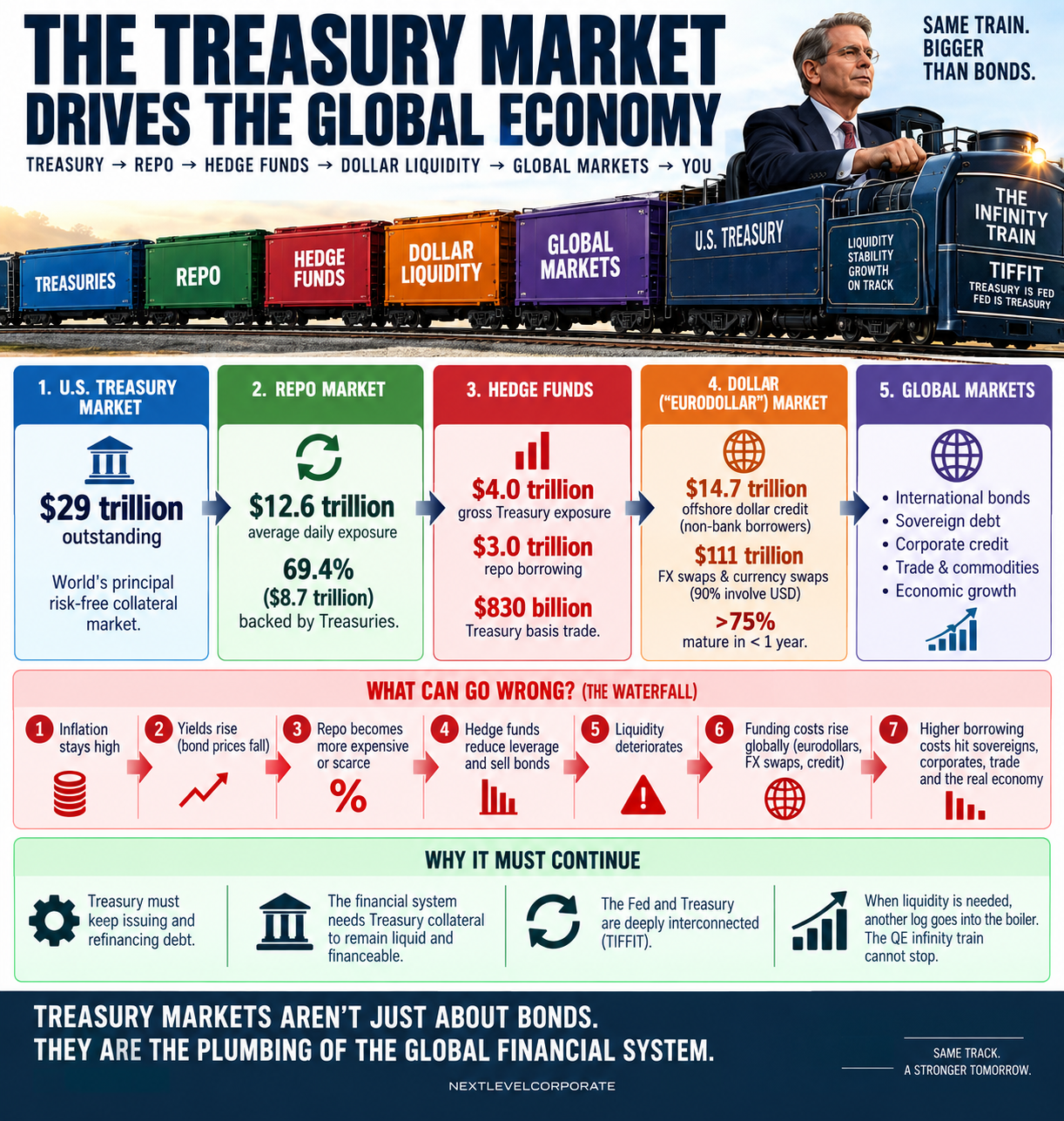
“The TIFFIT-QE Infinity Train to nowhere.” Copyright 2026. nextlevelcorporate. nextlevelcorporate prompts, AI generated image.
And now the numbers begin to make sense together.
$4 trillion of hedge-fund Treasury exposure.
$3 trillion of hedge-fund repo borrowing.
$830 billion of basis trades.
$12.6 trillion of US repo exposure.
~$8.7 trillion of that repo backed by Treasuries.
$14.7 trillion of offshore dollar credit.
$111 trillion of FX swaps, forwards and currency swaps.
And approximately $1.37 trillion of expected Treasury net marketable borrowing in just the final two quarters of 2026.
These numbers should not be added together because they represent different layers of the same system, and that is precisely why they matter. They are not a $150 trillion pile of interchangeable debt.
They are the stack.
And the stack is interconnected, globally. That’s because the train runs on interconnected global rails that are the single most critical piece of financial plumbing on this planet.
So, the next time someone asks who is going to buy the next U.S. Treasury bond, the answer is not simply hedge funds, pension funds, banks, foreign governments or domestic investors.
The more important question is:
Who will finance the buyer?
Because if the financing mechanism stops working, the Treasury market can discover very quickly that liquidity is not the same thing as solvency.
And if Treasury liquidity becomes a global dollar-liquidity problem, the consequences don't stop at the U.S. border.
The Infinity train is global, and the rail network runs through the Eurodollar system. Into sovereign debt. Into refinancing. Into corporate credit. Into trade. And eventually into the real economy.
Abracadabra.
See you in carriage 5 🖐
Mike

Macro first. Strategy second. Deal third.
An independent corporate development studio, established in Perth in 2001, advising you when — and when not — to do the deal. In 25 years, that discipline has been the difference.
This content is copyright NextLevelCorporate. It is not advice and it is provided for informational purposes only. NextLevelCorporate and logo are registered trademarks. All rights reserved.