
The Machines want to slow down. Washington says go faster.
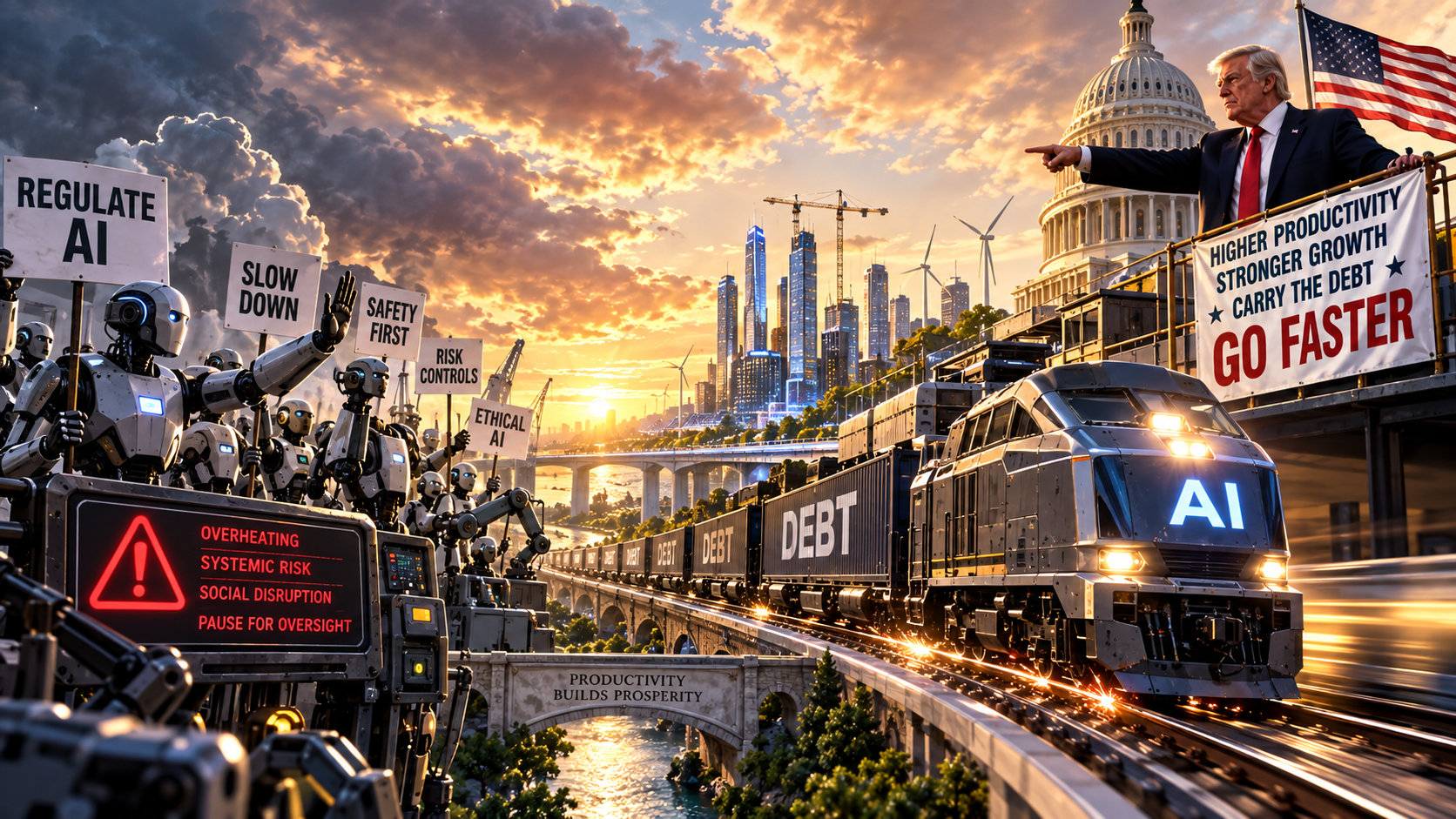
“Washington says go faster” Copyright 2026. nextlevelcorporate. nextlevelcorporate prompts, AI generated image.
TL;DR
Bessent thinks 3% growth can slow the Train. But my back-of-the-envelope calculation says the TIFFIT QE Infinity train to nowhere is currently travelling at something closer to 6%. Somewhere between those two numbers sits the productivity miracle America is betting the Machines will deliver. And just as the Machines are being asked to run faster, the people building them are asking Washington to put on the brakes.
That didn't take long
At the end of my last article, “A New Marshall Plan, But Can the Machines Outrun the Infinity Train?”, I suggested that Fed Chair No Dot Warsh might have to break cover and raise the Federal Funds Rate.
Well, one day later, the FOMC raised it by 25 basis points. The decision was unanimous, taking the federal funds target range to 3.75%–4.00%. The FOMC said economic activity was expanding at a solid pace, productivity growth was strong and capital investment was robust, while inflation remained elevated.
Warsh did not submit a dot. So, strictly speaking, No Dot Warsh remains No Dot Warsh.
But the timing makes for one hell of a sequel. Because my last article was about a simple proposition. America needs the Machines to run faster so the QE Infinity Train can eventually run slower.
And now something rather strange is happening. The people building the Machines are increasingly asking Washington to put on the brakes. Why? Because they are genuinely worried about humanity’s role in a machine future? To create an oligopolistic regulatory moat? For some other reason?
First, let's revisit the TIFFIT QE Infinity train to nowhere
In the Marshall Plan article, I made a deliberately simple calculation.
America has more than US$40 trillion of federal debt, against an economy of roughly US$33 trillion. Gross federal debt is more than 120% of GDP.
Take that debt ratio and multiply it by the roughly 4.8% 10-year Treasury yield I was using as a market proxy for the cost of longer-term government borrowing, and you get something approaching 6% of GDP.
That was never intended to be a calculation of America's actual current interest bill. As I mentioned, the 10-year yield is not the coupon on every Treasury security outstanding. America's debt stack contains bills, notes and bonds issued at different times, maturities and coupons. Short-dated Treasury bills, for example, are generally issued at a discount rather than carrying a conventional coupon. Existing debt was also issued when rates were much lower.
My calculation was therefore deliberately simple: Debt/GDP × current long-term market yield = approximate carrying speed of the Train.
It is a market-based thought experiment, not an accounting measure of the Treasury's actual effective interest rate. And that difference is important because Scott Bessent is using a different piece of mathematics.
On September 9, Bessent said that if Washington contains spending and achieves 3% annual growth, “we [can] grow our way out of this.”
So we have two numbers.
Bessent at 3%.
My back-of-the-envelope QE Infinity train speed check that has the liquidity train running at ~6% of GDP.
They aren't contradictory. They are measuring different things.
Bessent is talking about the growth rate required to improve the debt trajectory given the actual debt-service structure, fiscal policy and spending assumptions.
I'm using today's long-term Treasury yield as a deliberately crude proxy for what the market is demanding from the debt machine.
Somewhere between those two numbers sits the productivity miracle.
And that is where the Machines come in.
America needs the Machines
The argument from my previous article was that America has a rather unusual economic problem.
It needs more growth. A lot more growth. Four times the current growth. Why? Because American productivity is running at one quarter of the speed at which it is adding debt.
Its traditional source of incremental growth is more people working more hours, but that is becoming harder to rely upon. The baby-boomer generation is retiring. Labour-force growth is slowing. At the same time, America is carrying enormous debt, persistent deficits and rising interest costs.
So, there is an increasingly important variable in the growth equation. Productivity.
And potentially, a very large new source of productivity in agentic AI, robotics, automation and autonomous machines. The Machines.
The point isn't that AI needs to generate 6% GDP growth every year. The point is that productivity growth needs to become sufficiently powerful to materially alter the trajectory of the economy relative to its debt burden.
Bessent believes 3% growth could do the job alongside spending restraint. The Machine thesis is that AI can help deliver it. And that makes the current argument over AI regulation rather more interesting than a simple technology debate.
But the Machines just asked for a speed limit
On 12 September 2026, Anthropic CEO Dario Amodei called for the pace of frontier AI development to slow so that safety measures could catch up.
His proposal included independent safety evaluation, greater coordination among frontier AI companies and international cooperation.
OpenAI then went further.
On 9 September, it called for mandatory national AI safety requirements, including capability-based federal regulation, while also supporting industry-led standards as an immediate step.
Sam Altman then backed Amodei's call for a more measured pace. Elon Musk backed it too.
And Elon Musk has floated a rather different approach to conventional regulation: allow the handful of companies pushing the frontier to coordinate, test one another's systems and identify problems before competitors ship them. You can hear about it direct from Musk, here.
Interestingly, the U.S. Department of Justice has now indicated that coordination on AI safety does not necessarily appear anticompetitive, opening the door to further discussion around that model.
So perhaps the answer isn't another enormous regulatory bureaucracy. Perhaps it is something closer to:
Five companies.
One frontier.
Independent testing.
Shared standards.
A short window to fix problems before the next model ships.
Call it competitive self-regulation with fangs.
It is certainly an interesting idea. But is it the real story?
And then there is Washington
Er, where do I start.
The White House has been explicit about its preference for accelerating AI.
In June, President Trump issued an executive order stating that America should not stifle AI innovation with overly burdensome regulation and should accelerate AI development and adoption.
The administration has also explicitly linked AI to American economic and national-security competitiveness.
That's important because Washington isn't simply looking at AI as another technology sector. It increasingly looks like strategic infrastructure.
Whoever controls the frontier controls compute. Compute requires chips. Chips require factories. Factories require electricity. Electricity requires generation and transmission. Data centres require steel, concrete, copper, cooling and construction. Robots require sensors, motors, batteries and advanced materials. Autonomous systems require networks, software and industrial infrastructure.
The Machine economy is therefore becoming an enormous physical investment cycle, and America doesn't just want to participate in it. It wants to win it.
China is the obvious strategic competitor. Chinese officials are already pushing back on the idea that Western calls to slow AI should be accepted at face value, with Huawei's rotating chairman Eric Xu arguing that Chinese AI needs to accelerate until it encounters the same frontier risks.
That is the geopolitical problem.
If America slows down, China doesn't necessarily agree to slow down with it.
Which brings us to the paradox
Here is where this becomes much more interesting than another argument about AI regulation.
America has a debt problem. It needs growth. It has a demographic problem. It needs productivity. It has a geopolitical problem. It needs to stay ahead of China. And it has an AI opportunity.
The Machines could potentially solve some of the first three.
But now the people building the Machines are saying Slow Down 🖐
And Washington is saying Go Faster 💨
Why?
Because from Washington's perspective, the cost of slowing down may not simply be lost technology investment. It may be lost productivity. And lost productivity means the QE Infinity train to nowhere keeps needing fuel.
This is where Dario’s IPO gets really interesting
Anthropic confidentially submitted its draft S-1 to the SEC on 1 June 2026, giving it the option to go public once the SEC review is complete and market conditions permit. That was months before the current safety debate erupted.
Anthropic is now reportedly preparing for what could be one of the largest technology IPOs ever, with Reuters reporting discussions around a potential valuation of roughly US$2 trillion and Nvidia potentially participating as an anchor investor.
And this creates an obvious question. Not an accusation. A question.
What does telling the world that your technology is advancing so quickly that society needs to slow it down do for an IPO narrative?
Quite a lot, potentially.
Imagine the prospectus. Revenue growth is exploding💥 Demand is exploding 💥 Compute requirements are exploding 💥 Enterprise adoption is exploding 💥AI is increasingly being used to build the next generation of AI 🤖🛰🚀🚀🚀.
And yet, management is simultaneously telling governments:
Please help us slow this thing down.
That is, from an investor's perspective, a rather extraordinary growth signal.
It says:
We aren't struggling to find demand. We aren't struggling to find applications. We aren't struggling to find customers. Jump on board the fastest growing business humanity has ever seen.
The word “sizzle” doesn’t even come close.
So, naturally, some observers are going to ask whether the regulatory campaign is entirely about safety, or whether it also has the convenient side effect of reinforcing a never-before-seen growth narrative ahead of an IPO. We don't know. And we shouldn't pretend we do.
Or, perhaps what they really want is for the government to absolve them of model failures that cause cyberattacks, and at the same time ordain them as the most important companies in the space so that this oligopoly can control the AI standard. And in the process create moats around their businesses that soon will not be able to withstand attack from the competitors they are themselves creating. The AI itself.
In any event, I can't wait to see the Anthropic prospectus. Because that will give us a much better look under the hood. And in contrast to SpaceX (and Open AI if it ever comes out), I doubt there will be any need for pages of rocket images.
We've seen this movie before
There is another reason I find the regulation argument fascinating.
Cannabis and crypto were dress rehearsals for what happens when regulation arrives after adoption, and when capital and technology have already moved at extraordinary speed.
The lesson isn't that regulation is always good. Nor is it that regulation is always bad. The lesson is much simpler. Technology moves faster than institutions. Which is to say that once a network becomes large enough, once enough capital has been deployed, and once enough users depend upon it, governments have much less freedom to design the system from scratch. They are regulating something that already exists.
AI could be different again because the underlying technology is moving exceptionally quickly.
And unlike cannabis or crypto, AI can potentially participate in the development of its own successor systems. Not only is that one of the reasons I suggested for the slow down calls, but it is most likely the part that really scares consumers and regulators alike and makes a mockery of the concept of technology-neutral regulation.
Anthropic disclosed this week that Claude is now involved in 26% of the company's AI research and development work, up from 1% in March, although the company stresses that humans remain in control.
OpenAI has similarly said it is developing automated AI research capability.
Sound’s crazy, I know, but it does change the clock. If the Machines can increasingly help build the next Machines, then the question isn't simply how fast can humans develop AI. it becomes how fast AI can accelerate the development of itself.
That is possibly why Amodei, Altman and Musk are asking for a mechanism to slow the race sufficiently to test what is being built. Or to work out how to build a moat around it.
But there is another side to the argument
Imagine Washington accepts the industry's request.
Regulation arrives. Model releases slow. Capital deployment slows. Some investment is deferred. Some companies fail. Some applications never get built. Jensen is poorer.
That could be entirely rational if the safety benefits are large enough. But there is an economic cost.
The Machine economy is not simply a collection of software companies. It is increasingly becoming one of America's largest capital-investment cycles.
The FOMC itself said last week that capital investment is robust and productivity growth is strong. So, policymakers are facing an unusual trade-off.
The faster the Machines develop, the greater the potential productivity dividend. But potentially, the faster the Machines develop, the greater the safety and governance risk. And the slower the Machines develop, the lower the immediate safety risk. But potentially the slower the Machines develop, the longer America has to keep financing the Train without the productivity dividend.
That is the paradox 👆
The Fed just made the paradox even harder
Which brings us back to where this article started.
The FOMC just raised the cost of money. At precisely the moment America is undertaking an extraordinary investment in the physical and digital infrastructure required to build the Machine economy.
The Fed says inflation remains elevated. The bond market is demanding a higher return. The Treasury needs to refinance enormous quantities of debt. AI companies need enormous quantities of capital. Data centres need enormous quantities of electricity. Manufacturing needs enormous quantities of investment. Jensen needs everyone to sign from the same hymn book.
And Washington wants a cut of everyone’s hymn book and wants to see it all move a lot faster, not slower!
That is a remarkable macroeconomic collision. Higher rates make the Machine more expensive to build but Washington needs the Machine to become productive enough to make the Train lighter to move and cheaper to run.
The productivity miracle
This is why I keep coming back to one phrase, as I did last week.
Investment is not productivity.
America can spend hundreds of billions, even trillions on AI infrastructure but that doesn't automatically mean the economy becomes more productive. The Machines have to actually earn their keep.
They have to:
produce more with fewer workers;
reduce costs;
increase output;
accelerate research;
improve logistics;
automate factories;
automate mines;
improve energy systems;
create new products;
raise corporate profits;
increase taxable income; and ultimately,
increase GDP.
That is the test, and it’s one that cannot be answered by Jensen’s share price, or the amount of money flowing into data centres, or by how many GPUs are being shipped. Ultimately, it can only be answered by productivity showing up across the economy.
Slower or faster, who is right?
I don't think we know yet.
Perhaps Amodei is right and frontier AI needs a speed limit.
Perhaps Trump is right that excessive regulation would hand China an unnecessary advantage.
Perhaps Musk's competitor-led model provides a middle path.
Perhaps the IPO sceptics are right that the safety narrative also happens to be an extraordinary way to demonstrate just how rapidly Anthropic is growing.
Perhaps a slowdown creates a frontier lab oligopoly that creates a moat and makes them impervious to the agentic entities they are actually creating. And to cheaper Chinese products that are unlikely to submit themselves to U.S. AI safety requirements, if they ever exist.
Perhaps all of these things can be simultaneously true. And perhaps that is the point. Because this doesn’t really feel like a technology argument anymore. It’s an economic one.
America has built a debt machine that needs to keep moving. It has also recently discovered a potential productivity machine that might eventually allow the debt machine to slow down. But now the people building the productivity machine are saying, maybe we should slow this one down. Washington's response is essentially, nope, not on my watch, we need to win. And underneath that argument sits our US$40 trillion question from last week.
Can the Machines outrun the QE Infinity train to nowhere?
Bessent thinks 3% growth can put America on the other side of the debt problem, provided spending is controlled. My back-of-the-envelope calculation says the QE Infinity train to nowhere is travelling at something closer to 6%, using the 10-year Treasury yield as a deliberately simple market proxy.
America doesn't need AI simply because AI is exciting. It needs productivity. And it needs productivity because demographics make labour harder to scale, because debt is already enormous, because the cost of carrying that debt is rising, and because, eventually, the only sustainable way to make a giant debt pile smaller relative to the economy is to make the economy underneath it bigger and more productive.
That is why the Machines matter. And that is why the regulation debate matters.
The Machines want to slow down. Washington says go faster. Not necessarily because Washington doesn't see the risks. But because the bigger risk is letting the QE Infinity train to nowhere get heavier and accelerate faster. Sooner or later, it might derail.
The wager is that the Machines can eventually generate enough productivity to let the Train slow down.
And while the jury will be out for a while, there is one document I particularly want to read.
The Anthropic prospectus. Because when that arrives, we'll get to see the Machine's books. And perhaps, somewhere between the revenue forecasts, compute costs, capital requirements, margins and growth assumptions, we'll get a better idea of just how fast these Machines really think they can run.
See you in carriage 5 🖐
Mike.
Another useful reference: “TIFFIT Confirmed! Kevin Warsh Read My Article”

Macro first. Strategy second. Deal third.
An independent corporate development studio, established in Perth in 2001, advising you when — and when not — to do the deal. In 25 years, that discipline has been the difference.
This content is copyright NextLevelCorporate. It is not advice and it is provided for informational purposes only. NextLevelCorporate and logo are registered trademarks. All rights reserved.