
The age of science non-fiction
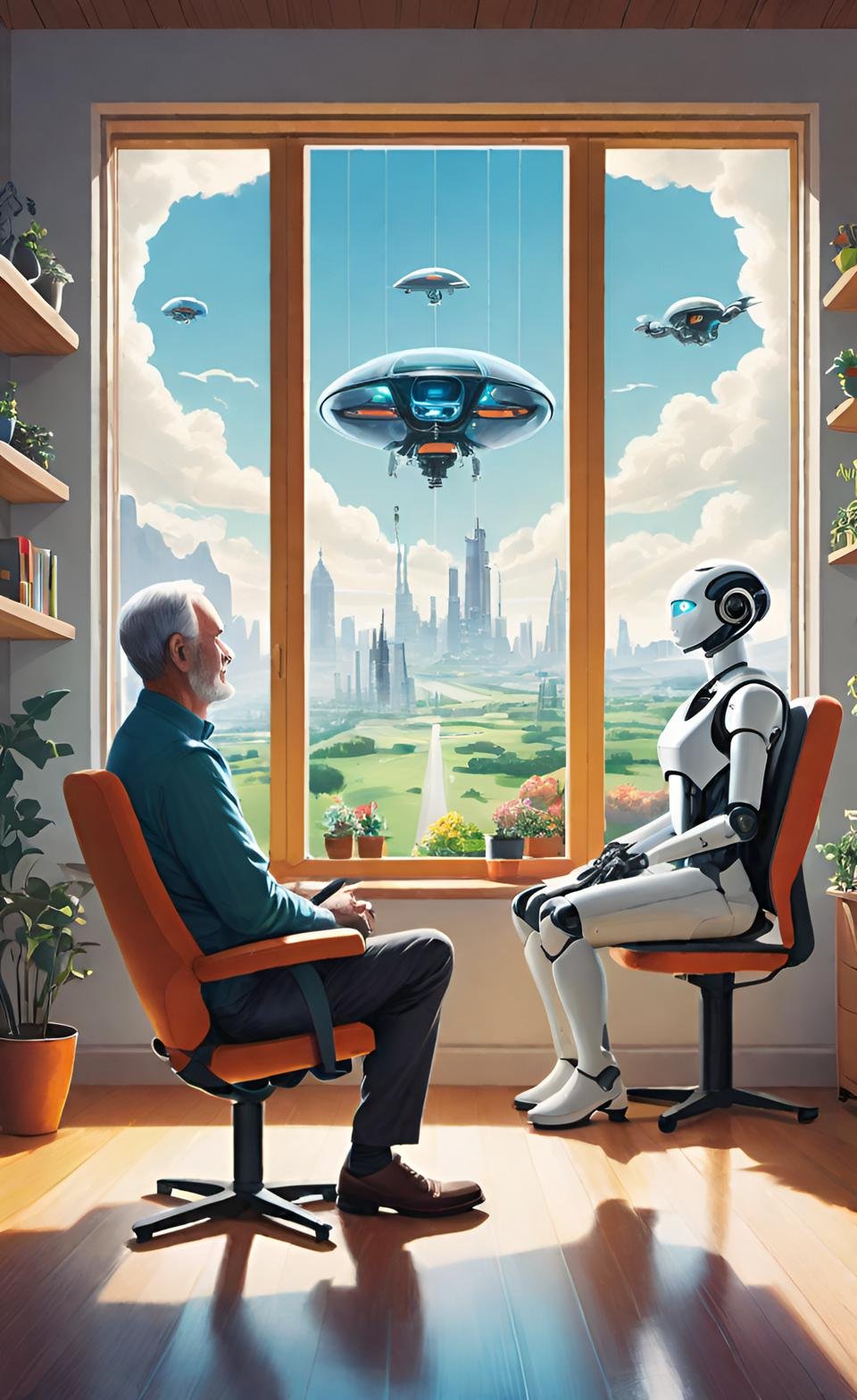
Image generated via Wombo. Prompts by NextLevelCorporate. All rights Reserved.
TL; DR
For most of the last century, science fiction imagined the future.
Artificial intelligence.
Autonomous machines.
Human industry in space.
Programmable biology.
These ideas lived in books, films and research labs.
Today they’re becoming infrastructure.
Reusable rockets from SpaceX have reduced the cost of reaching orbit by an order of magnitude.
Artificial intelligence (AI) systems developed by organisations such as OpenAI and Google DeepMind can generate code, analyse complex datasets and increasingly act as autonomous digital agents.
Advanced robotics platforms from Boston Dynamics are moving from controlled demonstrations into real industrial environments.
The timeline between discovery and deployment has compressed dramatically.
What once took decades now happens within a single investment cycle.
The result is that many technologies once considered speculative are now operational and scaling simultaneously.
The technology curve is no longer made up of one or two marginally overlapping S curves. The curve is now a fully shaded rectangle made up of several short curves touching each other, and all point up to the right.
We are entering an exponential epoch of science non-fiction, densely populated with technologies displaying network effects within network effects.
This is happening at the fastest rate in human history (held back only by energy availability and regulation), and is entering our non-fiction world without having to be imagined by humans.
Spoiler alert: Imagination is no longer required, it’s now outsourced to self-executing agentic code.
For businesses, investors and regulators, there are several implications which we deal with in this note.
The convergence of exponential technologies
We can talk about agentic AI all day, but no single technology explains the seismic nature of the shift that’s underway.
What makes this moment historically unusual is that multiple exponential technologies are advancing and interacting at the same time.
AI is rapidly improving its ability to generate insights, software and autonomous decision-making. Robotics is moving beyond factory automation into logistics, infrastructure and potentially domestic environments. Blockchain is the payment rail of the future and will enable agent to agent payments. Advances in biotechnology are turning biology itself into a personally programmable system.
Meanwhile, new capabilities are emerging in materials science, sensors, and advanced manufacturing.
When these technologies intersect, their impact multiplies. And so does the creative destruction of the old rails.
AI can design new materials and proteins. Robotics can manufacture them at scale. Blockchain based voting and payment systems can replace trust. Sensors and satellites can observe physical systems in real time. Cloud computing infrastructure trains the models that coordinate these processes.
What emerges is not simply faster innovation.
It is a new technological stack capable of compounding its own progress. Network effects within network effects Reed’s Law.
The space layer of the economy
One of the clearest signs of this transition is the transformation of the space sector.
For decades, space was primarily a domain of national exploration programs.
It is now becoming non-fiction, fuelled by an economic layer.
Satellite constellations are providing global communications infrastructure. Earth observation platforms are generating continuous streams of geospatial data. Private launch providers are dramatically reducing the cost of deploying orbital assets.
Companies like SpaceX are enabling entirely new business models based on space infrastructure, while commercial space station projects from Axiom Space signal the emergence of private orbital platforms.
Once infrastructure exists, industries follow.
Space is slowly evolving from the final frontier into a commercial operating environment complete with starships and star gates..
Robotics and the expansion of machine labour
Robotics represents another frontier where science fiction is quietly becoming operational reality.
Industrial robots have long existed in manufacturing, but a new generation of systems is beginning to move beyond fixed factory environments.
Advances in perception, mobility and artificial intelligence are enabling machines that can operate in complex and dynamic environments (including space).
Warehouse automation, agricultural robotics, autonomous mining vehicles and logistics systems are already reshaping labour-intensive industries. Companies like Boston Dynamics and new humanoid robotics programs from Tesla and several Chinese companies illustrate how quickly these systems, including humanoids, are evolving.
The implications are not simply technological.
They are economic and social.
Machine labour introduces a new form of productive capacity that scales differently from human labour.
Governments will have to start to think about how they replace personal income tax revenue with an autonomous tax levied on the income produced by robots and software.
Biology becomes programmable
Another technological frontier is emerging in biotechnology.
Advances in gene editing and synthetic biology are shifting biology from a discovery-based science to an engineering discipline.
Tools such as CRISPR allow scientists to modify genetic systems with increasing precision. AI is now being used to design proteins and biological pathways that would have taken years to discover through traditional experimentation.
Companies lime Ginkgo Bioworks are developing platforms that treat biological systems almost like programmable code.
If this trend continues, entire industries—from pharmaceuticals to agriculture to advanced materials—could be reshaped by engineered biology.
Intelligence as an industrial output
Beneath many of these developments sits a deeper shift.
Intelligence itself is becoming an industrial product or commodity.
AI systems require vast computational resources, specialised semis, memory, cooling, transformation and enormous electricity supply. Data centres designed for AI workloads are now being built on a scale comparable to major industrial infrastructure projects. It is absolutely an Industrial Revolution.
Companies like NVIDIA have become central to this ecosystem because their chips enable the training and deployment of large-scale AI systems, while manufacturers such as TSMC produce the advanced semiconductors required to power them, and Micron produces the sidebar memory chips.
Energy therefore becomes a central constraint.
More computation and inference require more electricity. More electricity enables more computation and inferencing.
This creates a powerful feedback loop: energy enables intelligence, and intelligence accelerates technological development.
Research initiatives like ITER and companies like Commonwealth Fusion Systems are exploring whether entirely new forms of energy generation may eventually support the next phase of computational expansion.
In this sense, the rise of machine intelligence is also a story about energy systems and infrastructure.
The new factors of production
Classical economic theory describes four factors of production: land, labour, capital and entrepreneurship.
While those foundations remain relevant, the emerging technological economy is introducing new strategic inputs.
Compute capacity, large-scale datasets, advanced energy systems and autonomous intelligence are becoming fundamental economic assets.
These new factors interact with traditional ones.
Critical minerals feed almost all of these areas (from electronics solder to the production of permanent magnets) and are shaping today’s geopolitics.
Energy powers computation. Computation produces intelligence.
Intelligence designs new technologies. Those technologies reshape productivity across industries.
The result is an economy where intelligence itself becomes a scalable productive resource that’s value added from a cocktail of natural and artificially intelligent resources and commodities.
Technology and the strategic economy
The implications extend well beyond technology companies.
Frontier models and physical technologies are increasingly shaping geopolitical strategy.
Semiconductors, artificial intelligence, advanced manufacturing and critical minerals have become strategic assets.
Governments are actively investing in technological leadership, while defence innovation ecosystems are accelerating the development of autonomous systems, space capabilities and advanced computing.
Institutions lime DARPA and organisations like the United States Space Force reflect how seriously governments now view these capabilities.
Gene Roddenberry’s legacy is manifesting before our eyes.
Technology is no longer simply an economic advantage. It’s increasingly a strategic one and make no mistake, geopolitics is what’s accelerating the shift from science fiction to science non-fiction.
Economic consequences
For businesses, investors and policymakers, the shift toward a science non-fiction economy carries several implications.
Capital investment is increasingly directed toward technological infrastructure—semiconductor fabrication, AI data centres, robotics manufacturing and energy systems.
Supply chains are being reorganised around resilience and strategic access to key technologies.
Critical minerals like silver, lithium, copper and rare earth elements are becoming essential inputs into electrification, robotics, EV wheel assemblies, wind masts, and computing infrastructure.
Countries with abundant resources, strong institutions and geopolitical wherewithal are likely to play a larger role in this evolving economic landscape.
Australia sits at an interesting intersection of these forces.
Whether we have leadership that’s smart enough to grab these tailwinds while navigating the geopolitical headwinds, is now a question every Australian needs to ask before they vote at the next Federal election.
Living inside the future while it’s being shaped
For decades, science fiction imagined a world defined by artificial intelligence, robotics, space infrastructure and engineered biology.
Today these systems are no longer speculative.
They are being funded, engineered and deployed across the global economy.
AI is generating software and research.
Robotics is entering the workforce.
Space is becoming infrastructure.
Biology is becoming programmable.
The future once imagined in fiction is gradually becoming operational reality.
We are no longer approaching a new technological era that needs to be imagined in an Asimov novel or Lucasfilm.
We are living inside the future as it is being remade, and we’re early in its opening chapters.
See you in the market 👋🏼
Mike

With decades of success across six continents, NextLevelCorporate expertly navigates the intersection of M&A, financial advisory, and business strategy—delivering macroeconomically aligned corporate development strategies, with bespoke transactions that bring them to life.
All content is copyright NextLevelCorporate. NextLevelCorporate and logo are registered trademarks.