
Trust. Regulation. Then Scale. Notes From the Black Swan Summit 2026
Why the exponential technologies touching money play by entirely different rules
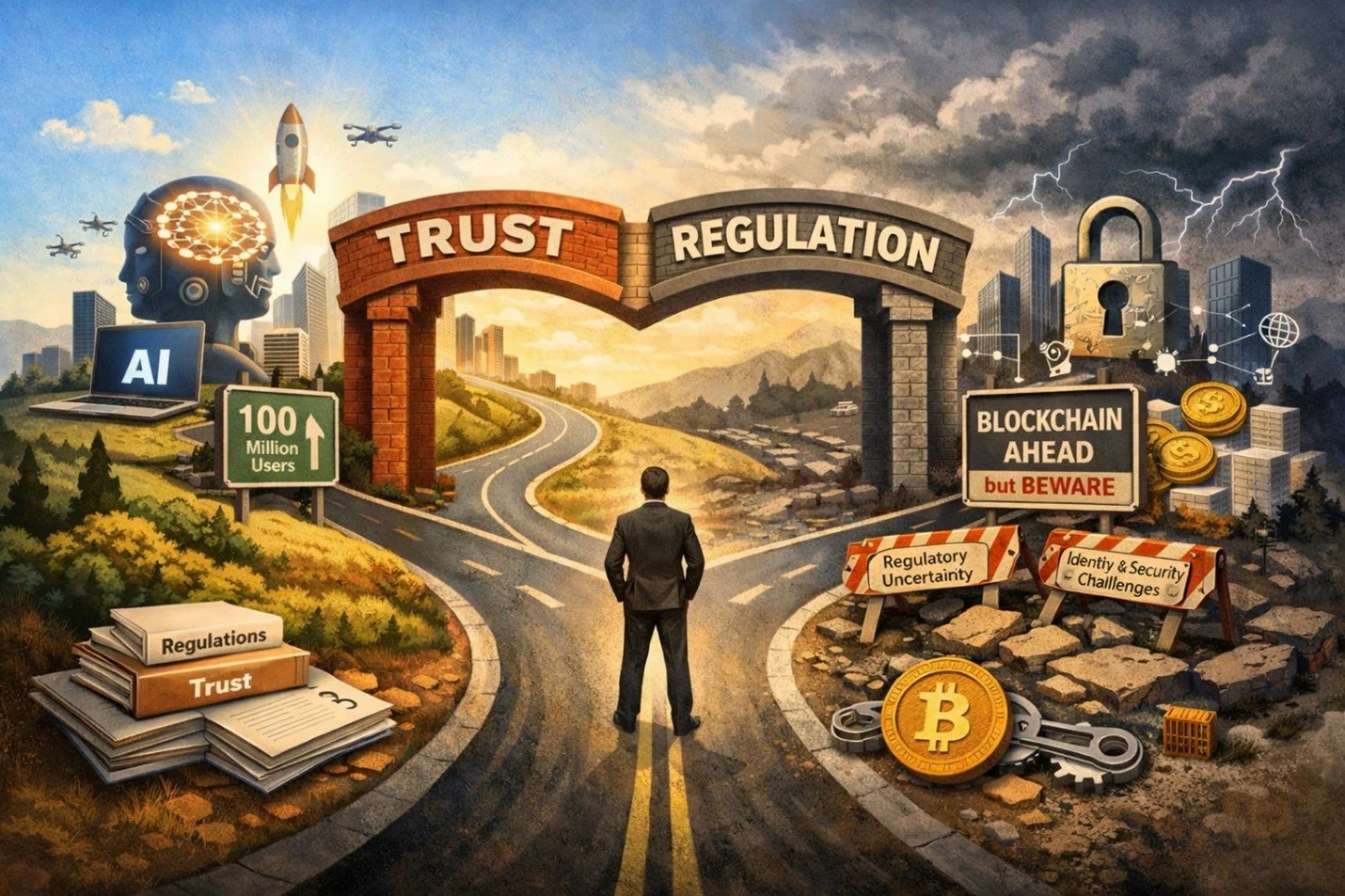
Image generated by AI, prompt by NextLevelCorporate.
Two words that kept coming back
I was sitting in on the third panel of the morning at GFTN's Black Swan Summit 2026, held last week in Perth, Western Australia, when I noticed something.
The speaker had changed. The topic had changed. The technology being discussed had changed. But two words had not. Trust. Regulation.
They came up in the quantum sessions. They came up with particular urgency in the conversations about stablecoins (you can get a refresher here), real world asset tokenisation, and blockchain-based financial infrastructure. Speaker after speaker, from technologists to regulators to project and company promoters, kept circling back to the same underlying question: what does it actually take for a technology to cross from promising to mainstream?
By the end of the day the answer felt unambiguous for stablecoins and certain blockchain based innovations. You can have brilliant technology. You can have a massive addressable market. You can have network effects waiting to compound. But none of it moves at scale and there’s no sense in hoping for liquidity to show up until two things are in place. Trust and regulation.
That insight is what this piece is about. And while I’ve written about these concepts extensively, the words came up so often I felt it was time to revisit trust and regulation, and the most useful way I know to illustrate it is through the sharpest contrast in modern technology.
Specifically, why AI achieved what no technology in history has ever achieved, while blockchain, a genuinely extraordinary technology with enormous potential, is still working its way through barriers that feel almost intractable.
Trust and regulation are not items on a checklist. They are the load-bearing walls of ecosystem adoption for anything touching money, identity, or financial infrastructure.
The chart that frames the adoption conversation
Let me begin with a data point I presented during a WA Innovation Calendar and pitchhawk webinar last year in September. It shows the time taken for technologies to reach 100 million users.
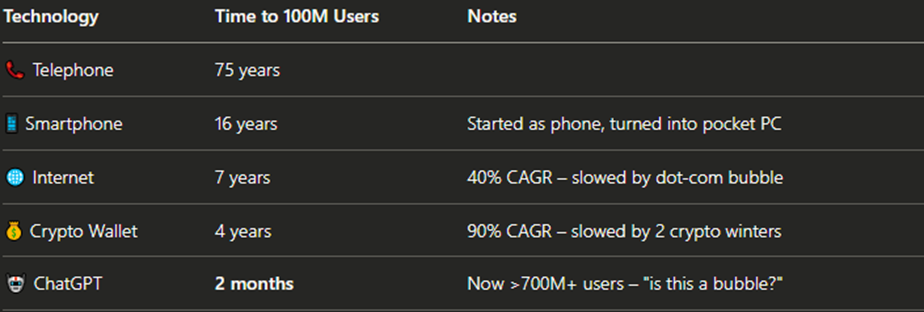
(c) 2026. NextLevelCorporate. Technology adoption curves.
The telephone took 75 years. The smartphone took 16 years, though it began life as a phone and had to reinvent itself as a pocket computer before the curve accelerated. The internet took 7 years, slowed significantly by the dot-com bubble of the early 2000s. Crypto wallets took 4 years, slowed by two brutal crypto winters that wiped out early confidence.
OpenAI’s ChatGPT took 2 months. It had more than 700 million users in September 2025.
That final data point is not just impressive. It’s historically unprecedented. No technology has ever moved from zero to 100 million users that fast. The curve did not just bend. It went vertical.
The obvious question is why. And the tempting answer is that AI is simply a better technology. But that explanation is too simple, and not very useful if you are trying to apply any of this to a business or investment decision. The more useful question is: what structural conditions made that vertical curve possible? And why have those conditions been so difficult for blockchain to replicate?
Why AI bypassed the two hardest barriers
Trust and regulation are not just two items on a checklist. They are the load-bearing walls of ecosystem adoption for anything touching money, identity, or financial infrastructure. And the reason AI bypassed them, at least in its first wave, is not luck or regulatory arbitrariness. It’s something more profound about human psychology.
People were already willing to outsource judgment, creativity, and thinking to tools they did not fully understand or control. Calculators. Search. Google. Autocorrect. GPS. Sensors. AR/VR. We gave up cognitive sovereignty incrementally over decades. Each step felt small. Each convenience felt worth it. ChatGPT did not ask us to make a new kind of trust decision. It asked us to take one more small step on a path we had been walking for thirty years. The trust was already banked.
On top of that, AI arrived framed as a consumer productivity tool in a web browser. It came free. There was no regulatory tripwire. It was not touching your bank account. It was not asking you to transfer assets to a digital wallet. Or to make choices between software and hardware wallets. It was not challenging the architecture of monetary systems or the role of central banks. It was helping you write emails faster and summarise documents. Regulators had no immediate reason to intervene, and by the time they did, 700 million people were already embedded in the product.
Blockchain asks for something categorically different. It asks you to trust a system with your money and your identity, two things that humans are hardwired to protect with maximum vigilance. That is a completely different trust threshold. And without regulatory frameworks that provide recourse when things go wrong, there is no institutional backstop to bridge the gap.
Here is the nuance that matters, though, and that the Adoption Stack you’ll find below tries to capture honestly. Bitcoin's proof-of-work consensus is one of the most battle-tested security architectures ever built. Thirteen years of continuous operation. No successful on-chain hack. A security model that has withstood nation-state level adversarial pressure. The trust within the chain has been earned. What has repeatedly failed is the ecosystem built around it, exchanges, wallets, custodians, and institutions that made promises the protocol itself never made. FTX was not a blockchain failure. Celsius was not a blockchain failure. They were human and institutional failures that happened to involve blockchain assets.
The crypto bro hacks outside the chain are what destroyed mainstream trust. Not the chain itself.
That distinction matters enormously for the investment thesis. It means the trust problem is solvable without reinventing the technology. It requires better regulation, better institutional infrastructure, better digital identity frameworks, and time. The technology is extraordinary. The barriers are structural but not permanent. And those two facts can be simultaneously true.
“ChatGPT did not ask us to make a new kind of trust decision. It asked us to take one more small step on a path we had been walking for thirty years. The trust was already banked.”
What the Summit speakers told us
The Black Swan Summit gave me five voices that crystallised this picture.
One of the most interesting panels was called “Trust under attack”. Dr W. Scott Stornetta of New Jersey based SureMark Digital was on that panel, joining virtually.

Image by NextLevelCorporate. GFTN’s Black Swan Summit, Perth, West Australia, 23-25 March 2026.
By way of background, Stornetta is described as one of the godfathers of blockchain. He co-authored the 1991 paper “How to Time-Stamp a Digital Document”, the work that Satoshi Nakamoto cited in the original Bitcoin white paper (and here’s a refresher on why Bitcoin was so revolutionary).
The fact that someone who helped invent the cryptographic foundations of blockchain was sitting on a panel called “Trust Under Attack” tells you something important about where the industry finds itself thirty-five years later.
But also on that panel was Victoria Richardson of ID Partners (pictured speaking below).

Image by NextLevelCorporate. GFTN’s Black Swan Summit, Perth, West Australia, 23-25 March 2026.
Richardson made the crucial point when she said that “We are still struggling with digital identity.” There is no robust, universally accepted mechanism for proving who you are in a digital environment without relying on centralised intermediaries. That gap, the inability to establish programmatic trust at scale, is a fundamental roadblock on the path to blockchain mainstream adoption. You can’t build a trustless financial system on top of an identity infrastructure that doesn’t work.
Rob Allen of Hedera, speaking on a panel about the tokenisation of real world assets, was direct about the enterprise reality. He said that not one enterprise pilot (and there have been many) has crossed from pilot to production. He cited Project Acacia, the Reserve Bank of Australia's initiative, as an example of promising technology stalled not by technical failure but by the absence of regulatory clarity. The rails are built. The train is ready. The signal is still red.
Kassia Kazmer of Prospex, a start-up focused on tokenising mining royalties, made a point that deserves to be called out separately. Once you have a quality asset class that has been fractionalised and tokenised, she said, it must be made “to fit into a proper framework”. So, while the technology can already do the work, the frameworks are not quite there to receive it.
Kate Cooper of OKX, speaking in the panel on building better money, described the trilemma any digital money system must navigate, namely continuity, accountability when something goes wrong, and evidentiary integrity, i.e., the ability to prove what happened.
Finally, Mark Staples of the Digital Finance CRC returned repeatedly to trust as the foundational precondition for everything else.
Different speakers, different panels, different topics, same two words.
And then there is the regulatory picture. In the U.S., the GENIUS Act and the CLARITY Act are attempting to provide the legal container that stablecoins and digital assets need. One of them remains in Congress awaiting approval. Australia is moving considerably more slowly. The speakers at the Summit were candid about the cost of that lag. Institutional capital does not move into ambiguous regulatory environments. That is not timidity. It’s fiduciary responsibility.
Australia's position is more nuanced than simply being behind. ASIC's INFO Sheet 225 defines stablecoins as financial products subject to existing financial services law. Two AFSLs have been issued for stablecoin issuance to Catena Digital, issuer of the AUDM token, and to AUDC Pty Ltd, issuer of AUDD, which in February 2026 became the first regulated digital Australian dollar authorised for institutional use. A sector-wide no-action grace period runs until June 2026, and transitional relief extends to 2028. But permanent primary legislation, namely the proposed Digital Assets Framework Bill remains in exposure draft. Australia is not absent from the conversation. It’s regulated “in transition” which is precisely the condition that keeps institutional capital cautious. You can build on a framework that exists. But you can’t build long-term infrastructure on one that sunsets in two years and has no permanent replacement yet enacted. As the representative for AUDM correctly noted, liquidity is what is required to support the TAM. We will soon see what level of liquidity surfaces between now and 2028 in light of the current levels of trust and regulation during this no-action grace period.
The Adoption Stack
Sitting with all of this after the Summit, I wanted to build something more systematic than a set of anecdotes. A framework that could be applied not just to blockchain but to any technology evaluation, whether it’s being used for corporate development, startup ideation, personal investing or something else.
I am calling it the Adoption Stack. Twelve dimensions that together determine whether a technology has the conditions for rapid, durable adoption, or whether it is likely to stall, regardless of its underlying technological quality.
I have scored three technologies against it: AI, blockchain, and quantum computing.
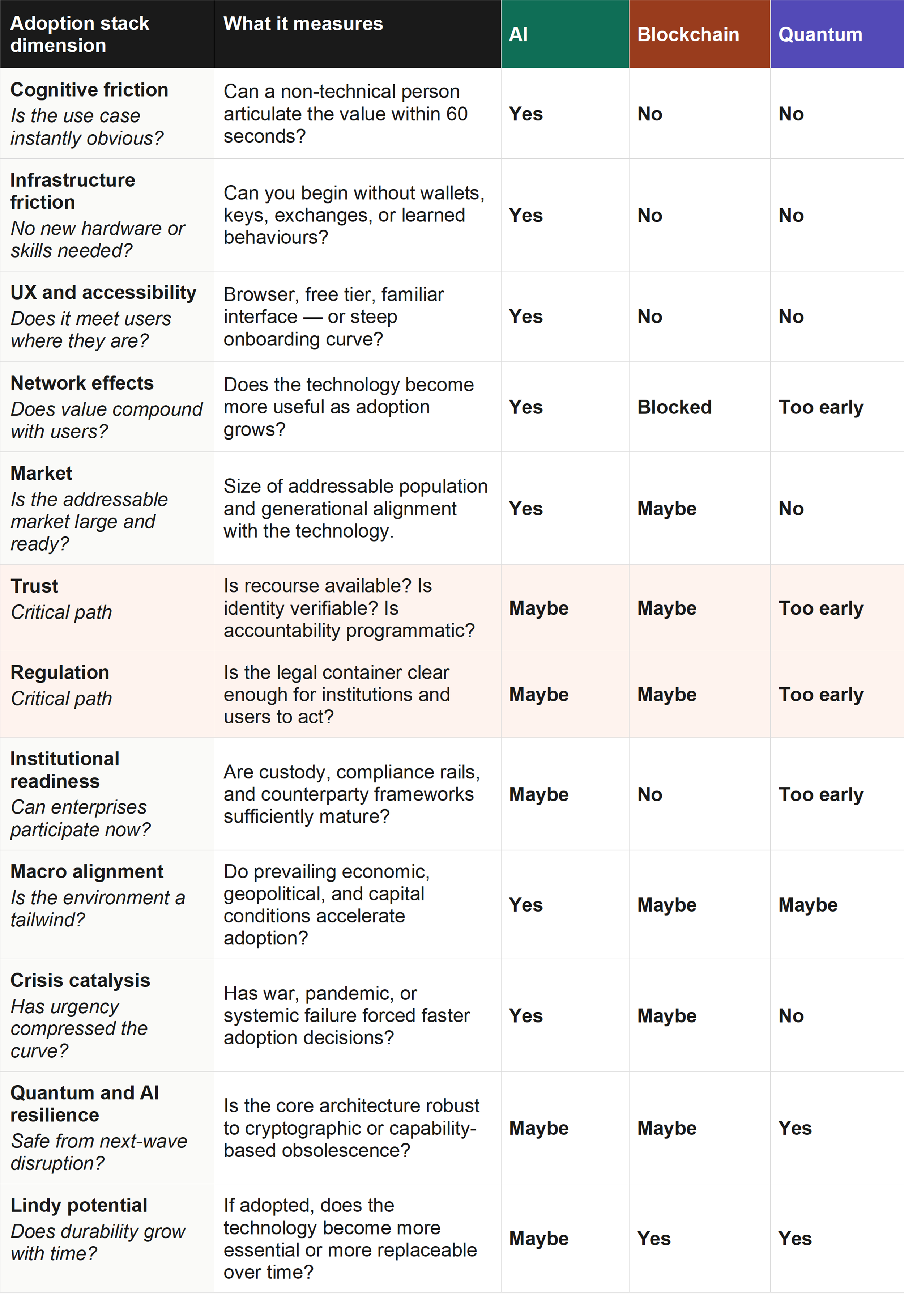
(c) 2026, NextLevelCorporate. Technology Adoption Stack.
Two rows are flagged as the critical path. Trust and regulation.
For any technology touching money, identity, or financial infrastructure, these two dimensions are not just important, they are the ones that hold everything else hostage until they are cleared.
Both score Maybe for blockchain, not No. That’s a deliberate and important distinction. A No would imply stasis. Maybe means progress is real, the direction is right, but we are not there yet. Blockchain's network effects, which are real and potentially enormous beyond what we’ve already seen with early cryptocurrencies, are scored Blocked, not because they do not exist, but because they cannot compound until the critical path scores move from Maybe to Yes.
The trust score deserves particular care. For example, Bitcoin's proof-of-work consensus has earned genuine trust at the protocol level, no successful on-chain hack in thirteen years of continuous operation. The trust deficit lives almost entirely offchain, in the exchanges, custodians, and institutions built around the protocol (as well as the energy drain). The distinction matters because it means the trust problem is solvable through regulation and institutional infrastructure rather than requiring a reinvention of the underlying technology.
The regulation score is also Maybe rather than No because the direction of travel is unambiguous even if the pace is frustrating. MiCA is live in Europe. The GENIUS Act and CLARITY Act are advancing in the U.S. Singapore has clear licensing frameworks. The question is no longer whether regulatory clarity will arrive but when, and whether Australia and other jurisdictions will move fast enough to remain competitive.
AI scores Maybe on both trust and regulation, not Yes. That is deliberate and important. AI's trust deficit is moderate, not zero. There is no meaningful regulation. The opportunity for bad actors to exploit AI at scale, deepfakes, financial fraud, synthetic disinformation, is significant and growing. The difference is that AI's trust problems have not yet manifested at a scale that triggered the kind of systemic loss of public confidence that crypto experienced through scams, hacks, and high-profile rug-pulls and collapses. That could change. And when it does, AI's vertical adoption curve will face its own reckoning.
Quantum scores Too early across most dimensions, which is honest. We do not yet have enough signal to score it reliably. What we can say is that its Lindy potential is sovereign grade. Technologies that become load bearing for national defence, pharmaceutical research, and financial cryptography do not get displaced. If quantum delivers on its promise, it becomes infrastructure in the deepest sense of that word.
Product adoption versus ecosystem adoption
There’s one more distinction I want to draw before I close, because I think it’s the most important idea in this piece and the one most often missed in mainstream technology commentary.
When we talk about ChatGPT reaching 100 million users in two months, we are talking about product adoption. A single product, in a relatively uncomplicated regulatory environment, with near-zero friction across almost every dimension of the Adoption Stack.
When we talk about blockchain adoption, we are almost always talking about ecosystem adoption. And ecosystem adoption is a fundamentally different challenge. It requires not just a compelling product but a complete stack of infrastructure: regulatory frameworks, digital identity systems, institutional custody solutions, legal clarity, and programmatic trust.
Every one of those components has to reach a sufficient state of maturity before the ecosystem can move. The weakest link sets the pace for the whole system.
That’s why the blockchain adoption curve looks so different from the AI curve. It’s not that the technology is inferior. The foundational intellectual contribution, the one Stornetta co-authored in 1991, is extraordinary. It’s that blockchain requires an entire ecosystem to be built, trusted, and regulated before the network effects can continuously compound. AI required almost none of that, because the trust was already there.
The optimism I took from the Summit is that the ecosystem is being built. Regulatory clarity is advancing. Digital identity frameworks are maturing. The conversation has moved from whether (industrial) blockchain will be adopted to when, and under what conditions. That shift in framing matters enormously.
The fastest adoption curve is not necessarily the most valuable long-term position. Sometimes the harder road builds the more durable destination.
A diagnostic lens for your strategy
So, what do you do with the Adoption Stack?
I want to close with the filter that emerged from the smartest people in the room at the Black Swan Summit, synthesised with my own thinking, for anyone evaluating a technology through the lens of corporate development, startup ideation, or personal investing.
Before forming a view on any technology's adoption potential, run it through the twelve dimensions. But pay particular attention to two questions above all others.
First: has the trust been pre-banked? AI benefited from thirty years of incremental cognitive outsourcing. Users did not need to make a new kind of trust decision. They just took one more step, served up in their browser. If a technology is asking users to make a genuinely new trust decision, especially with their money or their identity, the curve will be longer and the barriers will be higher, regardless of how good the technology is.
Second: is the regulatory container in place, or is the technology navigating genuine jurisdictional ambiguity? Regulatory clarity is a prerequisite for institutional capital. Without it, you are relying on retail and early adopters to carry the curve. That can take a technology a long way, but it cannot take it all the way to mainstream ecosystem adoption.
Everything else in the Adoption Stack matters. Liquidity, cognitive friction, infrastructure friction, UX, network effects, market size, macro alignment, crisis catalysis, resilience, and Lindy potential all shape the curve. But trust and regulation are the ones that, when they are missing, make everything else irrelevant.
And here’s the counterintuitive conclusion I want to leave you with. The technologies that are hardest to adopt, the ones fighting through regulatory ambiguity, building programmatic trust from scratch, constructing institutional rails that did not previously exist, are often the ones with the strongest Lindy curves once they arrive. The friction that slows adoption also builds durability. Blockchain and quantum are both harder roads. But if they deliver, they may also be more durable destinations.
The fastest adoption curve is not necessarily the most valuable long-term position. Sometimes the harder road builds the more durable destination.
If this article raises questions about your own business, corpdev or personal investing strategies, feel free to reach out.
See you in the market 🖐
Mike
(You can find more on trust, regulation and adoption here, here, here, and here).

With decades of success across six continents, NextLevelCorporate helps you navigate the intersection of M&A, financial advisory, and business strategy —delivering macro-aligned corporate development strategies and the transactions that bring them to life.
All content is copyright NextLevelCorporate. NextLevelCorporate and logo are registered trademarks.