
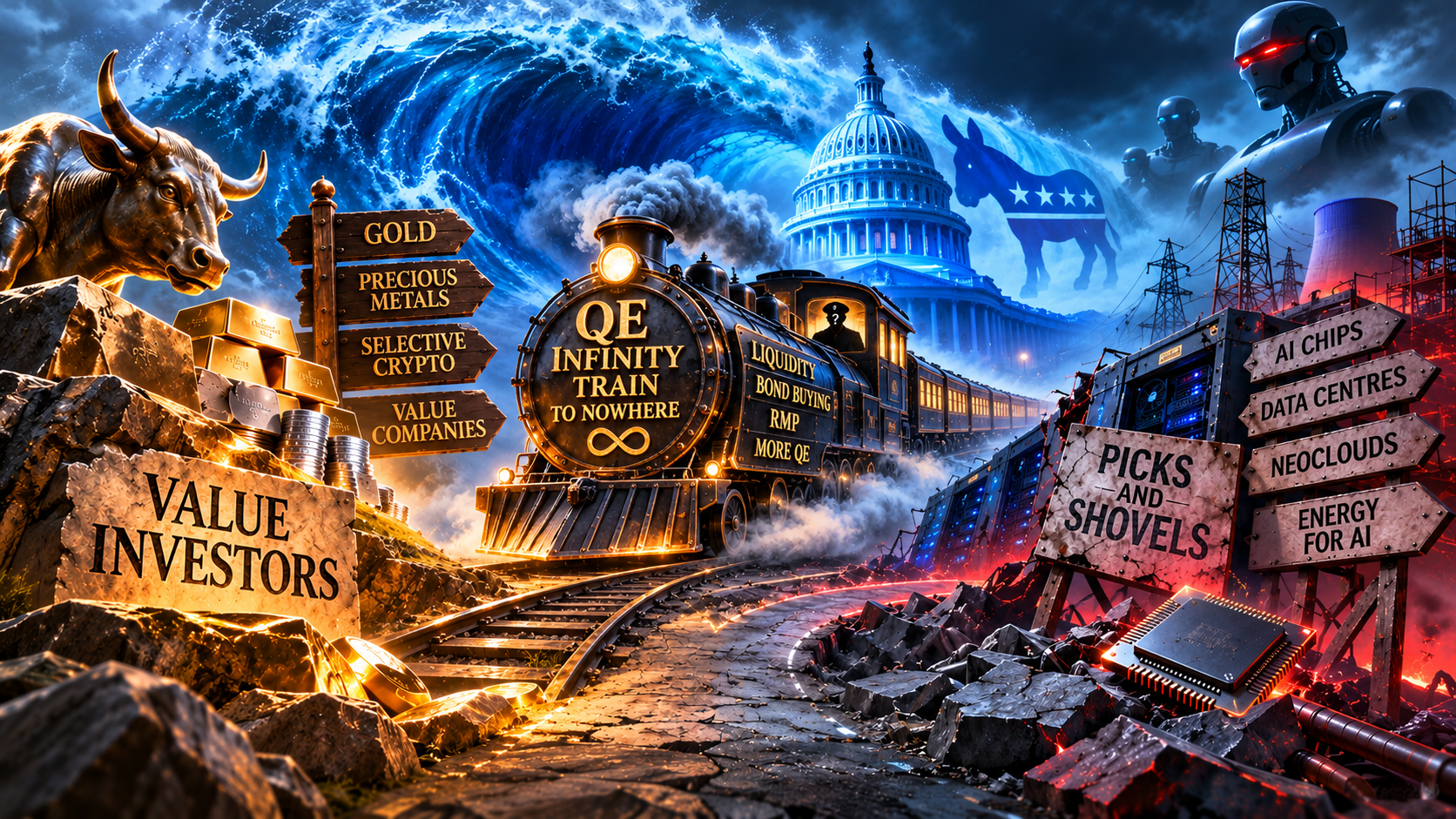
“The train, not the Tweet”. Copyright 2026. nextlevelcorporate. nextlevelcorporate prompts, AI generated image.
TL; DR
Last week a newly elected governor campaigned hard against data centres, Democrats took Congress, or they will on 3 January 2027, and AI stocks were barbequed. The talking heads had their story by lunchtime, the Blue Tsunami wiped out the AI trade.
Well, I want you to ask yourself a simpler question. Did one campaign promise really wipe trillions off the market? Or did the market already have a reason to sell?
The story we were told
The version on every screen went like this. Democrats win both houses. A new governor campaigns against data centres. Investors panic that the AI build-out is in trouble, and chip stocks fall 12% in a day.
It's a tidy story. It has a cause, a villain and a headline. But tidy stories are usually the ones worth questioning.
Look at AMD. Days earlier it had given some of the strongest guidance in the industry, with revenue expected to grow more than 80% next year. On Thursday it fell 17%. On Friday it bounced 11%, with no new news on data centres at all.
A business doesn't lose a sixth of its value over a campaign promise and win half of it back the next day. That's not people rethinking the future. That's people heading for the exit, and some of them wandering back in.
The QE Infinity train to nowhere
To see what's really going on, picture liquidity, the spare money in the system, as a train. Not a train that runs from A to B. An infinity train. It never stops. It runs around the world in an endless loop, and almost everything in markets, from shares to bonds to houses, is priced by how much cargo it's carrying and how fast it's moving.
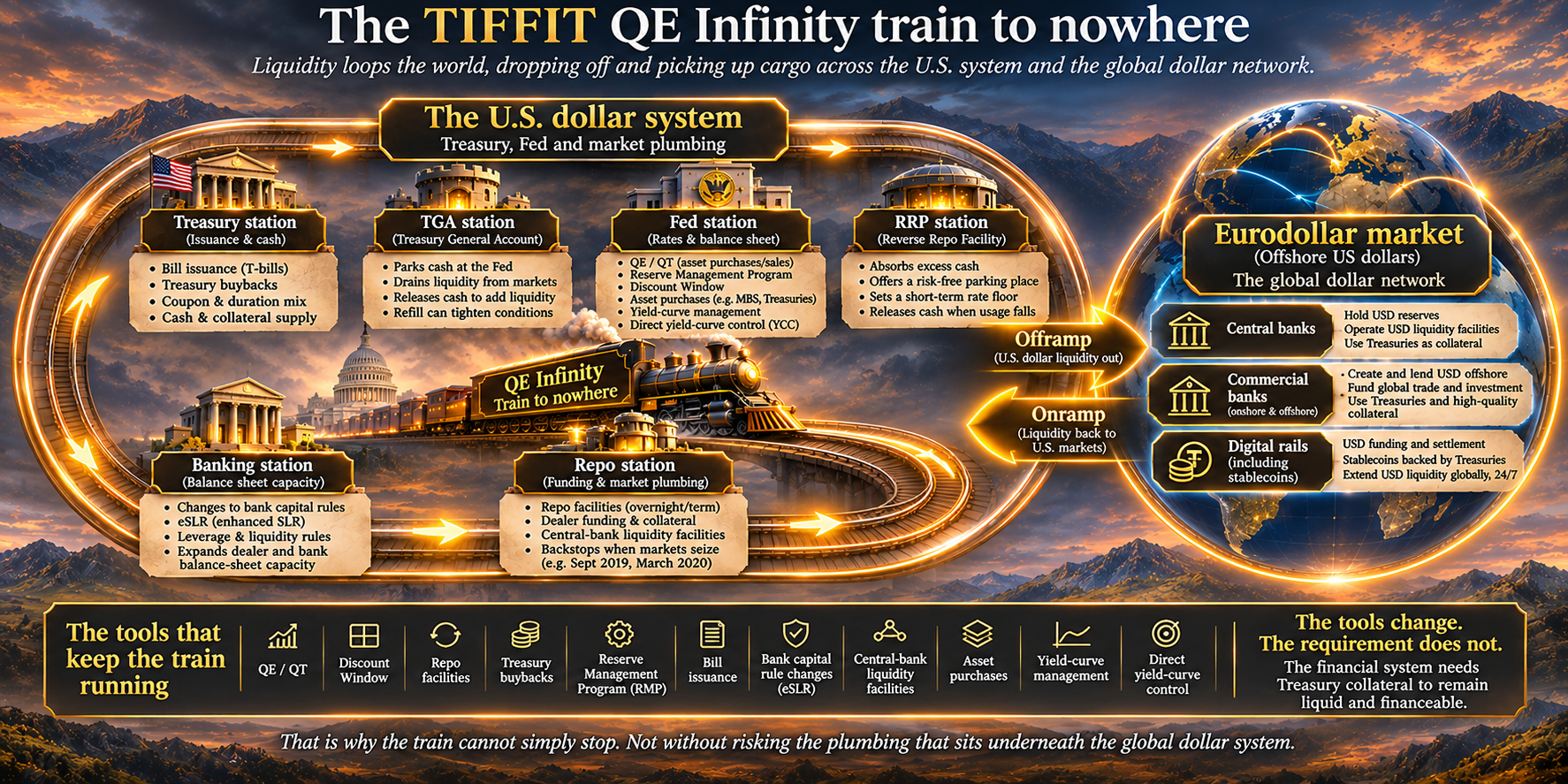
“NextLevelCorporate’s QE Infinity Train to nowhere.” Copyright 2026. nextlevelcorporate. nextlevelcorporate prompts, AI generated image.
Every now and then the train slows down at a station. Sometimes it drops liquidity off. Sometimes it picks it up.
The most important station right now is the U.S. government's bank account, the Treasury General Account, or TGA.
When the government fills that account, liquidity gets parked at the station and taken off the tracks. When the government spends it, the train picks that cargo back up and transmits it around the world.
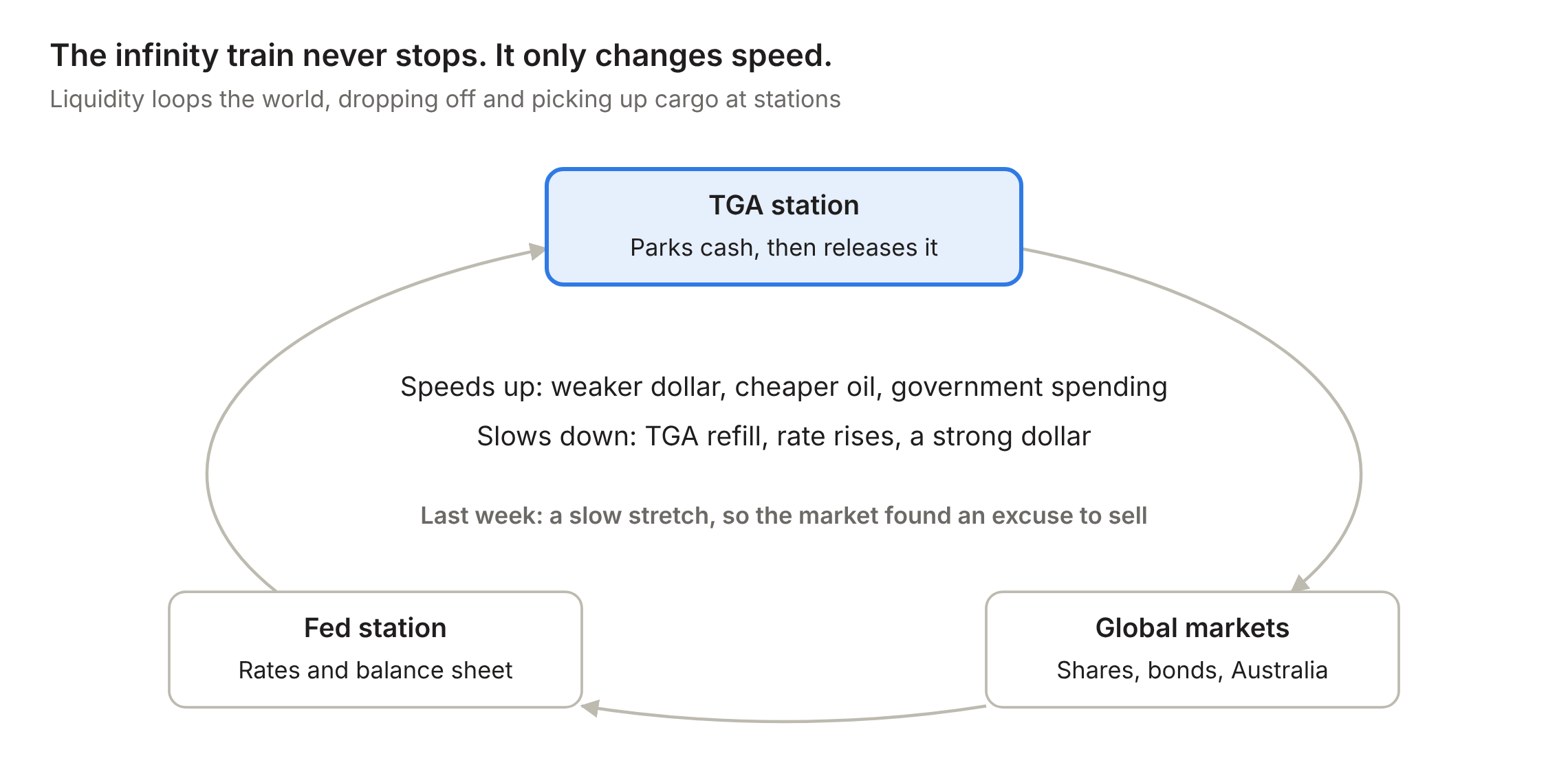
How the QE-Not QE Infinity train runs on U.S. tracks that are connected to the global infinity rail loop. This simplistic version focuses on the TGA.
Other things change the train's speed too. A weaker dollar and cheaper oil speed it up, because they free up money everywhere. Rate rises and a central bank shrinking its balance sheet slow it down.
Where the train is now
Right now, the train is in a slow stretch, and it has been since July 2025.
Since that time around $354 billion in liquidity has been sucked out of U.S. financial markets as the TGA has built up, and the Reverse Repo account has been drained. So, the TGA station is bloated with luggage and instead of the swamp being drained of politicians, it’s been drained of liquidity.
Today, the liquidity sucking TGA is holding $936 billion, and early next year the government plans to park roughly another $150 billion there. More liquidity out.
The Fed is also likely to lift rates once more in December (a 76% probability as of Friday) and may also decide whether it will shrink its balance sheet, or not. And a surprisingly strong U.S. jobs report has propped the dollar back up.
We’ve also had the SpaceX float. Apparently, we’re also getting an Anthropic IPO. And it’s the rotation from other investments into these IPOs that competes for liquidity. In fact, the SpaceX IPO probably marked the top of the AI trade, thus far. Will Anthropic bring the market down? It’s possible, but we’re not here to debate that.
Nonetheless, all of the above is liquidity negative.
At the same time, the Blue Tsunami probably means there will be less tax cuts for the wealthy, and less government spending next year, meaning a higher likelihood that No Dot Warsh may cut rates and/or not shrink the balance sheet as quickly as anticipated before last Thursday. In other words, less fiscal stimulus now, but potentially a return to monetary stimulus later.
Together, this potentially points to the liquidity train slowing down further, in the short term.
And when the train slows or when the market anticipates that it is likely to slow, markets get nervous. Nervous markets look for a reason to sell. And since valuations were already high, lots of investors were sitting on big gains in the same handful of stocks, and plenty had borrowed to hold them, all they needed was an excuse.
The data centre headlines were that excuse. If it hadn't been AI, it would have been something else, i.e., a rate scare, a bad earnings report, a tweet, an IPO, a circular financing doomscroll, etc. The trigger changes every time, but the cause underneath doesn't. The train is heavy, and when that happens, imperfections in the rails on which it travels matter a lot.
So, what was last week, really?
I don’t believe it was the end of the AI trade. Demand for chips is still enormous. 2027 might see more data centre developers and users paying a fairer share of rent, water, and energy use, but that form of “regulation” is likely to be healthy for adoption, and job markets. Governors that choose the path of outright bans will be smashed with lower taxes and higher unemployment. Think about it.
So, last week was a great excuse for profit-taking, portfolio trimming or “re-sizing,” and deleveraging while the train is in a slow patch. Some fund managers rotated into short bonds, ready to re-redeploy in January. Some people locked in gains, some paid down debt, and the headlines gave everyone a reason that sounded better than "we were waiting for the liquidity train, and we got tired of waiting."
Meanwhile, the things that speed the train up might be lining up for later, perhaps the middle of next year once the TGA has been drained. Why do I say that? Well, Oil fell 13% last week, its biggest drop since 2022. On the other hand, none of what happens in the U.S. means that Iran will play ball with Hormuz and supply.
Still, after April tax time, the U.S. government will start to spend its account down again, and the Infinity train to nowhere will pick that cargo back up. If Iran capitulates and oil and inflation keep cooling, the Fed can reconsider rate hikes. That's when liquidity starts getting delivered back onto the platforms for embarkation and transmission.
But wait, we’re not done yet. China’s financial rails are also connected to the global Infinity train tracks via the Eurodollar market. It remains a very large part of the liquidity journey. And that means we also need to consider whether the Party feels like it’s time to stimulate. That would also speed up the train.
So far, the Chinese economy has been collapsing under the weight of expensive oil and energy, and the question is how much more pain will be enough to move the party to stimulate. China wants to see a lower dollar before it stimulates, and Iran is also a key factor in terms of China’s ability to source sustainably cheap, high calorific value energy. In the interim it relies on its massive coal capacity for energy. It’s all connected.
Watch the train, not the headline
The next time markets fall, there'll be a new story ready to explain the Infinity train that seems to be invisible to retail traders and investors, in particular. It might be Private Credit. Michael Burry’s next short. Circular financing in the AI space. A keyman plagued with infidelity. Espionage. A massive cyber outage. A large language model gone rogue. An existential Chinese competitor. All of the above. Or something else.
Before you believe it to be the cause and not the catalyst, ask a different question. Is the liquidity train speeding up or slowing down, and is it dropping liquidity off or picking it up? Also, is the dollar rising or falling?
So far, the train’s been picking up liquidity, and the dollar has been strong. That’s negative for liquidity and markets.
Remember, the headlines tell you what people are saying. And very few people talk about the QE Infinity train to nowhere because it’s more convenient for central bankers and governments to talk about CPI than it is to address increases in the money supply. It’s why they never talk about it.
Nonetheless, the Infinity train tells you what money is doing. And over time, and barring cyclical and geopolitical rotations, money flows win.
See you on the trainspotting bridge 🖐
Mike.

Macro first. Strategy second. Deal third.
An independent corporate development studio, established in Perth in 2001, advising you when — and when not — to do the deal. In 25 years, that discipline has been the difference.
This content is copyright NextLevelCorporate. It is not advice and it is provided for informational purposes only. NextLevelCorporate and logo are registered trademarks. All rights reserved.