
The QE Infinity Train doesn't stop at the U.S. border. Australia has its own rails, on-ramps and off-ramps and its own monetary policy carriages. And as it turns out, the RBA just shared how it will keep liquidity flowing in a crisis.

“Global Infinity Train rail Network” Copyright 2026. nextlevelcorporate. nextlevelcorporate prompts, AI generated image.
Introduction
Today, there’s a reason we're returning to my favourite topic, the QE Infinity Train to nowhere.
Why do I say this? Because in June 2026, the Reserve Bank of Australia (RBA) published its new Framework for Additional Monetary Policy Tools at Low Interest Rates.
In plain English, the RBA is preparing for the possibility that cutting interest rates alone might not be enough next time around.
Yup, it says it wants to retain the capacity to deploy tools like asset purchases and targeted bank funding facilities if circumstances demand them.
Clearly, the RBA has assigned a reasonable probability to the economy slowing sharply and feels the machinery for providing additional monetary support may become relevant again, when we get the next crisis.
And we’ve seen the beginnings, with Australian unemployment jumping to 4.9%.
However, I sincerely hope that if we do go down this path, the RBA has learned some hard lessons from its bond buying/YCC fiasco of 2021/22, and that it does the work now and secures the talent to ensure it does a better job this time around.
In the meantime, we are waiting for the balance sheet to resolve so that the bank can start paying the government dividends again, after not having paid an estimated $10 billion over the past five years. You should read that again.
But the RBA isn't the only one reaching for the machinery. In Washington, Treasury and the Federal Reserve (Fed) are working on the same underlying problem with their own tools, and with more urgency.
Fact is that all governments need to borrow. Very few operate surpluses, financial markets need liquidity, banks need reserves and the global financial system needs a functioning supply of collateral.
That's as true in Canberra as it is in Washington. And that’s why in Australia we are not watching this story from the platform. We're on the train too.
But before we bring this story back home, let's first take a proper look at the liquidity train that lubricates the global dollar network and financial system.
The TIFFIT QE Infinity train to nowhere
Here's the most important thing about our train to nowhere. It doesn't stop. It can't. It simply changes locomotive drivers, carriages and the type of fuel being thrown into the boiler.
It’s a train to nowhere that circles the globe in a figure of 8 loop, sometimes accelerating, sometimes braking, but because demographics and productivity can no longer keep up with the debt, this liquidity train can never stop.
Why do I call it the TIFFIT QE Infinity Train?
Well, TIFFIT refers to the locomotive which we’ll discuss in a moment. But first, the fuel.
The Infinity train’s fuel is liquidity. But it isn't always conventional QE. In fact, the logs going into the train’s boiler take many different forms even though they are all designed to accommodate sovereign debt and liquidity.
The train solves for solvency and liquidity and in doing so, preserves the world’s collateral base. Why is that important? Because that collateral base secures and allows borrowers to roll/refinance the world’s $365 trillion debt exposure and another $850 trillion in notional outstanding derivatives. So, let’s call that $1.2 quadrillion reasons.
For those reasons and unless the world becomes productive again (does more with less) and doesn’t need so much debt to paper over the productivity gaps caused by ageing demographics, it simply can’t stop.
The Fed has its monetary and liquidity toolkit, or fuel that can be added or subtracted from the infinity train’s boiler:
Quantitative easing (QE) and quantitative tightening (QT).
Discount Window lending.
Overnight and standing repo facilities.
Reserve Management Purchases (RMP).
Outright asset purchases.
Yield-curve management and, historically, direct yield curve control.
Emergency central-bank liquidity facilities.
Changes to reserve supply and administered interest rates.
Treasury has a different collection of instruments:
Government bond issuance and refinancing.
Adjustments to the maturity profile of government debt
Changes in the mix of bills, notes and longer-dated bonds (more short-term = more liquidity).
Treasury buybacks.
Management of the Treasury General Account (TGA).
Cash balance management.
Then there is the regulatory and banking machinery:
Changes to bank capital requirements.
The enhanced Supplementary Leverage Ratio (eSLR).
Changes to liquidity requirements and balance-sheet constraints.
Dealer balance-sheet capacity and the ability to intermediate government securities and repo transactions.
These aren't interchangeable instruments and they don't all inject or withdraw systemic liquidity in the same way. Some create reserves, some redistribute them, some improve collateral availability and others influence the capacity of financial institutions to absorb and finance government debt.
But collectively, they influence how the financial system accommodates an ever-growing supply of sovereign debt and maintains the liquidity needed to keep debt collateralised, and markets functioning.
This is the essence of what I call Not-QE QE. The Fed doesn't necessarily have to announce conventional QE to expand reserves or support liquidity. And Treasury doesn't need QE at all to influence the supply of collateral and the functioning of the bond market. It can do that through what it issues, the mix of bills and bonds and adjusting or “twisting” through duration, buybacks and how it manages its cash balance at the Fed.
The instruments change, but the underlying requirement does not. For convenience, and since many of these tools have the same effect, I see them as a collective of carriages and call that the QE Infinity train to nowhere.
And when Treasury is driving it, it’s called the TIFFIT Infinity train to nowhere because Treasury becomes Fed and Fed becomes Treasury. This is further discussed in the next section.
But first, here’s what the global liquidity train tracks look like when we put it all together, noting that the Australian rails are connected via the Eurodollar market.
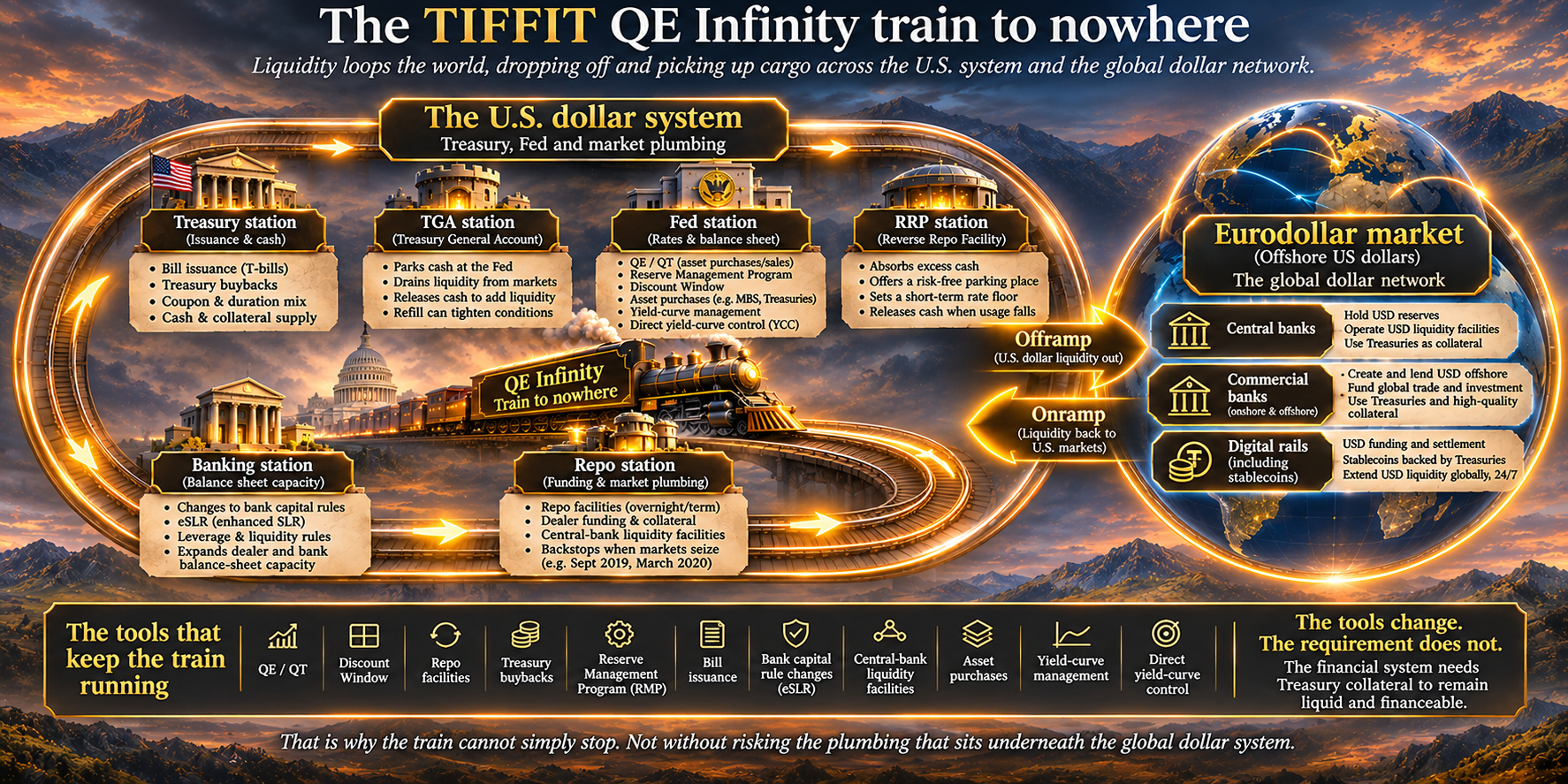
“NextLevelCorporate’s TIFFIT QE Infinity train to nowhere”, ©2026 NextLevelCorporate. All rights reserved.
And the key to the health of the global rail system? Treasuries.
Treasuries are interest-bearing IOUs backed by the world's reserve currency. The highest form of collateral that can be posted to support debt so that the financial system remains liquid and financeable.
That's why the Fed intervened in September 2019 when repo markets seized up. It's why the Fed intervened on an enormous scale in March 2020. And it's also why Treasury is paying increasing attention to market liquidity, dealer balance sheets, repo capacity and the marginal demand for longer-dated government securities.
The logs and different types of fuel keep going into the boiler because the train cannot simply stop. Not without risking the plumbing underneath the global dollar system.
Treasury and the Fed share a carriage
Traditionally, we think of Treasury and the central bank as separate institutions.
Treasury finances government expenditure and manages government debt. The central bank manages monetary policy, interest rates and financial-system liquidity.
But consider what happens when the Fed purchases government bonds, creates reserves, provides liquidity to commercial banks and absorbs interest-rate risk.
The Government still has its debt outstanding, but the composition of who holds it changes. The private sector holds fewer longer-dated government securities and more cash-like deposits and reserves within the banking system.
When interest rates rise, the financial consequences can flow back through the central bank's balance sheet and ultimately affect the Government's financial position through reduced distributions or, in some circumstances, recapitalisation requirements.
The two institutions haven't formally merged. But their balance sheets are financially interconnected. Institutional independence does not eliminate balance-sheet interdependence.
Economists describe this through the consolidated public-sector balance sheet.
It’s also the foundation of my TIFFIT thesis, which is an acronym for my Treasury Is Fed, Fed Is Treasury framework. If you haven’t followed my earlier TIFFIT episodes, I first introduced the idea in TIFFIT Episode 1: Treasury Is Fed, Fed Is Treasury. I then explored the consequences further in TIFFIT Episode 5.
No Brake Bessent and No Dot Warsh = TIFFIT
This relationship is becoming particularly interesting. U.S. Treasury Chief, Scott Bessent has become an increasingly influential figure in managing government financing and financial-market liquidity.
Through Treasury debt issuance, buybacks, cash management and the composition of government borrowing, he can influence the supply of securities, collateral availability and market liquidity.
These aren't QE operations. Treasury cannot create Fed reserves simply by issuing government debt. But Treasury decisions can materially influence the financial conditions in which the Fed operates.
Then came Kevin Warsh, who took over from Jerome Powell in May 2026. Warsh has brought a different philosophy towards the Fed's balance sheet, quantitative easing and central bank intervention.
I awarded Warsh the nickname: “No Dot” because he refuses to submit a dot into FOMC’s so-called “dot plot” and will not give guidance even though he seems to be happy if the other Governors do. Case in point being Waller’s recent comments about the potential for a 50bp hike.
Meanwhile, Bessent gets “No Brake” Bessent because Treasury cannot stop refinancing existing government debt and issuing new debt to finance ongoing debts and deficits.
No Brake is currently driving the infinity train with his hand on the throttle. No Dot sits in the train's fireman's seat, waiting for his balance sheet task force to report back, and/or for Bessent to ask him to do something.
And then came the November 2026 Blue Tsunami, with the Democrats winning control of both chambers of Congress, which will occur in January 2027.
The political landscape has acquired a few more signals, barriers and potentially the occasional derailment. But the underlying financing requirements haven't gone away.
Australia's role
So, back home. Is Australia on the QE Infinity Train?
Absolutely. The QE Infinity train to nowhere doesn’t stop at the U.S. border. Australia has its own rails, on-ramps and off-ramps, and its own monetary policy carriages.
Sure, our onramps and offramps are narrower gauge, our locomotive is around 40 times smaller, our financial markets are different, and our monetary policy toolkit has its own characteristics.
But we’re part of the global Infinity train rail system, enabled by the international dollar funding and Eurodollar markets. That’s what connects it all.
In terms of the carriages being pulled by RBA Gov. Bullock’s locomotive, we have a rather interesting collection of ways to keep liquidity flowing.
We have QE, repo facilities, ample reserves and a framework for potentially deploying targeted funding facilities again. And the Chalmers Treasury has its own debt-management and cash-management tools, while the RBA can defend the dollar through direct foreign exchange intervention courtesy of our dollars’ dirty float.
Which brings us back to the question in the title. If we want to know whether the RBA will drive its locomotive more adeptly through the next crisis without causing billions in losses, we need to look at how it drove it last time.
A little touch of Australian history
When COVID arrived in 2020, the RBA joined the global monetary intervention party by reaching for the punchbowl.
It cut interest rates, introduced yield curve control (YCC), purchased government bonds through quantitative easing (QE), and it established the Term Funding Facility (TFF) which provided commercial banks with three-year funding at exceptionally low fixed rates.
While conceptually similar to the U.S. Discount Window in the sense of being a direct, low-cost central bank funding facility for banks, the Australian TFF was very different in design, duration, and specific policy objective.
The TFF probably sits in a separate train carriage of the infinity train, but with the same targeted policy outcome. It gave banks three year money at a fixed, very low rate, so they could keep lending cheaply during COVID, especially to businesses.
Ultimately, it provided ~$188 billion in funding to Australian banks before banks stopped drawing on it in mid-2021.
This suite of interventions, or collection of different train fuels, helped support credit, employment and financial-market stability. But they also created substantial financial exposures for the RBA.
Let’s take a quick look at YCC, QE and the TFF to see how well the Australian infinity train was driven.
Let’s start with YCC, i.e., yield curve control. The RBA attempted to maintain the three-year Australian Government bond yield at 0.25%, subsequently reduced to 0.10%. It stood ready to purchase bonds of that duration to defend that target. YCC is different to QE because it targets a very specific part of the curve.
The bond market eventually challenged the commitment as inflation expectations changed. In November 2021, the RBA abandoned the target, taking a considerable credibility hit in the process.
Next was QE. QE created a different problem. The effect of which was a dividend barbeque that’s still burning today.
So, what went wrong there? Well, the RBA purchased substantial quantities of government bonds at exceptionally low yields and high prices across different durations. When interest rates subsequently rose, bond valuations fell and the cost of remunerating the reserves created by those interventions increased.
The result was a substantial accounting loss. In 2021/22, the RBA reported a $36.7 billion loss and negative equity of approximately $12.4 billion. It subsequently recorded further losses.
An accounting loss doesn’t mean a central bank runs out of money or becomes unable to operate. But the financial consequences were nevertheless significant.
First of all, the Commonwealth hasn’t received a distribution from the RBA since 2021, when approximately $2.67 billion was last paid. Let’s unpack the opportunity cost of that. Over the five financial years from 2015/16 to 2019/20, distributions totalled approximately $9.36 billion.
If the Commonwealth had continued to receive distributions at the average rate recorded between 2015/16 and 2019/20, the total over the subsequent five years would have been close to A$10 billion. That’s not a claim that those payments were guaranteed. But it gives us a sense of the fiscal consequences when central bank profits disappear.
And the TFF added another lesson. Banks locked in cheap three-year funding, which was ultimately repaid in 2024, while the RBA was exposed to the rising cost of interest on its associated liabilities. The Bank has estimated the financial cost of the facility at approximately $9 billion.
So, the emergency measures eventually produced a financial tail that extended well beyond the emergency itself, with a cost to us (the taxpayers) of around $19 billion in lost dividends and excess interest on those liabilities. And that $19 billion would have come in handy, right about now as the government scrambles to fund its spending with controversial tax changes.
But there’s no such thing as a free monetary lunch, right?!
Finally, there were changes in the train locomotive. In February 2023, the board was refreshed with Iain Ross and Elana Rubin. They replaced board members Mark Barnaba and Wendy Craik who did not seek reappointment. Treasurer Chalmers described it as an opportunity to refresh the board. Additionally, Philip Lowe’s term as Governor wasn’t renewed and Michele Bullock took over the locomotive in September 2023.
New driver, new crew, and after the RBA Review, a new two-board structure. One for monetary policy and the other for the payment system. And while the crew was changing, so was the plumbing underneath the train, which we talk about below.
For those interested in the detail, the RBA’s review of the Term Funding Facility is definitely worth a read. I’ve also explored the financial consequences of the RBA’s bond purchases in an earlier NextPerspective article.
The plumbing that changed
Separately, the RBA is moving towards an ample-reserves operating system.
And what that means is that rather than constantly adjusting the quantity of reserves available to banks, the central bank supplies sufficient reserves to meet demand and manages the price of money through administered interest rates and liquidity facilities.
One important instrument to achieve this is the repurchase agreement, or repo. A repo is a temporary, collateralised funding arrangement. Banks obtain reserves by providing eligible securities as collateral, with an agreement to reverse the transaction. These are usually overnight mechanisms.
It isn’t QE. The central bank isn’t buying the asset outright. But it can increase reserves in the banking system and support financial-market liquidity.
The difference is that a central bank can allow its QE bond portfolio to mature while still providing liquidity through short term repo facilities. Put another way, a shrinking balance sheet doesn’t necessarily mean a shrinking supply of liquidity.
In Australia, the banks help determine how full the lake needs to be
There is another important change here. Under the RBA’s ample-reserves framework, the banking system’s demand for liquidity increasingly determines how many reserves the RBA needs to supply.
Think of it as a lake. The commercial banks collectively signal how much water they need to manage payments, meet liquidity requirements and maintain a prudent buffer that keeps all boats comfortably afloat. The RBA provides access to additional water through its full-allotment repo operations, against eligible collateral, at a price it sets close to the cash rate target.
In other words, the RBA is moving away from trying to guess precisely how much water the banking system needs in the lake. It is building a system in which the banks’ demand helps determine the level, while the RBA controls the price of drawing water from it. Like a spigot.
The idea is that it makes the system less vulnerable to unnecessary shortages of settlement liquidity and sudden spikes in short-term funding rates. It also means banks have greater confidence that they can obtain reserves when they need them.
But it doesn’t give them unlimited free money or remove the need to manage credit risk, capital, collateral and funding costs. And that’s worth keeping in mind because more reserves do not automatically mean more bank lending. Banks still need creditworthy borrowers, adequate capital and a commercial reason to lend.
There’s also a timing point. In an August 2026 speech, the RBA said the transition was still underway. Reserves remained above banks’ underlying demand, and the Bank’s regular repo operations were not yet the main source of reserves for the system. The full demand-driven effect will become clearer as the pandemic era bond holdings continue to mature and reserves decline.
The interesting consequence is that the RBA can allow those bond holdings to run down without necessarily creating a shortage of settlement liquidity. As reserves approach the level banks want to hold, banks can increasingly replace the reserves lost through bond maturities with short-term funding from the RBA’s repo operations.
So, the composition of the RBA’s balance sheet changes, but liquidity can remain available.
That’s a significant change in the plumbing. It also means that a shrinking RBA balance sheet does not necessarily mean the banking system is becoming less liquid.
The RBA explains this transition in its August 2026 speech, The road to ample: towards a demand-driven liquidity regime.
Back to the RBA's AMPT (Additional Monetary Policy Tools) framework
So, back to the Bank’s forward instruction manual.
The newly released AMPT framework sets out how the RBA would approach additional monetary policy tools if the cash rate were very low and further support was needed.
It does not announce a new QE program, nor does it commit the Bank to restarting the TFF. But at the same time, here is how the RBA ranks its tools, with the TFF and QE first and second in the pantheon of monetary policy tools it would reach for in the event of another financial system shock.
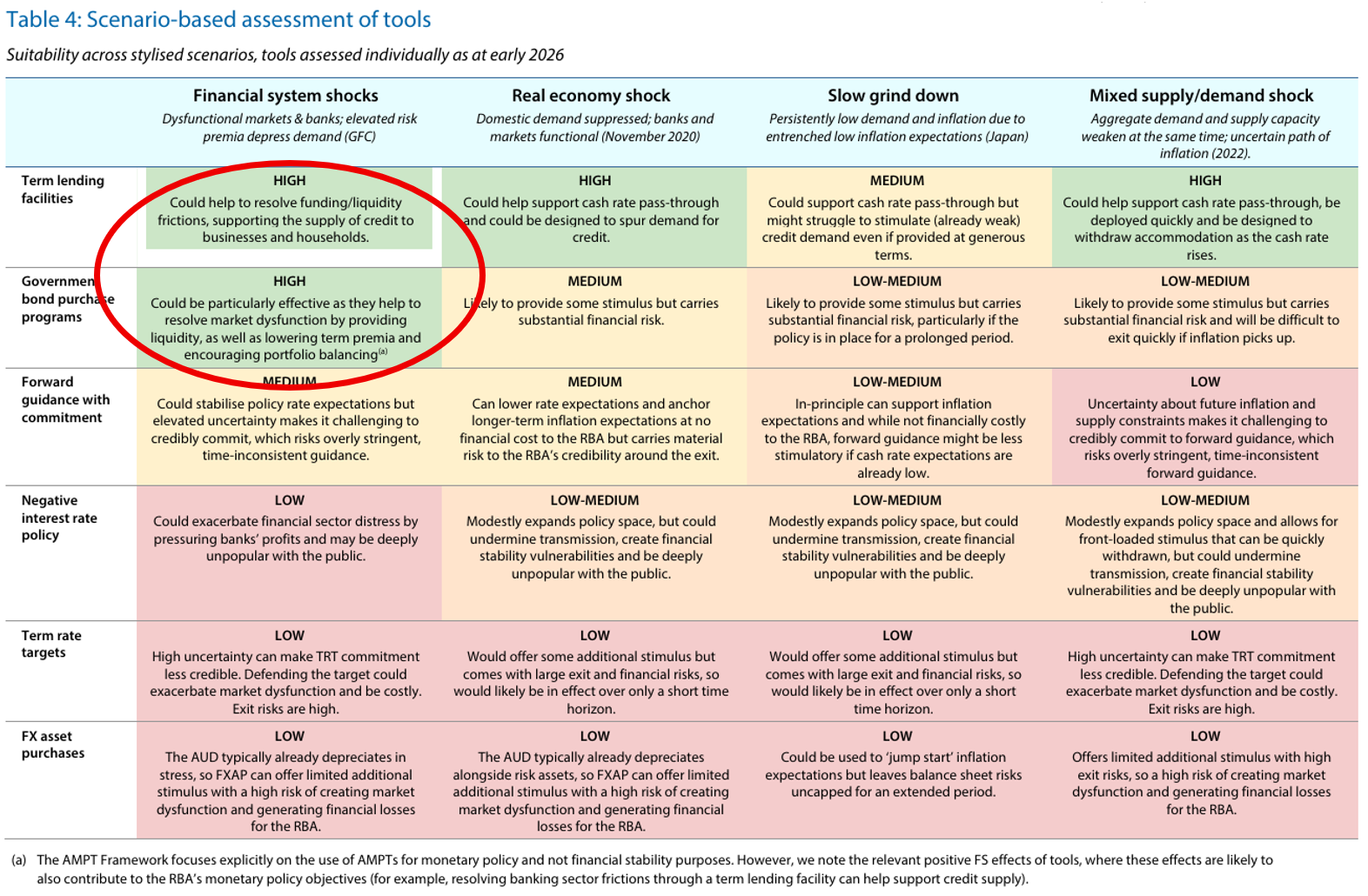
Table 4 ranks the TFF and QE as its best tools to fight financial system shocks with those two methods also credibly assisting the real economy and aggregate demand/supply shocks.
We’ve seen this movie before.
In both cases, these tools would again accelerate the QE Infinity train to nowhere. The second order effect is a further widening of the divide between those with assets and accessibility to the asset price inflation and wealth effects of the train, versus those trying to get by on a wage and low/no asset ownership.
It’s no longer a question of whether there is a better method because call it what you will, some form of monetary inflation/money supply expansion/currency debasement has to occur to allow a sovereign to inflate away its debts. There’s simply no getting off this train unless and until productivity starts growing faster than the cost to service the debt burden.
But did you notice “Term rate targets” in Table 4?
On my interpretation, this would include yield curve control, which is seen to be undesirable. I imagine the RBA has learned from the disastrous and arguably unnecessary YCC experiment by the previous board.
The framework also recognises that monetary policy cannot be considered entirely in isolation from other public-sector policies. It calls for consideration of the broader public sector balance sheet, while maintaining the RBA’s operational independence.
That’s probably the correct stance. Monetary policy should never be seen as the solution for lazy or vacuous fiscal policy thinking or unbridled spending by governments, and yet that’s where we have landed, currently.
The second point there is the idea of “blurry independence”. The RBA is wholly owned by the Commonwealth of Australia. The RBA has its own mandate and decision-making process. The Chalmers Treasury has responsibility for fiscal policy, taxation and government financing. They are not the same institution, and they do not have the same objectives. But their decisions can interact through investment, borrowing costs, household balance sheets and the wider economy.
The May 2026 Budget is a good example of why this matters, so let’s take a quick look
The monetary/fiscal tension exposed by the May 2026 budget
Australia is trying to bring inflation under control through monetary tightening at the same time as Treasurer Jim Chalmers and his Treasury are implementing significant fiscal and tax policy changes.
The changes to negative gearing and capital gains tax were sold by Government as being intended to redirect investment towards new housing supply and change the taxation of capital gains. The proposed 30% minimum tax on discretionary trusts is intended to change the tax treatment of income distributed through those structures. The Government has also announced measures aimed at encouraging business investment, innovation and productivity.
These are significant changes to the incentives that influence where capital is invested and how it is structured, and the ideological lens through which these changes have been shaped also matters.
But most of the key property and trust tax changes are prospective. The negative gearing and CGT changes are scheduled to commence from 1 July 2027, while the discretionary trust minimum tax is scheduled to commence from 1 July 2028. Their full effects will depend on how investors, businesses and households respond over time.
So, we have the RBA trying to manage inflation and tightening into weakening economic activity, while the Government is reshaping parts of the tax system to encourage a different pattern of investment.
This means the RBA has to assess how much pressure the economy can absorb without creating a much more serious slowdown. And it has to assess the economy as it actually evolves, potentially with a declining wealth effect from declining property and other asset prices, with housing around Australia already declining by ~9.3% (five capital city average) according to a recent post from Coolabah Capital.
Still, the RBA cannot simply assume that tax reform will lift productivity and/or tax aspiration into a recession, or that investment will move as intended or that changes in asset prices will translate neatly into lower inflation, and/or that the “bank of mum and dad” will remain open in the face of declining wealth effects.
There is a much broader productivity question too. Australia needs stronger productivity growth to lift living standards and support the economy’s capacity to grow without adding persistent inflationary pressure and bridging the gap with more spending/debt.
Investment in technology, infrastructure, energy and business capability may help, but the gains take time to emerge especially given the prohibitive cost of energy.
Bullock’s difficult balance
This all creates a complex and difficult balancing act.
Monetary policy can restrain demand, but it cannot directly fix weak productivity or determine energy policy or where private capital should go, nor solve for high imported fuel costs.
Fiscal and tax policy can influence investment incentives, but they cannot guarantee that investment will be productive.
The RBA’s job is to manage inflation and employment through the tools available to it and based on the makeup of our installed land, labour and capital base. The Government’s job is to set fiscal and structural policies. The important point for businesses and investors is that both sets of decisions affect the environment in which capital is raised, deployed and valued.
In the U.S., the scale is considerably larger, and the institutional arrangements are different, but the underlying relationship between government financing, central bank operations and financial market liquidity is much the same.
The modern monetary system in most centrally banked countries is no longer simply about adjusting interest rates and waiting for the economy to respond. It’s more about managing the price and availability of money, the supply of reserves, the availability of collateral, the capacity of banks to intermediate and the financing requirements of governments.
This doesn’t mean every intervention is bad. The pandemic demonstrated that extraordinary measures can be necessary. But it also demonstrated that those interventions have consequences, sometimes years after the original emergency has passed, especially if the largesse is not reversed, or repaid.
What does this mean for businesses and investors?
The question is no longer whether we need the QE Infinity train to nowhere. We do. Nor is the question whether Treasury or the central bank is driving. In the U.S., the answer firmly is that the Treasury is driving and the Fed is subservient until needed, hence my TIFFIT framework. But it differs between sovereigns and across Administrations. In Australia, the balancing act is difficult as a result of the RBA’s ultimate owner, so it is part rules-based and part optics.
Rather, the question now is where the risks sit, how their balance sheets interact and who ultimately pays when the machinery needs another round of support. The new RBA framework is instructive because in the event of another crisis, the ones most heavily taxed will be those who are in no position to access the benefits of the TFF and QE.
For businesses, the practical lesson is to pay attention to more than just the cash rate.
The availability and cost of credit are influenced by a wider set of conditions. Bank funding costs, bond yields, credit spreads, collateral availability, liquidity and the appetite of lenders to take risk.
A business planning an acquisition, raising growth capital or refinancing debt needs to understand where it sits in that funding cycle. A change in the cash rate is important, but it is only one part of the picture. Capital structure and funding flexibility are arguably more important. Businesses should stress-test their ability to service debt under different interest-rate and revenue scenarios, consider the timing of major capital commitments and avoid assuming that liquidity will always be available on yesterday’s terms.
For investors, the challenge is to distinguish between a market rising because liquidity is improving and one rising because the underlying businesses are generating stronger earnings and cash flow. Flows versus fundamentals. Both can happen at the same time, for sure. But they are not the same investment/divestment signal.
Keep an eye on government bond yields, credit spreads, bank lending standards, repo conditions, collateral markets and the U.S. dollar. These can provide useful clues about how financial conditions are changing before those changes become obvious in company results.
And remember that liquidity can move through the system in different ways. QE, repo funding, government debt issuance and changes to bank balance sheet constraints are not identical. Understanding the mechanism helps avoid treating every expansion in reserves or improvement in market liquidity as the same thing.
The train’s final destination?
Nowhere, of course. It just keeps chugging along, sometimes accelerating and other times slowing.
The driver may change. The carriages may be repainted. The fuel may be called QE, Not-QE QE, repo, buybacks, U.S. dollar swap lines, reserve management, YCC, RMP programs, Discount Window lending, Operation Twist, or something else.
But governments still need to borrow and refinance, banks still need liquidity and the global financial system still needs collateral.
In Australia, the new AMPT framework tells you the RBA will reach for a new TFF and engage in QE during the next crisis. In effect, it is justifying the old playbook in advance, despite the TFF costing around $9 billion in excess interest last time. But at least yield curve control looks to be off the table. That disastrous foray, and the bond-buying accounting losses that led the RBA to stop its distributions to the Commonwealth, have left around $10 billion in dividends unpaid. That's roughly $19 billion all up, and we, as taxpayers, are now funding it.
And as broad money, or the money supply increases, asset prices will reinflate, and those with assets will do well, and those with only a wage, assuming AI does not replace it, will not do anywhere near as well.
This will happen again because debt will continue to be created to fund spending unless governments find a way and will to tax machine productivity, and the old and new debts will need to be collateralised and serviced.
Thus, the QE Infinity train to nowhere keeps circling, picking up and putting down liquidity along the way.
But that’s not all. The scale of the financial architecture sitting underneath that train is worth remembering.
As I explored in The further we abstract the asset, the closer we get to the bailout, global debt is estimated at roughly US$365 trillion. Alongside it sits an enormous OTC derivatives market. The Bank for International Settlements puts the gross market value of those derivatives at US$21.8 trillion, with notional outstanding of US$846 trillion as at June 2025.
Call it roughly US$387 trillion in global debt and OTC derivative replacement exposure, before we properly capture the economic exposure embedded in global exchange-traded futures and options markets. The IMF's October 2026 World Economic Outlook puts annual global GDP at approximately US$128 trillion.
That means the readily measurable stock of debt and OTC derivative replacement exposure is already around three times the annual output of the entire global economy. And if we look at the notional architecture rather than economic exposure, the number becomes almost surreal. Debt plus OTC derivative notional alone gets us above US$1.2 quadrillion.
These figures need to be understood in context. Derivative notional is the reference value used to calculate contractual payments, not the amount that would be lost or owed if everything unwound. Gross market value is a more meaningful measure of replacement exposure, although it is still measured before netting.
But the sheer scale of the contractual architecture tells us something about how interconnected the global financial system has become.
It's all connected, and so is Australia
The RBA has a framework for the next emergency, and it includes QE. At the same time the Treasury is changing the fiscal and tax settings that influence the allocation of capital.
Businesses and investors have to navigate the interaction between the two, alongside the global liquidity cycle.
We don’t need to predict exactly when the next monetary intervention will arrive. But we do need to understand the machinery, where the risks are accumulating and how quickly the financial conditions around us can change.
We now know the tools that this RBA will use when it happens. We also know what happens to asset prices after a decent amount of QE is injected into the system and what the TFF can do.
Thus, becoming good at trainspotting where and when liquidity gets trapped and/or unloaded is key to knowing when to advance projects and/or M&A activity, and for investors looking to deploy capital in equity, debt and alternative markets.
And when the next big change in liquidity comes along, you want to be already positioned, not scrambling for a ticket at the station because there may not be any luggage for you to pick up.
All aboard carriage 5. 📢
Mike

Macro first. Strategy second. Deal third.
An independent corporate development studio, established in Perth in 2001, advising you when — and when not — to do the deal. In 25 years, that discipline has been the difference.
This content is copyright NextLevelCorporate. It is not advice and it is provided for informational purposes only. NextLevelCorporate and logo are registered trademarks. All rights reserved.