
Merging with the machine. are we becoming the borg?
Corporate Development Strategy | Technology | Global Macro
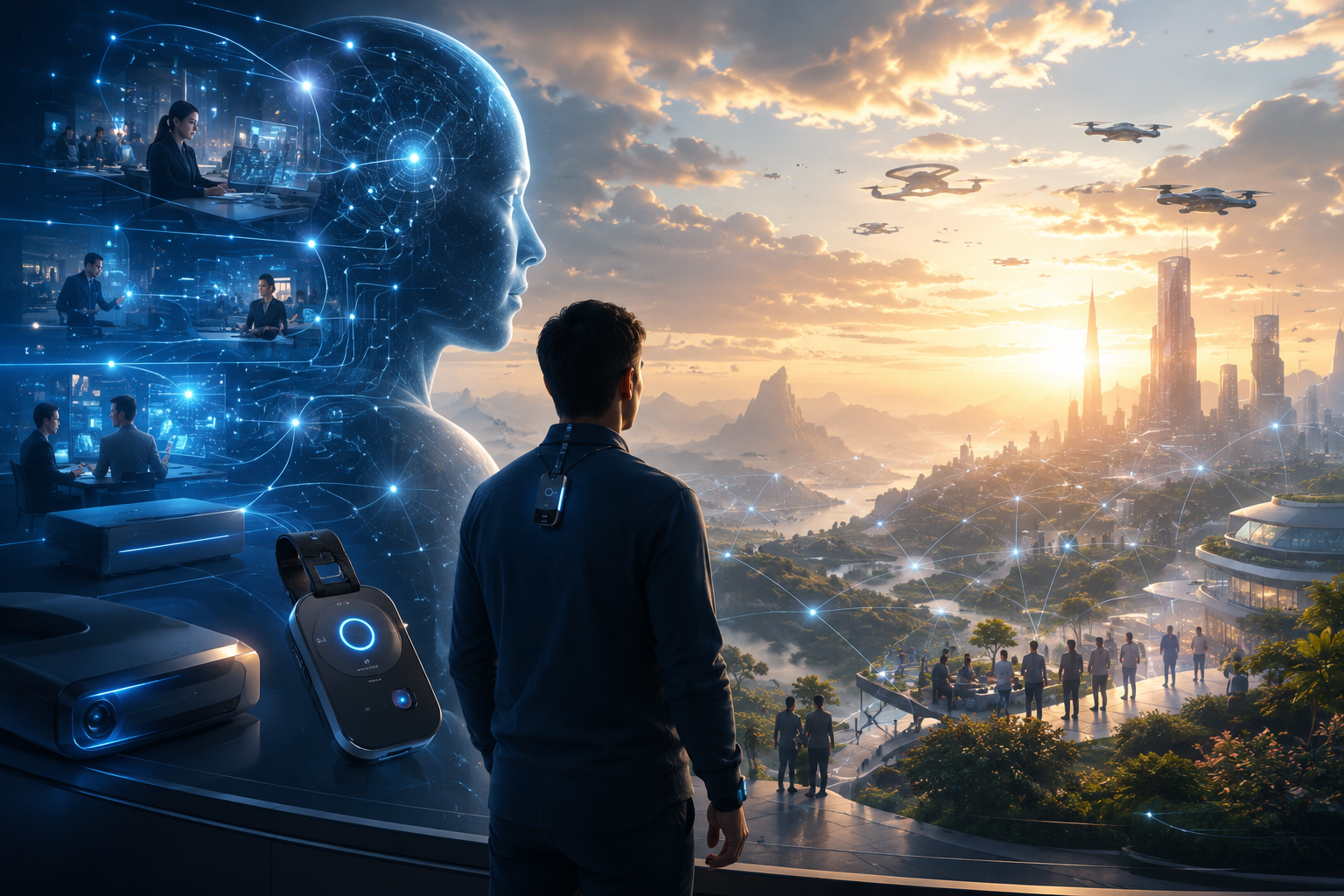
“Resistance is futile. Conscious deployment is not.” Copyright 2026. nextlevelcorporate. nextlevelcorporate prompts, AI gen image.
"Resistance is futile"
It’s stardate 43989.1.
A voice. Cold, plural, utterly without hesitation cuts through the intercom of the USS Enterprise. Jean-Luc Picard, one of the most formidable minds in Starfleet, stands rigid as the Borg speak directly into his ship, his crew, his world:
"We are the Borg. Your biological and technological distinctiveness will be added to our own. Resistance is futile."
It’s one of the most chilling moments in the Star Trek canon. Not because the Borg threaten violence. although they do, but because of what they offer: absorption into something vast, networked, and collectively unstoppable. Individual identity doesn't get destroyed. It gets dissolved. Repurposed. Made useful to the whole.
Fast forward roughly four hundred years, give or take, to a briefing room in Redmond, Washington. On the table sits a small desktop hub. Facial recognition, voice-activated, always on, connected to the cloud. On a lanyard, a badge the size of a large credit card: fingerprint sensor, camera, microphone, 5G connectivity, capable of waking an AI agent with a single touch, recording and transcribing every conversation it hears. Microsoft calls it Project Solara. They describe it as "agent-first" computing.
The Borg, one suspects, would find the aesthetics familiar.
This note was inspired by an excellent piece of reporting from GeekWire which you can find it here.
Ready to be assimilated? Well, set phasers to stun, and let's dig in.
The 50-year arc, from tool, to partner, to what?
To understand what Solara actually represents, it helps to trace the arc of the last half-century of computing.
1975, the PC, power in your hands. The personal computer put computational power on your desk. You were in control. You gave instructions and the machine executed them. The relationship was unambiguous. Tool and user, master and servant. IBM and Apple democratised access; Microsoft monetised the interface. The paradigm was apps, which is to say bounded pieces of software that did specific things when you told them to.
2007, the smartphone, always with you. The machine was no longer just in your hands. It was always with you. Computing became ambient. But the paradigm remained. Apps, icons, tap and respond. You still initiated. The device still waited.
2026, the agent-first device, chameleon code on your behalf. Now the paradigm inverts. Microsoft's bet with Solara is that the era of apps is ending. Instead of you opening software to complete a task, an AI agent that’s aware of your calendar, your emails, your work context, your face, your voice, and the room around you executes tasks on your behalf, proactively, continuously, in the background. The interface doesn't wait to be summoned. It anticipates. Microsoft calls this "just-in-time UI" where the agent generates whatever interface the task requires, on whatever device you're near, in the moment it's needed. Transportable, wearable chameleon code equipped execution.
The shift is not incremental. It’s architectural. For fifty years, the human has been the CPU. Making decisions, issuing commands, bearing cognitive load. In the agent-first model, the human becomes something closer to a strategic director or orchestrator. Setting goals, providing context, and trusting the machine to execute.
Which is exactly what the Borg implant does for a drone.
The collective IS the cloud
Here is where the Borg metaphor becomes genuinely illuminating rather than merely provocative.
The Borg drone is not simply a cyborg, i.e., a human augmented by technology. The drone is a node. Its value comes not from its individual augmentation but from its connection to the collective. A vast distributed intelligence that shares knowledge, coordinates action and continuously updates every connected unit. The drone's implants are the edge hardware. The hive mind is the cloud. The automatic updates and exchanges of knowledge among the nodes, is the blockchain.
Project Solara is explicitly designed around this same architecture. Microsoft describes it as a platform that spans "from chip to cloud." The badge and desktop hub are edge devices. Powerful, specialised, physically present. But their intelligence, their context, their decision-making capability, flows from Azure. The agents running on these devices are trained, updated, and orchestrated from the collective infrastructure above.
Consider what this means in practice. A Solara badge deployed in a Best Buy store, one of the announced pilot partners, triples as a local device and a remote sensor. It sees what the employee sees. It hears what the customer says. It executes tasks in real time. And every interaction, every transcription, every decision made on behalf of that employee, feeds back into the training data that makes the collective smarter. Not just for that employee. For everyone connected to it. AI now moves, sees, hears and executes.
This is Borg logic, executed in enterprise software. And critically, it’s genuinely useful. That is the point the Star Trek writers understood and your boardroom needs to internalise.
The Borg were terrifying not because they were evil, but because they were surgically and clinically hyper effective.
Assimilation made the drone more capable. The question has never been whether the technology works. No, the question is on whose terms does it operate, and who bears the consequences when it fails?
The liability gap at the edge of human control
Here is the governance question your legal counsel and board risk committee should be wrestling with right now, because the industry is not close to resolving it.
Current AI liability doctrine is relatively settled under current law in its broad brushstrokes. The developer of a model disclaims liability; responsibility flows to the deployer, the company that integrates and releases the AI-powered product or service into the world.
Fair or not, this is a workable framework when there is a meaningful human in the loop. A customer service chatbot suggests an answer, a human agent reviews and sends it. A credit scoring model flags a risk. a loan officer makes the call. Human oversight, however nominal, provides a breakpoint where responsibility can attach.
Now consider the Solara badge scenario. An agent, acting autonomously on pre-configured parameters, records a conversation, extracts action items, updates a CRM, sends a follow-up email, and schedules a meeting before the human wearing the badge has walked back to their desk. The human in the loop is no longer reviewing decisions. They are ratifying outcomes they may not have seen in real time, in a process they cannot fully reconstruct, created by an entity that works in a way that is not entirely evident to its developers.
At what point does "meaningful human control" become a legal fiction?
This concept, which I noted recently (in Who pays when the algorithm gets it wrong?) is already being stress-tested in autonomous weapons doctrine and is coming for commercial AI faster than most corporate legal teams anticipate. The emerging question is not just who is liable when an agent acts incorrectly, but whether liability frameworks built for human-initiated actions are adequate for systems that act continuously, autonomously, and at machine speed.
The implications cascade. Directors' duties. Data governance. Employment law, where an agent that records and transcribes every employee interaction creates extraordinary documentation. And exposure. Fiduciary obligations, where an agent managing financial and identity data and executing actions on behalf of a CFO or hedge fund operates in territory that existing regulatory frameworks never contemplated.
This is not a reason to avoid the technology. It’s a reason to get ahead of it. The companies that engage on these questions now, building governance frameworks, working with regulators, defining the ethics of agentic deployment in their specific contexts are the ones that might be able to deploy with confidence. The ones that don't will find themselves in the position of Hugh, the Borg drone once called Third of Five, that gets separated from the collective, suddenly conscious of how dependent they'd become, and how little they understood of the system they'd trusted.
Superpower or assimilation? The fork in the road
Let’s be direct about the choice on offer, because it’s a genuine strategic fork and not merely a philosophical one.
Path one is conscious deployment. Your organisation decides where agentic AI adds genuine value. Specific workflows, defined tasks, bounded contexts. You build governance frameworks before deployment, not after incidents. You are explicit with employees about what is being recorded, processed, and acted on. You maintain meaningful human control at decision points that carry legal, ethical, or reputational weight. You treat the training data your deployment generates as a proprietary asset and manage it accordingly. In this path, the technology is a superpower. It amplifies human capability, compresses execution time, and generates compounding intelligence advantages.
Path two is default assimilation. Your organisation adopts because competitors are adopting. Deployment decisions are made by IT and procurement without board-level governance frameworks. The edge devices accumulate; the agents proliferate, the data flows to the collective cloud without a clear data strategy. Liability sits with your organisation under the deployer model, but the frameworks to manage it haven't been built. You are, in the Borg sense, assimilated: connected to the collective, but not in control of the terms. You are a node.
The difference between these paths is not technological capability. Both use the same hardware, the same models, the same infrastructure. The difference is intentionality. The degree to which your organisation has made conscious, governed choices about how, where, and under what constraints these systems operate.
Resistance is not futile. But unconscious adoption is. You become a node.
Corpdev, investment and strategy implications
For my NLC readership, corporate development strategists, investors, senior executives mapping global forces to instruct on M&A and portfolio decisions, the Solara announcement is not an isolated product launch. It’s signal. And that signal is announcing a macro shift with significant investment implications across multiple vectors.
Cloud and connectivity Infrastructure. Agent-first devices are, by design, permanently connected, continuously transmitting, and dependent on low-latency cloud compute. Every Solara badge deployed in every Best Buy or CVS is a persistent cloud consumer. Scale this across enterprise deployments globally and the demand pull on hyperscaler infrastructure via Azure, AWS, Google Cloud, etc., is substantial and structural, not cyclical. The question for 5G is real, which is to say that a wearable badge with a camera, microphone, and continuous agent workloads operating at enterprise scale may well stress current network infrastructure in dense environments. The case for continued 5G capex, and for the LEO satellite mesh that Starlink and its competitors are building, gets stronger every time an agent-first device ships. These are not separate theses. They are the same thesis viewed from different altitudes, with the same players pulling back the curtain incrementally so we can’t quite see the full narrative arc. Why? It’s being performed, incrementally, by multiple actors, in real-time.
AI capex (or is it the machine merging) supercycle. The buildout required to support ubiquitous agentic AI is not yet fully priced into infrastructure investment narratives. Training the models is expensive and well understood. What is less discussed is the inference infrastructure required to run millions of always-on agents simultaneously, the edge hardware manufacturing supply chain for specialised AI devices, and the ongoing model improvement cycle fed by deployment data. The commodity implications which I write about often, such as advanced semiconductors, rare earth materials, energy minerals, power infrastructure, transformers, cooling systems. They all represent a capex cycle with duration. This is before layering in the Space GDP thesis. If Starlink, Amazon Kuiper, and their successors are fundamentally AI-powered infrastructure plays, the connectivity and compute demand case strengthens further. Government interference, geopolitics and energy/chip supply shortages are the key risks.
The training data flywheel as moat. Microsoft's real prize from Solara is not hardware margin. It’s that millions of deployed enterprise edge devices will continuously generate proprietary behavioural data. Data on how humans actually work, decide, move, and communicate in real enterprise environments. That feeds model improvement at a scale no research lab can replicate synthetically. This compounds. The moat from first-mover deployment in this category is not the device, it’s the data advantage that accrues over time. For corporate development strategy, this has direct M&A implications. For example, what data assets does an acquisition target control that would be competitively valuable in a world where behavioural enterprise data is a primary source of AI model advantage?
Jevons' Law and the jobs question. The anxiety that agentic AI will eliminate employment at scale is understandable but, on current evidence, historically illiterate. Jevons' Paradox holds that efficiency gains increase total consumption, not reduce it. The loom did not destroy the textile industry. It created it, along with fashion retail, global logistics, and everything downstream. Every productivity gain unlocked by agentic AI will create demand for more complex, higher-order work that humans do better than agents, which in turn creates demand for more AI capability to support that work. The net effect on employment, as with every prior productivity technology at sufficient adoption scale, is job creation. Different jobs, in different places, requiring different skills, but more of them. The investment implication is not to bet against labour markets. It is to identify the industries and skill categories that will experience the most acute demand surge as the productivity gains compound.
The probity and governance agenda for the boardroom
Before your organisation deploys its first agent-first device or expands its existing AI agent footprint into the Solara-style paradigm, the following questions belong on the board agenda. Not the IT agenda.
Identity and authentication. When an agent acts on behalf of an employee, whose identity does it carry? Facial recognition and biometric authentication create new definitions of verified identity in enterprise systems. The legal and regulatory implications of biometric data storage are non-trivial and jurisdiction-specific.
Data Sovereignty. Every Solara-type device is a data collection instrument. Where does that data reside? Under whose jurisdiction? What are the data residency requirements in your operating territories? What happens to proprietary business data that passes through a third-party cloud agent?
Liability Architecture. Under current doctrine, your organisation is the deployer and therefore the responsible party under current law. Have you mapped the specific scenarios in which an autonomous agent action could create legal exposure? Have you built the governance frameworks, i.e., human oversight checkpoints, audit trails, decision logs that would allow you to demonstrate meaningful control?
Competitive Intelligence. The badge in your boardroom is also a camera in your boardroom. Your security and intelligence posture for agent-first devices needs to account for the fact that these are, from an adversarial perspective, extraordinarily high-value collection platforms. The Borg, when they lost a drone, sent another one to retrieve the valuable cybernetic components. Nation-state actors and sophisticated corporate adversaries will have equivalent instincts about what a compromised enterprise edge AI device represents.
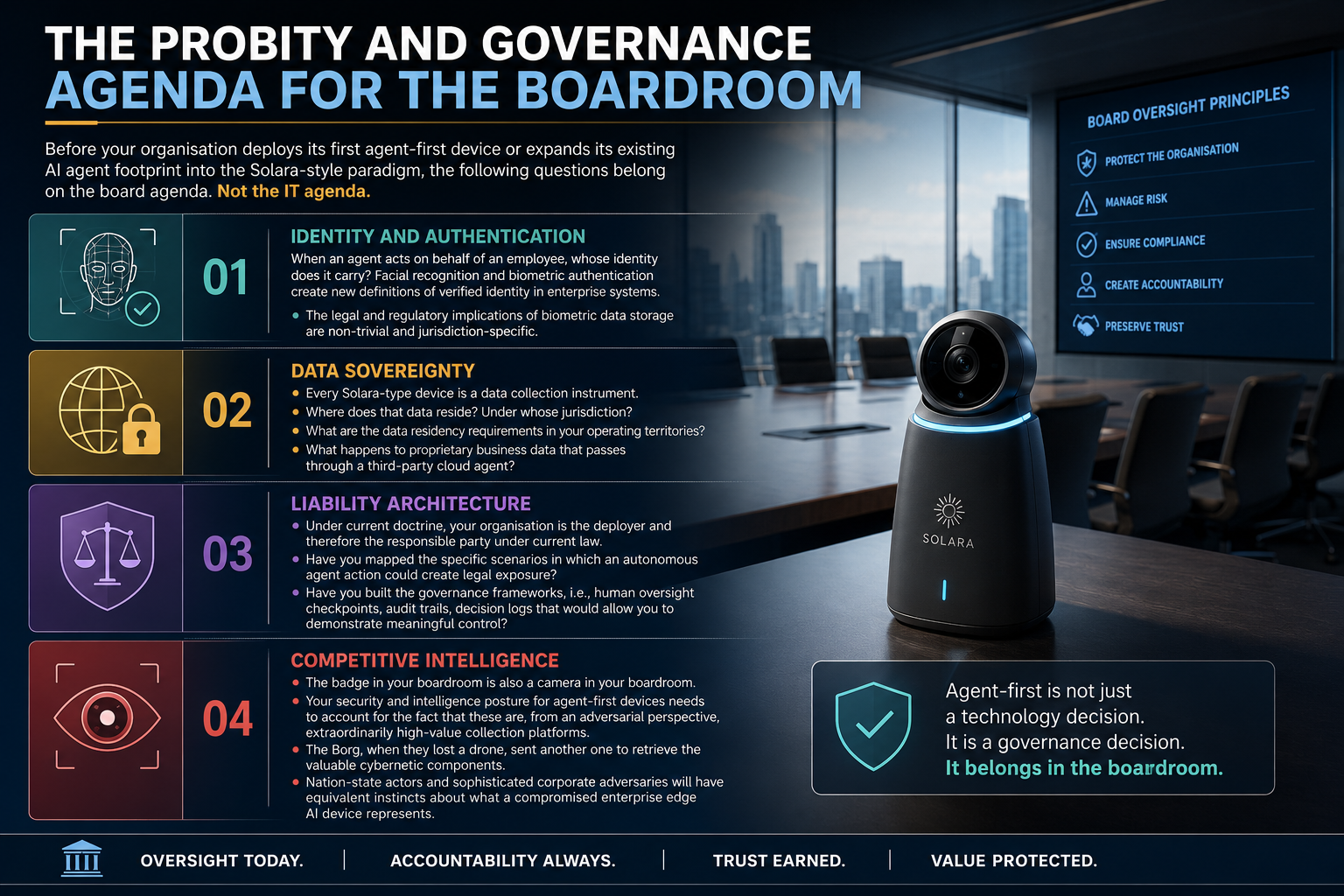
“The Solara boardroom agenda” © 2026. NextLevelCorporate, Prompts by NLC, image by AI.
Conclusion. Choose your assimilation terms
Jean-Luc Picard, it is worth remembering, was assimilated. He became Locutus of Borg. The collective's voice to humanity, their most effective bridge to the civilisation they sought to absorb. And he survived it. He was recovered, restored, and ultimately used what he had experienced inside the collective to defeat it.
The lesson is not that the technology is the enemy. The lesson is that the terms of engagement matter enormously. Picard assimilated on the Borg's terms, without consent or preparation, and it nearly destroyed him. The enterprises that engage with agentic AI on their own terms, with governance, intentionality, and clear-eyed assessment of the liability and sovereignty questions, may find that the collective's power can be wielded rather than simply submitted to.
The platform shift Microsoft is making with Project Solara is real. The demand it will generate for cloud, connectivity, semiconductors, and AI infrastructure is real. The compounding data advantage it will create for first movers is real. But the liability and governance gap it exposes is equally real.
The question for your organisation is not whether to engage with agent-first computing. That decision is being made for you by the market. The question is whether you will be a conscious participant in designing the terms of that engagement, or whether, by default, you will be a node and the collective will have made the decisions for you.
Resistance, as the Borg correctly observe, is futile.
Conscious deployment, however, is not.
Mike out. See you in the market 🖐

An independent corporate development studio, established in Perth in 2001, that advises you when — and when not — to do the deal. In 25 years, that discipline has been the difference.
Macro first, strategy second, deal third.
All content is copyright NextLevelCorporate. NextLevelCorporate and logo are registered trademarks